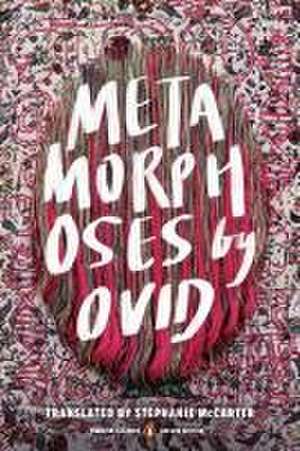
Metamorphoses
Autor Ovid Traducere de Stephanie McCarteren Limba Engleză Paperback – 14 noi 2023
În Roma de la începutul mileniului, Ovid a creat o lume în care singura constantă este schimbarea, un spațiu mitic unde granițele dintre uman, divin și vegetal sunt fluide. Alegerea acestui cadru temporal și spiritual nu este întâmplătoare; într-o epocă a consolidării puterii imperiale, poemul devine o cronică a modului în care autoritatea modelează și, adesea, fragmentează identitatea. Observăm în această nouă ediție a The Metamorphoses, semnată de Stephanie McCarter, o schimbare de paradigmă necesară: traducerea nu mai ascunde brutalitatea sub metafore galante, ci redă cu precizie impactul puterii asupra celor vulnerabili. Suntem de părere că forța narativă a lui Alessandro Barchiesi combinată cu sensibilitatea interpretativă a unor autori precum Lee Fratantuono se regăsește aici, dar cu un glas propriu, marcat de o onestitate tăioasă. Spre deosebire de The Love Poems, unde ironia viza jocurile seducției, sau de The Fall of Icarus, unde accentul cădea pe hybrisul uman, acest volum se concentrează pe transformare ca act de supraviețuire sau ca obiectificare finală. Structura operei, reflectată în cuprins, ne poartă de la „Crearea Lumii” și „Potop” până la legendele tragice ale lui „Actaeon” sau „Philomela”, demonstrând o progresie de la haosul primordial la o ordine socială marcată de conflicte de gen și clasă. Este o epopee fără erou, unde protagonistul real este corpul uman aflat în pragul metamorfozei. Ritmul este alert, susținut de hexametrul dactilic adaptat unei engleze moderne care nu sacrifică rigoarea academică pentru accesibilitate, oferind o experiență de lectură ce recuperează nuanțele pierdute ale textului original latin.
Preț: 139.26 lei
Carte disponibilă
Livrare economică 06-20 noiembrie
Specificații
ISBN-10: 014313423X
Pagini: 608
Dimensiuni: 141 x 211 x 41 mm
Greutate: 0.66 kg
Editura: Penguin Publishing Group
V-ar putea interesa
-
 Voltaire in LoveNancy Mitford-37%Preț: 58.20 lei92.60 lei
 -
 Selected Poems of Pablo NerudaPablo Neruda-18%Preț: 77.98 lei94.67 lei
 -
 The Bacchae and Other PlaysPhilip VellacottPreț: 78.21 lei
 -
 The OresteiaAeschylusPreț: 99.68 lei
 -
 The IliadHomerPreț: 81.29 lei
 -
 The OdysseyHomer-17%Preț: 61.09 lei73.45 lei
 -
 The Old Man of the MoonShen Fu-31%Preț: 16.25 lei23.61 lei
 -
 -39%Preț: 17.44 lei28.47 lei
 -
 Lips too ChilledMatsuo Basho-21%Preț: 16.18 lei20.47 lei
 -
 It Was Snowing ButterfliesCharles Darwin-21%Preț: 16.18 lei20.47 lei
 -
 Twenty Love Poems and a Song of DespairPablo NerudaPreț: 78.71 lei
 -
 Northern Renaissance ArtSusie Nash-23%Preț: 146.60 lei191.26 lei
 -
 Byzantine ArtRobin Cormack-24%Preț: 146.48 lei192.00 lei
 -
 AeneidVirgilPreț: 61.98 lei
 -
 Love That Moves the Sun and Other StarsDante Alighieri-39%Preț: 17.48 lei28.48 lei
 -
 The Distance of the MoonItalo Calvino-39%Preț: 17.27 lei28.37 lei
 -
 PerfumePatrick Süskind-25%Preț: 59.05 lei79.20 lei
 -
 Too Much and Not the MoodDurga Chew-BosePreț: 100.41 lei
 -
 The MothersBrit BennettPreț: 94.34 lei
 -
 Selected Short StoriesLeo TolstoyPreț: 59.98 lei
 -
 Selected Poems of T. S. EliotT. S. EliotPreț: 92.17 lei
 -
 Selected Letters of C.G. Jung, 1909-1961C. G. JungPreț: 317.53 lei
 -
 The Man of Light in Iranian SufismHenry CorbinPreț: 110.36 lei
 -
 -35%Preț: 107.17 lei164.91 lei
 -
 The Best Short Stories of Fyodor DostoyevskyFyodor DostoyevskyPreț: 69.22 lei
 -
 Leaves of GrassWalt Whitman-34%Preț: 51.73 lei78.70 lei
 -
 Collected PoemsW. B. YeatsPreț: 79.59 lei
 -
 BonsaiAlejandro ZambraPreț: 91.62 lei
 -
 The ProphetGibran KhalilPreț: 119.20 lei
De ce să citești această carte
Recomandăm această ediție cititorilor care doresc să redescopere clasicii dintr-o perspectivă contemporană și neîndulcită. Câștigătoare a premiului Harold Morton Landon, traducerea lui McCarter este esențială pentru a înțelege cum au fost construite ideile despre gen și violență în cultura occidentală. Veți câștiga o viziune clară asupra mitologiei, eliberată de straturile de cenzură istorică, într-un format Penguin Classic de o calitate ireproșabilă.
Despre autor
Publius Ovidius Naso, cunoscut sub numele de Ovid, a fost unul dintre cei mai prolifici și influenți poeți ai epocii de aur a literaturaturii latine. Opera sa, care include titluri celebre precum The Love Poems (Amores) și The Metamorphoses, a explorat teme variate, de la erotism și ironie socială până la cosmogonie și mitologie. Deși a fost exilat la Tomis de către împăratul Augustus, influența sa asupra artei și literaturii europene a rămas neîntreruptă timp de două milenii, fiind considerat maestrul suprem al narațiunii în versuri și al analizei psihologice a pasiunilor umane.
Descriere scurtă
The first female translator of the epic into English in over sixty years, Stephanie McCarter addresses accuracy in translation and its representation of women, gendered dynamics of power, and sexual violence in Ovid’s classic.
A Penguin Classic
Ovid’s Metamorphoses is an epic poem, but one that upturns almost every convention. There is no main hero, no central conflict, and no sustained objective. What it is about (power, defiance, art, love, abuse, grief, rape, war, beauty, and so on) is as changeable as the beings that inhabit its pages. The sustained thread is power and how it transforms us, both those of us who have it and those of us who do not. For those who are brutalized and traumatized, transformation is often the outward manifestation of their trauma. A beautiful virgin is caught in the gaze of someone more powerful who rapes or tries to rape them, and they ultimately are turned into a tree or a lake or a stone or a bird. The victim’s objectification is clear: They are first a visual object, then a sexual object, and finally simply an object. Around 50 of the epic’s tales involve rape or attempted rape of women. Past translations have obscured or mitigated Ovid’s language so that rape appears to be consensual sex. Through her translation, McCarter considers the responsibility of handling sexual and social dynamics.
Then why continue to read Ovid? McCarter proposes Ovid should be read because he gives us stories through which we can better explore ourselves and our world, and he illuminates problems that humans have been grappling with for millennia. Careful translation of rape and the body allows readers to see Ovid’s nuances clearly and to better appreciate how ideas about sexuality, beauty, and gender are constructed over time. This is especially important since so many of our own ideas about these phenomena are themselves undergoing rapid metamorphosis, and Ovid can help us see and understand this progression. The Metamorphoses holds up a kaleidoscopic lens to the modern world, one that offers us the opportunity to reflect on contemporary discussions about gender, sexuality, race, violence, art, and identity.
Descriere
The translation is accompanied by an exhilarating Introduction by W. R. Johnson that unweaves and reweaves many of the poem’s most important themes while showing how the poet achieves some of his most brilliant effects.
An analytical table of contents, a catalog of transformations, and a glossary are also included.
Recenzii
Cuprins
BOOK ONE
The Creation
The Four Ages
Jove's Intervention
The Story of Lycaon
The Flood
Deucalion and Pyrrha
Apollo and Daphne
Jove and Io
BOOK TWO
The Story of Phaethon
Jove in Arcady
The Story of the Raven
The Story of Ocyrhoe
Mercury and Battus
Mercury, Herse, and Aglauros
The House of the Goddess Envy
Europa
BOOK THREE
The Story of Cadmus
The Story of Actaeon
The Story of Semele
The Story of Tiresias
The Story of Echo and Narcissus
The Story of Pentheus and Bacchus
BOOK FOUR
The Story of Pyramus and Thisbe
The Story of Mars and Venus
The Sun-god and Leucothoe
The Story of Salmacis
The End of the Daughters of Minyas
The Story of Athamas and Ino
The End of Cadmus
The Story of Perseus
BOOK FIVE
The Fighting of Perseus
Minerva Visits the Muses
BOOK SIX
The Story of Niobe
The Story of Tereus, Procne, and Philomela
BOOK SEVEN
The Story of Jason and Medea
War Between Crete and Athens
The Story of Cephalus and Procris
BOOK EIGHT
The Story of Nisus and Scylla
The Story of Daedalus and Icarus
The Calydonian Boar
The Brand of Meleager
The Return of Theseus
The Story of Baucis and Philemon
The Story of Erysichthon
BOOK NINE
The Story of Achelous' Duel for Deianira
The Story of Hercules, Nessus, and Deianira
The Story of Hercules' Birth
The Story of Dry ope
The Story of Caunus and Byblis
The Story of Iphis and Lanthe
BOOK TEN
The Story of Orpheus and Eurydice
The Story of Cyparissus
The Story of Ganymede
The Story of Apollo and Hyacinthus
Two Incidents of Venus Anger
The Story of Pygmalion
The Story of Cinyras and Myrrha
The Story of Adonis
Venus Tells Adonis the Story of Atalanta
The Fate of Adonis
BOOK ELEVEN
The Death of Orpheus
The Story of Midas
Midas Never Learns
The Building of the Walls of Troy
The Story of Thetis
Ceyx Tells the Story of Daedalion
The Story of Peleus' Cattle
The Quest of Ceyx
The Story of Aesacus and Hesperia
BOOK TWELVE
The Invasion of Troy
Nestor Tells the Story of Caeneus
Story of the Battle with the Centaurs
Nestor Is Asked Why He Omitted Hercules
BOOK THIRTEEN
The Argument between Ajax and Ulysses
After the Fall
The Sacrifice of Polyxena
The Discovery of Polydorus
The Story of Memnon
The Pilgrimage of Aeneas
The Story of Anius' Daughters
The Pilgrimage Resumed
The Story of Galatea
The Song of Polyphemus
The Transformation of Acis
The Story of Glaucus
BOOK FOURTEEN
The Story of Glaucus Continued
The Pilgrimage of Aeneas Resumed
Achaemenides Tells His Story
The Story of Picus
The Pilgrimage of Aeneas Resumed
The Narrative of Diomedes
The Return of Venulus
The Deification of Aeneas
Legendary History of Rome
Pomona and Vertumnus
The Story of Iphis and Anaxarete
More Early Roman History
BOOK FIFTEEN
The Succession of Numa
The Teachings of Pythagoras
The Return of Numa
The Story of Hippolytus
The Story of Cipus
The Story of Aesculapius
The Deification of Caesar
The Epilogue
COMMENTARY by Joseph D. Reed
EXPANDED GLOSSARY AND INDEX