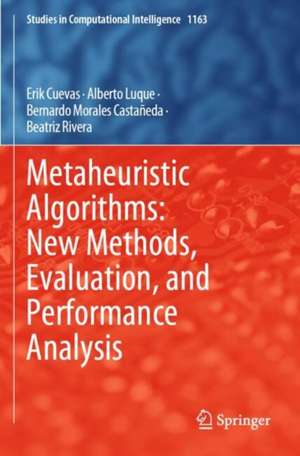
Metaheuristic Algorithms: New Methods, Evaluation, and Performance Analysis
Autor Erik Cuevas, Alberto Luque, Bernardo Morales Castañeda, Beatriz Riveraen Limba Engleză Paperback – 28 iun 2025
Preț: 1137.66 lei
Preț vechi: 1422.08 lei
-20%
Puncte Express: 1706
Carte tipărită la comandă
Livrare economică 26 noiembrie-02 decembrie
Livrare prin curier în România Termenul estimat este afișat lângă disponibilitate.
Transport gratuit pentru acest produs Plată online sau ramburs, în funcție de opțiunile comenzii.
Retur gratuit în 14 zile Comandă securizată și suport în română.
Specificații
ISBN-13: 9783031630552
ISBN-10: 3031630556
Pagini: 316
Dimensiuni: 155 x 235 x 18 mm
Greutate: 0.48 kg
Editura: Springer
ISBN-10: 3031630556
Pagini: 316
Dimensiuni: 155 x 235 x 18 mm
Greutate: 0.48 kg
Editura: Springer
V-ar putea interesa
-
 Introduction to Optimum DesignJasbir Singh Arora-32%Preț: 721.59 lei1059.00 lei
 -
 -20%Preț: 845.46 lei1056.83 lei
 -
 -20%Preț: 1153.31 lei1441.65 lei
 -
 Optimization AlgorithmsAlaa Khamis-20%Preț: 405.89 lei507.37 lei
 -
 -20%Preț: 681.68 lei852.10 lei
 -
 -20%Preț: 946.90 lei1183.62 lei
 -
 -20%Preț: 1012.93 lei1266.17 lei
 -
 Hybrid Metaheuristics in Structural EngineeringGebrail Bekda¿-20%Preț: 1327.60 lei1659.51 lei
 -
 -20%Preț: 1034.90 lei1293.62 lei
 -
 -20%Preț: 1133.57 lei1416.96 lei
 -
 Metaheuristics and Nature Inspired ComputingBernabé Dorronsoro-20%Preț: 477.50 lei596.87 lei
 -
 Handbook of HeuristicsRafael Martí-24%Preț: 5685.99 lei7481.57 lei
 -
 Nature-Inspired Computation in EngineeringXin She Yang-20%Preț: 510.13 lei637.67 lei
 -
 Constraint Handling in Metaheuristics and ApplicationsAnand J. Kulkarni-20%Preț: 1051.07 lei1313.84 lei
 -
 -20%Preț: 1210.01 lei1512.52 lei
 -
 Optimization Methods and AlgorithmsAnand J. Kulkarni-15%Preț: 559.55 lei658.30 lei
 -
 Intelligent OptimizationChanghe Li-20%Preț: 404.62 lei505.77 lei
 -
 Machine Learning and Metaheuristics: Methods and AnalysisUma N. Dulhare-20%Preț: 1209.30 lei1511.62 lei
 -
 -18%Preț: 1271.28 lei1550.35 lei
Cuprins
.- 1. Introduction to Metaheuristic methods.
.- 2. A novel method for initializing populations using the Metropolis-Hastings (MH) technique.
.- 3. A measure of diversity for metaheuristic algorithms employing population-based approaches.
.- 4. Population Control in Metaheuristic Algorithms: Can Fewer Be Better?.
.- 5. Exploration Paths Derived from Trajectories Extracted from Second-Order System Responses.
.- 6. Utilizing the Moth Swarm Algorithm to Improve Image Contrast.
.- 7. Enhancing Anisotropic Diffusion Filtering via Multi-Objective Optimization.
.- 8. Fractional Fuzzy Controller Calibration Using metaheuristic Techniques.
.- 9. Striving for Optimal Equilibrium in Metaheuristic Algorithms: Is It Attainable?.
.- 2. A novel method for initializing populations using the Metropolis-Hastings (MH) technique.
.- 3. A measure of diversity for metaheuristic algorithms employing population-based approaches.
.- 4. Population Control in Metaheuristic Algorithms: Can Fewer Be Better?.
.- 5. Exploration Paths Derived from Trajectories Extracted from Second-Order System Responses.
.- 6. Utilizing the Moth Swarm Algorithm to Improve Image Contrast.
.- 7. Enhancing Anisotropic Diffusion Filtering via Multi-Objective Optimization.
.- 8. Fractional Fuzzy Controller Calibration Using metaheuristic Techniques.
.- 9. Striving for Optimal Equilibrium in Metaheuristic Algorithms: Is It Attainable?.
Textul de pe ultima copertă
This book encompasses three distinct yet interconnected objectives. Firstly, it aims to present and elucidate novel metaheuristic algorithms that feature innovative search mechanisms, setting them apart from conventional metaheuristic methods. Secondly, this book endeavors to systematically assess the performance of well-established algorithms across a spectrum of intricate and real-world problems. Finally, this book serves as a vital resource for the analysis and evaluation of metaheuristic algorithms. It provides a foundational framework for assessing their performance, particularly in terms of the balance between exploration and exploitation, as well as their capacity to obtain optimal solutions. Collectively, these objectives contribute to advancing our understanding of metaheuristic methods and their applicability in addressing diverse and demanding optimization tasks. The materials were compiled from a teaching perspective. For this reason, the book is primarily intended for undergraduate and postgraduate students of Science, Electrical Engineering, or Computational Mathematics. Additionally, engineering practitioners who are not familiar with metaheuristic computation concepts will appreciate that the techniques discussed are beyond simple theoretical tools because they have been adapted to solve significant problems that commonly arise in engineering areas.
Caracteristici
Presents and elucidates novel metaheuristic algorithms that feature innovative search mechanisms Provides a foundational framework for assessing the performance of metaheuristic Offers practical insights into the performance of optimization algorithms on real-world problems
Notă biografică
Dr. Erik Cuevas received his B.S. degree with distinction in Electronics and Communications Engineering from the University of Guadalajara, Mexico, in 1995, the M.Sc. degree in Industrial Electronics from ITESO, Mexico, in 2000, and the Ph.D. degree from Freie Universität Berlin, Germany in 2006. Since 2006 he has been with the University of Guadalajara, where he is currently a full-time Professor in the Department of Computer Science. Since 2008, he is a member of the Mexican National Research System (SNI III). He is the author of several books and articles. His current research interest includes Meta-heuristics, computer vision, and mathematical methods. He serves as an editor in Expert System with Applications, ISA Transactions, and Applied Soft Computing, Applied Mathematical Modeling and Mathematics and Computers in Simulation.
Daniel Zaldivar graduated from the University of Guadalajara, Mexico in 1995 with a B.S. degree in Electronics and Communications Engineering. Later, in 2000, he earned his M.Sc. degree in Industrial Electronics from ITESO, Mexico, and in 2006 he received his Ph.D. degree from Freie Universität Berlin, Germany. Since then, he has been employed as a full-time Professor in the Department of Computer Science at the University of Guadalajara, where he currently holds his position.
Ernesto Ayala, originally from León, Guanajuato was born in 1982. He received the title of Electrical Mechanical Engineer in 2017 and in 2019 the master's degree in Applied Computing at the University of Guadalajara. He is currently a PhD candidate in Electronics and Computing Sciences. Since 2018, he has been teaching curricular courses in Robotics Engineering and Electronic Engineering in the Division of Technologies for Cyber-human Integration of the University Center for Exact Sciences and Engineering. His area of expertise is computer vision and evolutionary computing.
Mr. Ayala collaborates with a research group atthe University of Guadalajara focused on the development of ecological and autonomous driving vehicles.
Oscar González received his B.S. with distinction in Electronic Engineering and Communications from the University of Guadalajara, Mexico, in 2022. During the COVID-19 pandemic, he was a member of the advisory committee for the COVID-19 pandemic of the University of Guadalajara. For his contributions and studies on COVID-19, he has been awarded the Irene Robledo García Award, the highest distinction of the University of Guadalajara for social service in 2022.
Fernando Vega received the title of technical career in electricity by C.B.E.T.I.S. in 2014. Obtained a B.S. degree in Mechatronics from the National Technologist of Mexico, campus Culiacan, Mexico, in 2019. He is part of the University of Guadalajara, a full-time student M.S. in the Electronics and Computer Science program. His current research interests include motors design, electric vehicle design, Metaheuristics.