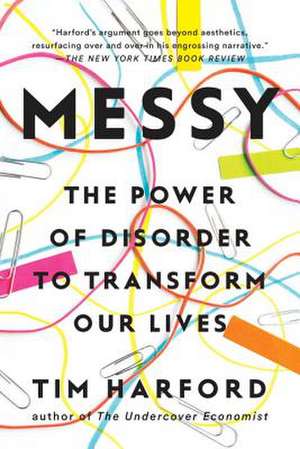
Messy
Autor Tim Harforden Limba Engleză Paperback – 3 oct 2017
Look out for Tim's next book, Fifty Inventions That Shaped the Modern Economy.Messy: The Power of Disorder to Transform Our Lives celebrates the benefits that messiness has in our lives: why it's important, why we resist it, and why we should embrace it instead. Using research from neuroscience, psychology, social science, as well as captivating examples of real people doing extraordinary things, Tim Harford explains that the human qualities we value - creativity, responsiveness, resilience - are integral to the disorder, confusion, and disarray that produce them. From the music studio of Brian Eno to the Lincoln Memorial with Martin Luther King, Jr., from the board room to the classroom, messiness lies at the core of how we innovate, how we achieve, how we reach each other - in short, how we succeed. In Messy, you'll learn about the unexpected connections between creativity and mess; understand why unexpected changes of plans, unfamiliar people, and unforeseen events can help generate new ideas and opportunities as they make you anxious and angry; and come to appreciate that the human inclination for tidiness - in our personal and professional lives, online, even in children's play - can mask deep and debilitating fragility that keep us from innovation. Stimulating and readable as it points exciting ways forward, Messy is an insightful exploration of the real advantages of mess in our lives.
| Toate formatele și edițiile | Preț | Express |
|---|---|---|
| Paperback (2) | 64.34 lei 22-36 zile | +36.75 lei 6-12 zile |
| Little Brown – 22 mar 2018 | 64.34 lei 22-36 zile | +36.75 lei 6-12 zile |
| PENGUIN RANDOM HOUSE LLC – 3 oct 2017 | 128.54 lei 22-36 zile |
Preț: 128.54 lei
22.74€ • 26.81$ • 19.75£
Carte disponibilă
Livrare economică 02-16 martie
Specificații
ISBN-10: 1594634807
Pagini: 304
Dimensiuni: 139 x 208 x 22 mm
Greutate: 0.27 kg
Editura: PENGUIN RANDOM HOUSE LLC
V-ar putea interesa
-
 ReWorkDavid Heinemeier Hansson-30%Preț: 71.56 lei102.61 lei
 -
 AntifragileNassim Nicholas Taleb-29%Preț: 73.23 lei103.74 lei
 -
 Solving Problems with Design ThinkingJeanne LiedtkaPreț: 156.75 lei
 -
 Connect the DotsChristian Busch-20%Preț: 61.06 lei76.09 lei
 -
 Adapt: Why Success Always Starts with FailureTim Harford-28%Preț: 63.41 lei88.53 lei
 -
 Hegarty on CreativityJohn Hegarty-20%Preț: 60.22 lei75.42 lei
 -
 Resilience: Why Things Bounce BackAndrew Zolli-26%Preț: 56.75 lei76.81 lei
 -
 ShatterproofTasha EurichPreț: 117.32 lei
 -
 -27%Preț: 98.98 lei136.10 lei
 -
 -28%Preț: 83.52 lei116.14 lei
 -
 Lose Your MindJosh Pais-25%Preț: 136.11 lei182.25 lei
 -
 The Manager's PathCamille FournierPreț: 211.46 lei
 -
 -22%Preț: 89.74 lei114.72 lei
 -
 The Story of a New NameElena Ferrante-20%Preț: 83.54 lei104.42 lei
 -
 Preț: 170.96 lei
 -
 The Story of a New NameElena FerrantePreț: 76.72 lei
 -
 -20%Preț: 65.56 lei82.34 lei
 -
 Tiny Experiments: How to Live Freely in a Goal-Obsessed WorldAnne-Laure Le Cunff-20%Preț: 60.75 lei75.68 lei
 -
 Embrace the ChaosJason FoxPreț: 75.06 lei
 -
 Great by ChoiceJim CollinsPreț: 136.60 lei
 -
 The Creative Ambush: How to Unleash Your Fire into the WorldMatteo di Pascale-19%Preț: 96.73 lei118.97 leiRecomandat
Descriere
'Ranging expertly across business, politics and the arts, Tim Harford makes a compelling case for the creative benefits of disorganization, improvisation and confusion. His liberating message: you'll be more successful if you stop struggling so hard to plan or control your success. Messyis a deeply researched, endlessly eye-opening adventure in the life-changing magic of not tidying up' Oliver Burkeman
The urge to tidiness seems to be rooted deep in the human psyche. Many of us feel threatened by anything that is vague, unplanned, scattered around or hard to describe. We find comfort in having a script to rely on, a system to follow, in being able to categorise and file away.
We all benefit from tidy organisation - up to a point. A large library needs a reference system. Global trade needs the shipping container. Scientific collaboration needs measurement units. But the forces of tidiness have marched too far. Corporate middle managers and government bureaucrats have long tended to insist that everything must have a label, a number and a logical place in a logical system. Now that they are armed with computers and serial numbers, there is little to hold this tidy-mindedness in check. It's even spilling into our personal lives, as we corral our children into sanitised play areas or entrust our quest for love to the soulless algorithms of dating websites. Order is imposed when chaos would be more productive. Or if not chaos, then . . . messiness.
The trouble with tidiness is that, in excess, it becomes rigid, fragile and sterile. In Messy, Tim Harford reveals how qualities we value more than ever - responsiveness, resilience and creativity - simply cannot be disentangled from the messy soil that produces them.
This, then, is a book about the benefits of being messy: messy in our private lives; messy in the office, with piles of paper on the desk and unread spreadsheets; messy in the recording studio, the laboratory or in preparing for an important presentation; and messy in our approach to business, politics and economics, leaving things vague, diverse and uncomfortably made-up-on-the-spot. It's time to rediscover the benefits of a little mess.
Recenzii
[Harford's] best and deepest book
Messy masterfully weaves together anecdote and academic work
Harford urges us to recapture our autonomy . . . fascinating . . . Harford's argument goes beyond aesthetics, resurfacing over and over in his engrossing narrative
A profoundly stimulating canter through why we should all allow a little mess - but not chaos - in our lives, on our desks, and in our minds. A powerful expansion of Harford's previous excellent work, from a fascinating and contrasting viewpoint
It's a very very good book, full of wise counterintuitions and clever insights
A charismatic book . . . Few writers are better qualified to champion disorder and particularity . . . Harford is an elegant and dizzyingly catholic thinker . . . entertaining and insightful
Tim Harford's brilliant new book
Messy is a book filled with instructive stories in the manner of Malcolm Gladwell
Messy is an intelligent self-help book designed to cultivate greater tolerance for spontaneity, uncertainty, dissonance and diversity. Harford's evidence-based account transcends the cliches endemic to the genre - or refashions them anew
'A very very good book, full of wise counterintuitions and clever insights' Brian Eno
Messy celebrates the benefits that messiness has in our lives: why it's important, why we resist it, and why we should embrace it instead. Drawing from research in neuroscience, psychology, and social science, Tim Harford explains that the human qualities we value - creativity, responsiveness, resilience - are integral to the disorder, confusion, and disarray that produce them.
'Ranging expertly across business, politics and the arts, Tim Harford makes a compelling case for the creative benefits of disorganization, improvisation and confusion. His liberating message: you'll be more successful if you stop struggling so hard to plan or control your success. Messy is a deeply researched, endlessly eye-opening adventure in the life-changing magic of not tidying up' Oliver Burkeman
'Harford's argument goes beyond aesthetics, resurfacing over and over in his engrossing narrative' Maria Konnikova, New York Times Book Review