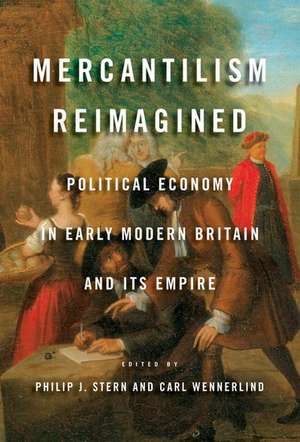
Mercantilism Reimagined: Political Economy in Early Modern Britain and Its Empire
Editat de Philip J. Stern, Carl Wennerlinden Limba Engleză Hardback – 19 dec 2013
Subliniem apariția volumului Mercantilism Reimagined, o lucrare colectivă care reevaluează fundamental un concept adesea considerat anacronic în mediul academic, dar care supraviețuiește cu încăpățânare în discursul didactic. Ediția de față marchează o schimbare de paradigmă: în loc să caute „mercantilismul” ca ideologie economică definită, autorii investighează modul în care considerentele economice erau integrate în dezbaterile științifice, politice și culturale ale secolului al XVII-lea. Notăm cu interes respingerea metodei deductive în favoarea unei abordări inductive, care eliberează analiza de presupunerile istoriografiei Iluminismului scoțian și de lentila economiei moderne.
Structura celor optsprezece eseuri demonstrează că viziunea unui „sistem mercantil” bazat pe un stat-națiune puternic și expansiv este nesustenabilă pentru perioada modernă timpurie. Putem afirma că relevanța acestui volum pentru curriculumul de istorie și economie politică rezidă în recunoașterea naturii descentralizate și amorfe a statului de atunci. Alternativă la lucrarea Mercantilism de Lars Magnusson pentru cursurile de istoria gândirii economice, acest volum are avantajul de a integra perspective noi din istoria socială și culturală, depășind simpla analiză a balanței comerciale.
În contextul operei editorului Philip J. Stern, lucrarea funcționează ca o extensie teoretică a temelor abordate în The Company-State și Empire, Incorporated. Dacă în lucrările anterioare Stern demonstra cum corporațiile au condus expansiunea colonială, în acest volum colectiv el coordonează o analiză mai largă asupra modului în care diverse comunități politice — de la biserică la asociații de pirați — au modelat politicile economice, oferind o imagine mult mai nuanțată a puterii în imperiul britanic.
Preț: 753.89 lei
Preț vechi: 1121.66 lei
-33%
Carte tipărită la comandă
Livrare economică 04-15 decembrie
Specificații
ISBN-10: 0199988536
Pagini: 416
Dimensiuni: 160 x 236 x 36 mm
Greutate: 0.73 kg
Editura: Oxford University Press
Colecția OUP USA
Locul publicării:New York, United States
V-ar putea interesa
-
 -23%Preț: 160.16 lei207.34 lei
 -
 -30%Preț: 688.14 lei980.03 lei
 -
 Appropriation and Invention of Tradition: The East India Company and Hindu Law in Early Colonial BengalNandini Bhattacharya-Panda-6%Preț: 115.86 lei122.69 lei
 -
 -33%Preț: 674.74 lei1011.25 lei
 -
 Colonial Copyright: Intellectual Property in Mandate PalestineMichael D. Birnhack-30%Preț: 1029.98 lei1474.20 lei
 -
 Preț: 411.23 lei
 -
 Preț: 401.62 lei
 -
 Colonialism in QuestionFrederick CooperPreț: 252.09 lei
 -
 Preț: 258.57 lei
 -
 The Assassination of LumumbaLudo de WittePreț: 165.21 lei
 -
 Out Of PlaceEdward W. SaidPreț: 93.44 lei
De ce să citești această carte
Recomandăm această carte cercetătorilor și studenților la istorie sau științe politice care doresc să înțeleagă rădăcinile economiei imperiale britanice dincolo de mitul statului atotputernic. Cititorul va câștiga o perspectivă proaspătă asupra modului în care ideile despre bogăție și putere au fost modelate de actori non-statali, precum corporațiile și comunitățile locale, oferind o alternativă riguroasă la interpretările economice clasice.
Despre autor
Philip J. Stern este un istoric recunoscut pentru cercetările sale asupra Imperiului Britanic și a rolului corporațiilor în guvernarea colonială. În lucrările sale de referință, precum The Company-State și Empire, Incorporated, el a răsturnat viziunea tradițională conform căreia imperiul a fost un proiect strict statal, argumentând că entitățile comerciale au deținut suveranitatea de facto. Alături de Carl Wennerlind, Stern coordonează în acest volum o echipă de tineri istorici pentru a redefini mercantilismul ca pe un fenomen intelectual complex, integrat în transformările sociale și politice ale epocii moderne timpurii.