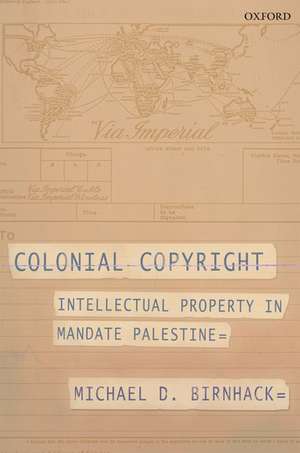
Colonial Copyright: Intellectual Property in Mandate Palestine
Autor Michael D. Birnhacken Limba Engleză Hardback – 4 oct 2012
Preț: 996.31 lei
Preț vechi: 1448.54 lei
-31%
Puncte Express: 1494
Carte tipărită la comandă
Livrare economică 20 noiembrie-01 decembrie
Livrare prin curier în România Termenul estimat este afișat lângă disponibilitate.
Transport gratuit pentru acest produs Plată online sau ramburs, în funcție de opțiunile comenzii.
Retur gratuit în 14 zile Comandă securizată și suport în română.
Specificații
ISBN-13: 9780199661138
ISBN-10: 0199661138
Pagini: 336
Dimensiuni: 178 x 244 x 26 mm
Greutate: 0.66 kg
Editura: OUP OXFORD
Colecția OUP Oxford
Locul publicării:Oxford, United Kingdom
ISBN-10: 0199661138
Pagini: 336
Dimensiuni: 178 x 244 x 26 mm
Greutate: 0.66 kg
Editura: OUP OXFORD
Colecția OUP Oxford
Locul publicării:Oxford, United Kingdom
V-ar putea interesa
-
 -23%Preț: 160.16 lei207.34 lei
 -
 -31%Preț: 665.69 lei963.00 lei
 -
 Appropriation and Invention of Tradition: The East India Company and Hindu Law in Early Colonial BengalNandini Bhattacharya-Panda-6%Preț: 115.86 lei122.69 lei
 -
 -33%Preț: 674.74 lei1011.25 lei
 -
 -34%Preț: 729.29 lei1102.11 lei
 -
 Preț: 411.23 lei
 -
 Preț: 412.99 lei
 -
 Colonialism in QuestionFrederick CooperPreț: 252.09 lei
 -
 Decolonization and Its ImpactShipwayPreț: 310.17 lei
 -
 Preț: 258.57 lei
 -
 The Arab Spring: The End of PostcolonialismHamid Dabashi-10%Preț: 140.60 lei156.93 lei
 -
 The Assassination of LumumbaLudo de WittePreț: 159.75 lei
 -
 Out Of PlaceEdward W. SaidPreț: 93.44 lei
Recenzii
This intriguing book includes both consideration of some major themes in law and society, and very detailed discussion of specific processes and events in legal history. ... the author has produced a fascinating book, which ... makes a major contribution to the study of Palestine Mandate law specifically, and Imperial copyright law generally. This book should be enjoyed by anyone with an interest in either the history of intellectual property or the legal history of the State of Israel.
Its strengths lie in its meticulously researched accounts of how legal intermediaries in the Mandate first ignored copyright, relying on social norms rather than law to order their business affairs, and slowly began to mobilise copyright law to negotiate the novel legal questions presented by new technologies of public performance. ... The book's engagement with an array of hitherto neglected legal and archival sources in English, Hebrew and Arabic is a welcome contribution to this fast-evolving sub-field of legal history.
The author has produced a fascinating book, which ... makes a major contribution to the study of Palestine Mandate law specifically, and Imperial copyright law generally. This book should be enjoyed by anyone with an interest in either the history of intellectual property or the legal history of the State of Israel. Finally, anyone exploring the law as a tool of colonialism and other instances of legal transplants will also find this book well worth the read.
[A]n exciting read that reaches beyond existing studies on the history of copyright.4 It offers a sophisticated and profound analysis of copyright in a period and region that has never been explored. This makes Birnhack's book a ground-breaking work ... Birnhack has succeeded in making his readers think about the early days of copyright in Palestine and how lessons gleaned from this period inform the development of contemporary norms and principles of copyright regulation.
A work that deserves attention from both copyright scholars and from historians interested in the legal dimensions of the British Empire.
Michael Birnhack's book is a highly stimulating study of how British copyright laws were transposed to its colonial territories in the early twentieth century...the book is to be highly recommended, and not just for those with an interest in IP law...[Birnhack] truly proves himself to be a legal scholar of some renown.
Birnhack's fascinating and provocative account opens a true Pandora's Box; a series of haunting episodes always running in the background of copyright's history, whose traces remained buried in archives dispersed throughout the world...[Colonial Copyright] will become a useful reference as an initial and lucid attempt to provide a sophisticated theoretical analysis of colonial copyright.
This is a groundbreaking history of copyright law in British-ruled Palestine in the first half of the twentieth century. Birnhack provides a rich and detailed description of emergence of copyright norms based on a remarkable range of sources. The story is told from a number of different perspectives - British, Jewish, and Arab - and contains many fascinating episodes and actors. The book will prove indispensable to legal historians as well as comparative lawyers, students of nationalism and colonialism, historians of culture and technology, and anyone interested in legal globalization.
Michael Birnhack's Colonial Copyright breaks new ground in the increasingly popular field of IP history by moving away from a focus on Britain, Europe, and the US and probing how copyright norms were transplanted into colonial settings. In this fascinating account of copyright's operation in Palestine between the 1920s and establishment of the state of Israel in 1948, Birnhack provides a wonderfully-researched and legally-sophisticated account of how copyright was (and was not) deployed in the fields of publishing, performing rights, broadcasting, and journalism.
On the whole ... this book offers a sophisticated but readable presentation of copyright law that will work well for graduate courses and for scholars in the field.
Its strengths lie in its meticulously researched accounts of how legal intermediaries in the Mandate first ignored copyright, relying on social norms rather than law to order their business affairs, and slowly began to mobilise copyright law to negotiate the novel legal questions presented by new technologies of public performance. ... The book's engagement with an array of hitherto neglected legal and archival sources in English, Hebrew and Arabic is a welcome contribution to this fast-evolving sub-field of legal history.
The author has produced a fascinating book, which ... makes a major contribution to the study of Palestine Mandate law specifically, and Imperial copyright law generally. This book should be enjoyed by anyone with an interest in either the history of intellectual property or the legal history of the State of Israel. Finally, anyone exploring the law as a tool of colonialism and other instances of legal transplants will also find this book well worth the read.
[A]n exciting read that reaches beyond existing studies on the history of copyright.4 It offers a sophisticated and profound analysis of copyright in a period and region that has never been explored. This makes Birnhack's book a ground-breaking work ... Birnhack has succeeded in making his readers think about the early days of copyright in Palestine and how lessons gleaned from this period inform the development of contemporary norms and principles of copyright regulation.
A work that deserves attention from both copyright scholars and from historians interested in the legal dimensions of the British Empire.
Michael Birnhack's book is a highly stimulating study of how British copyright laws were transposed to its colonial territories in the early twentieth century...the book is to be highly recommended, and not just for those with an interest in IP law...[Birnhack] truly proves himself to be a legal scholar of some renown.
Birnhack's fascinating and provocative account opens a true Pandora's Box; a series of haunting episodes always running in the background of copyright's history, whose traces remained buried in archives dispersed throughout the world...[Colonial Copyright] will become a useful reference as an initial and lucid attempt to provide a sophisticated theoretical analysis of colonial copyright.
This is a groundbreaking history of copyright law in British-ruled Palestine in the first half of the twentieth century. Birnhack provides a rich and detailed description of emergence of copyright norms based on a remarkable range of sources. The story is told from a number of different perspectives - British, Jewish, and Arab - and contains many fascinating episodes and actors. The book will prove indispensable to legal historians as well as comparative lawyers, students of nationalism and colonialism, historians of culture and technology, and anyone interested in legal globalization.
Michael Birnhack's Colonial Copyright breaks new ground in the increasingly popular field of IP history by moving away from a focus on Britain, Europe, and the US and probing how copyright norms were transplanted into colonial settings. In this fascinating account of copyright's operation in Palestine between the 1920s and establishment of the state of Israel in 1948, Birnhack provides a wonderfully-researched and legally-sophisticated account of how copyright was (and was not) deployed in the fields of publishing, performing rights, broadcasting, and journalism.
On the whole ... this book offers a sophisticated but readable presentation of copyright law that will work well for graduate courses and for scholars in the field.
Notă biografică
Michael Birnhack is a professor of law at Tel-Aviv University, Israel. He is fascinated by the way the law treats information and the interaction between law and culture. His research focuses on copyright, privacy, and freedom of expression, which he views as different aspects of information. Before joining Tel-Aviv University in 2007, he was a member of the faculty of law at Haifa University, where he was co-founder and co-director of the Haifa Centre of Law & Technology. He served on the board of several Israeli public bodies, including the Public Council for Privacy, the Ethics Centre in Jerusalem, and the Association of Civil Rights in Israel. Birnhack testified in the Knesset numerous times, on issues of copyright and privacy. He studied law at Tel-Aviv and at NYU School of Law and prior to his academic career he was a news reporter (legal affairs) and news editor for an Israeli radio station and then a member of the founding team of Channel 2 Television News.