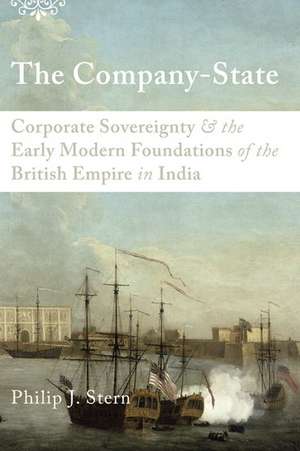
The Company-State: Corporate Sovereignty and the Early Modern Foundations of the British Empire in India
Autor Philip J. Sternen Limba Engleză Paperback – 29 noi 2012
Preț: 354.01 lei
Preț vechi: 398.70 lei
-11%
Puncte Express: 531
Carte tipărită la comandă
Livrare economică 04-15 decembrie
Livrare prin curier în România Termenul estimat este afișat lângă disponibilitate.
Transport gratuit de la 400.00 lei Plată online sau ramburs, în funcție de opțiunile comenzii.
Retur gratuit în 14 zile Comandă securizată și suport în română.
Specificații
ISBN-13: 9780199930364
ISBN-10: 0199930368
Pagini: 316
Ilustrații: 13 illus.
Dimensiuni: 155 x 231 x 18 mm
Greutate: 0.48 kg
Editura: Oxford University Press
Colecția OUP USA
Locul publicării:New York, United States
ISBN-10: 0199930368
Pagini: 316
Ilustrații: 13 illus.
Dimensiuni: 155 x 231 x 18 mm
Greutate: 0.48 kg
Editura: Oxford University Press
Colecția OUP USA
Locul publicării:New York, United States
V-ar putea interesa
-
 The Honourable CompanyJohn KeayPreț: 94.54 lei
 -
 The British Empire: A Very Short IntroductionAshley Jackson-20%Preț: 57.03 lei70.96 lei
 -
 -30%Preț: 981.42 lei1403.81 lei
 -
 -20%Preț: 57.03 lei71.06 lei
 -
 -12%Preț: 308.99 lei350.21 lei
 -
 -17%Preț: 376.76 lei453.07 lei
 -
 Thicker than Water: Siblings and their Relations, 1780-1920Leonore Davidoff-19%Preț: 316.42 lei390.61 lei
 -
 -14%Preț: 249.47 lei289.27 lei
 -
 -19%Preț: 313.41 lei387.49 lei
 -
 -33%Preț: 753.89 lei1121.66 lei
 -
 -26%Preț: 74.30 lei100.18 lei
 -
 -26%Preț: 67.68 lei92.06 lei
 -
 The Trading World of Asia and the English East India CompanyK. N. ChaudhuriPreț: 383.26 lei
 -
 Indian Society and the Making of the British EmpireChristopher Alan Bayly-14%Preț: 734.60 lei854.19 lei
 -
 -27%Preț: 88.27 lei120.46 lei
 -
 Make Your Own Board Game: Designing, Building, and Playing an Original Tabletop GameJesse Terrance Daniels-24%Preț: 88.61 lei116.21 lei
 -
 World War II River Assault TacticsGordon L. Rottman-32%Preț: 77.49 lei114.56 lei
 -
 V1 Flying Bomb AcesAndrew Thomas-28%Preț: 98.10 lei135.72 lei
 -
 King ArthurDaniel Mersey-30%Preț: 60.14 lei85.85 lei
 -
 East India Company at Home, 1757-1857Margot FinnPreț: 223.89 lei
 -
 -23%Preț: 825.27 lei1071.78 lei
 -
 Inglorious EmpireShashi Tharoor-21%Preț: 174.36 lei221.58 lei
Recenzii
With great skill, Stern has extracted from the archives a cogent and highly engaging narrative of events that even participants found highly tremendously confusing. He deftly conveys the world of the East India company, marshaling striking visual materials and wonderfully evocative quotations from a wide array of Company documents.
A thought-provoking reinterpretation that will compel us to reexamine assumptions about colonial companies in general.
In a work of deep erudition and striking originality Philip Stern deftly demolishes many of the categories by which we try to organize our work: are states and companies really different animals, were the early modern Atlantic and Indian Oceans distinct worlds, what, if anything, was new about the post-Plassey British Indian empire? We are politely but firmly directed back to the drawing board.
In The Company-State, Philip Stern has made an important contribution not only to studies of empire, but to early modern history in general. This is an important and innovative reconsideration of the East India Company as a political actor in the first phase of its career. This incisively crafted book will be widely read, cited, and debated.
A bracing re-thinking of the early modern East India Company and its role in shaping English practices of empire, governance, 'trade,' and polity, Philip Stern's book will replace all previous studies on the topic.
A thought-provoking reinterpretation that will compel us to reexamine assumptions about colonial companies in general.
In a work of deep erudition and striking originality Philip Stern deftly demolishes many of the categories by which we try to organize our work: are states and companies really different animals, were the early modern Atlantic and Indian Oceans distinct worlds, what, if anything, was new about the post-Plassey British Indian empire? We are politely but firmly directed back to the drawing board.
In The Company-State, Philip Stern has made an important contribution not only to studies of empire, but to early modern history in general. This is an important and innovative reconsideration of the East India Company as a political actor in the first phase of its career. This incisively crafted book will be widely read, cited, and debated.
A bracing re-thinking of the early modern East India Company and its role in shaping English practices of empire, governance, 'trade,' and polity, Philip Stern's book will replace all previous studies on the topic.
Notă biografică
Philip J. Stern is Assistant Professor of History at Duke University.
Cuprins
- Introduction: "A State in the Disguise of a Merchant"
- Part I: Foundations
- Chapter 1 "Planning and Peopling Your Colony": Building a Company-State
- Chapter 2 "A Sort of Republic for the Management of Trade": The Jurisdiction of a Company-State
- Chapter 3 "A Politie of Civill and Military Power": Diplomacy, War, and Expansion
- Chapter 4 "Politicall Science and Martiall Prudence": Political Thought and Political Economy
- Chapter 5 "The Most Sure and Profitable Sort of Merchandice": Protestantism and Piety
- Part II: Transformations
- Chapter 6 "Great Warrs Leave Behind them Long Tales": Crisis and Response in Asia after 1688
- Chapter 7 Auspicio Regis et Senatus Angliae": Crisis and Response in Britain after 1688
- Chapter 8 "The Day of Small Things": Civic Governance in the New Century
- Chapter 9 "A Sword in One Hand and Money in the Other": Old Patterns, New Rivals
- Conclusion "A Great and Famous Superstructure"
- Abbreviations
- Glossary
- Notes
- Index