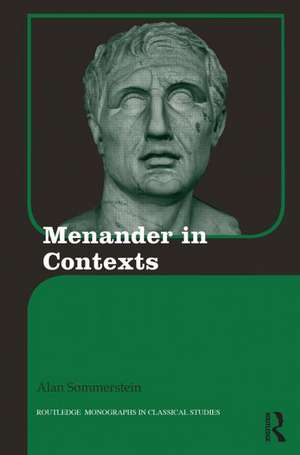
Menander in Contexts: Routledge Monographs in Classical Studies
Editat de Alan H. Sommersteinen Limba Engleză Hardback – 13 dec 2013
In this book, sixteen contributors examine and explore the Menander we know today in light of the various literary, intellectual, and social contexts in which his plays can be viewed. Topics covered include: the society, culture, and politics of his generation; the intellectual currents of the period; the literary precursors who inspired Menander (or whom he expected his audiences to recall); and responses to Menander, from his own time to ours. As the first wide-ranging collective study of Menander in English, this book is essential reading for those interested in ancient comedy the world over.
Din seria Routledge Monographs in Classical Studies
-
 Preț: 421.26 lei
 - 9%
 Preț: 1128.06 lei
 -
 Preț: 385.28 lei
 - 24%
 Preț: 1128.65 lei
 - 15%
 Preț: 461.82 lei
 - 15%
 Preț: 462.09 lei
 - 15%
 Preț: 479.52 lei
 - 15%
 Preț: 423.54 lei
 - 18%
 Preț: 1255.51 lei
 - 18%
 Preț: 1287.64 lei
 - 18%
 Preț: 1117.75 lei
 -
 Preț: 434.74 lei
 - 15%
 Preț: 453.53 lei
 - 18%
 Preț: 1074.51 lei
 - 15%
 Preț: 479.52 lei
 - 8%
 Preț: 436.83 lei
 - 18%
 Preț: 1112.80 lei
 - 15%
 Preț: 483.04 lei
 - 18%
 Preț: 1153.48 lei
 - 18%
 Preț: 1246.62 lei
 - 18%
 Preț: 1121.80 lei
 -
 Preț: 474.36 lei
 - 18%
 Preț: 1256.21 lei
 -
 Preț: 415.63 lei
 - 18%
 Preț: 1117.23 lei
 - 18%
 Preț: 1302.78 lei
 - 18%
 Preț: 1113.91 lei
 - 15%
 Preț: 498.57 lei
 - 18%
 Preț: 1066.59 lei
 - 18%
 Preț: 1112.48 lei
 - 18%
 Preț: 1262.14 lei
 - 18%
 Preț: 1263.48 lei
 - 18%
 Preț: 1114.12 lei
 - 18%
 Preț: 1121.60 lei
 - 18%
 Preț: 1313.85 lei
 - 18%
 Preț: 1292.69 lei
 - 18%
 Preț: 1248.98 lei
 - 18%
 Preț: 1248.18 lei
 - 18%
 Preț: 1144.09 lei
 - 18%
 Preț: 1122.96 lei
Preț: 1258.30 lei
Preț vechi: 1534.51 lei
-18%
Puncte Express: 1887
Carte tipărită la comandă
Livrare economică 30 noiembrie-14 decembrie
Livrare prin curier în România Termenul estimat este afișat lângă disponibilitate.
Transport gratuit pentru acest produs Plată online sau ramburs, în funcție de opțiunile comenzii.
Retur gratuit în 14 zile Comandă securizată și suport în română.
Specificații
ISBN-13: 9780415843713
ISBN-10: 0415843715
Pagini: 302
Ilustrații: 5 b/w images and 1 table
Dimensiuni: 152 x 229 x 23 mm
Greutate: 0.72 kg
Ediția:1
Editura: Taylor & Francis
Colecția Routledge
Seria Routledge Monographs in Classical Studies
Locul publicării:Oxford, United Kingdom
ISBN-10: 0415843715
Pagini: 302
Ilustrații: 5 b/w images and 1 table
Dimensiuni: 152 x 229 x 23 mm
Greutate: 0.72 kg
Ediția:1
Editura: Taylor & Francis
Colecția Routledge
Seria Routledge Monographs in Classical Studies
Locul publicării:Oxford, United Kingdom
V-ar putea interesa
-
 The Birds and Other PlaysAristophanes-31%Preț: 63.00 lei91.48 lei
 -
 The Persians and Other PlaysAeschylus-31%Preț: 64.31 lei93.00 lei
 -
 Ovid: Times and Reasons: A New Translation of FastiPeter Wiseman-31%Preț: 928.66 lei1353.22 lei
 -
 Satires and EpistlesHorace-19%Preț: 58.05 lei71.65 lei
 -
 Seneca: De ClementiaSusanna Braund-22%Preț: 373.40 lei477.51 lei
 -
 The Primacy of Vision in Virgil's AeneidRiggs Alden SmithPreț: 204.28 lei
 -
 Rhetoric, Women and Politics in Early Modern EnglandJennifer RichardsPreț: 439.22 lei
 -
 Classical Literature: An IntroductionNeil CroallyPreț: 446.32 lei
 -
 Medieval Arabic Praise Poetry: Ibn Al-Rumi and the Patron's RedemptionBeatrice Gruendler-15%Preț: 469.69 lei552.57 lei
 -
 Greek TragedyH.D.F. KittoPreț: 193.03 lei
 -
 Preț: 486.27 lei
 -
 Medievalisms: Making the Past in the PresentTison PughPreț: 387.07 lei
 -
 Greek Word OrderDover Publications IncPreț: 177.62 lei
 -
 Documents Illustrating the Principates of Gaius Claudius and NeroE. Mary SmallwoodPreț: 328.62 lei
 -
 Reading VirgilPeter JonesPreț: 292.92 lei
 -
 Dante and the Making of a Modern AuthorAlbert AscoliPreț: 453.40 lei
 -
 The Cambridge Introduction to the Old Norse-Icelandic SagaMargaret Clunies RossPreț: 228.53 lei
 -
 Aeschylean TragedyAlan H. SommersteinPreț: 335.66 lei
 -
 Legends of Alexander the GreatDr Richard Stoneman-21%Preț: 167.08 lei212.02 lei
Public țintă
Postgraduate and UndergraduateCuprins
Introduction Alan H. Sommerstein Part 1. Context: Society (Gender, Slavery, War) 1. Money and Love in Menandrian Comedy Horst-Dieter Blume 2. Menander and the Pallake Alan H. Sommerstein 3. Rethinking Rape in Menander’s Comedy and Athenian Life: Modern Comparative Evidence Sharon L. James 4. Relationships among Slaves in Menander Eftychia Bathrellou 5. Military Culture and Menander Mario Lamagna Part 2. Context: Dramatic Tradition 6. Staging and Constructing the Divine in Menander Sarah Miles 7. The Unity of Time in Menander Robert Germany 8. Aspects of Recognition in Perikeiromene and Other Plays William D. Furley 9. Failing Communication in Menander and Others Gunther Martin Part 3. Context: Philosophy and Medical Thought 10. Menander and the Peripatos: New Insights into an Old Question Angelo Casanova 11. Menander, Aristotle, Chance and Accidental Ignorance Valeria Cinaglia 12. Melancholic Lovers in Menander Christophe Cusset Part 4. Context: Posterity 13. On the Reception of Menander in the Imperial Period Orestes Karavas and Jean-Luc Vix 14. ‘Not Even Menander Would Use this Word!’: Perceptions of
Menander’s Language in Greek Lexicography Olga Tribulato 15. An Ideal Reception: Oscar Wilde, Menander’s Comedy, and the Context of Victorian Classical Studies Serena Witzke 16. Menander’s Epitrepontes in Modern Greek Theatre: The Poetics of its Reception and Performance Stavroula Kiritsi
Menander’s Language in Greek Lexicography Olga Tribulato 15. An Ideal Reception: Oscar Wilde, Menander’s Comedy, and the Context of Victorian Classical Studies Serena Witzke 16. Menander’s Epitrepontes in Modern Greek Theatre: The Poetics of its Reception and Performance Stavroula Kiritsi
Notă biografică
Alan H. Sommerstein is Professor of Greek in the University of Nottingham, UK. He has published extensively on Greek tragedy and comedy, producing editions and/or translations of complete or fragmentary plays by Aeschylus, Sophocles, Aristophanes and Menander, as well as co-authoring two volumes on the oath in ancient Greece.
Descriere
The comedies of the Athenian dramatist Menander (c. 342-291 BC) were the ultimate source of a Western tradition of light drama that has continued to the present day. Thanks to a long and continuing series of papyrus discoveries, Menander has now been able to take his place among the major surviving ancient Greek dramatists. In this book, sixteen contributors examine and explore the Menander we know today in light of the various literary, intellectual, and social contexts in which his plays can be viewed. Topics covered include: the society, culture, and politics of his generation; the intellectual currents of the period; the literary precursors who inspired Menander (or whom he expected his audiences to recall); and responses to Menander, from his own time to ours. As the first wide-ranging collective study of Menander in English, this book is essential reading for those interested in ancient comedy the world over.