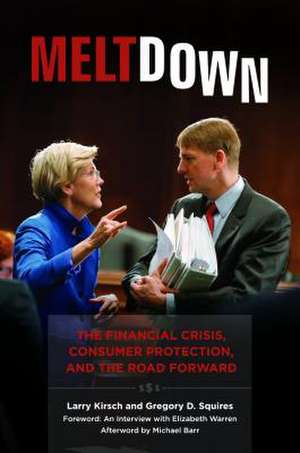
Meltdown: The Financial Crisis, Consumer Protection, and the Road Forward
Autor Larry Kirsch Cuvânt după de Michael Barr Autor Gregory D. Squires Cuvânt înainte de Elizabeth Warrenen Limba Engleză Hardback – 9 mar 2017
Open for business in 2011, the CFPB was Congress's response to the financial catastrophe that shattered millions of middle-class and lower-income households and threatened the stability of the global economy. But only a few years later, with U.S. economic conditions on a path to recovery, there are already disturbing signs of the (re)emergence of the high-risk, high-reward credit practices that the CFPB was designed to curb. This book profiles how the Bureau has attempted to stop abusive and discriminatory lending practices in the mortgage and automobile lending sectors and documents the multilayered challenges faced by an untested new regulatory agency in its efforts to transform the broken-but lucrative-business practices of the financial services industry.
Authors Kirsch and Squires raise the question of whether the consumer protection approach to financial services reform will succeed over the long term in light of political and business efforts to scuttle it. Case studies of mortgage and automobile lending reforms highlight the key contextual and structural conditions that explain the CFPB's ability to transform financial service industry business models and practices. Meltdown: The Financial Crisis, Consumer Protection, and the Road Forward is essential reading for a wide audience, including anyone involved in the provision of financial services, staff of financial services and consumer protection regulatory agencies, and fair lending and consumer protection advocates. Its accessible presentation of financial information will also serve students and general readers.
Preț: 383.96 lei
Preț vechi: 433.17 lei
-11%
Puncte Express: 576
Carte tipărită la comandă
Livrare economică 28 noiembrie-12 decembrie
Livrare prin curier în România Termenul estimat este afișat lângă disponibilitate.
Transport gratuit de la 400.00 lei Plată online sau ramburs, în funcție de opțiunile comenzii.
Retur gratuit în 14 zile Comandă securizată și suport în română.
Specificații
ISBN-13: 9781440842429
ISBN-10: 1440842426
Pagini: 176
Dimensiuni: 156 x 235 mm
Greutate: 0.5 kg
Editura: Bloomsbury Publishing
Colecția Praeger
Locul publicării:New York, United States
ISBN-10: 1440842426
Pagini: 176
Dimensiuni: 156 x 235 mm
Greutate: 0.5 kg
Editura: Bloomsbury Publishing
Colecția Praeger
Locul publicării:New York, United States
V-ar putea interesa
-
 The Hour Between Dog and WolfJohn CoatesPreț: 93.13 lei
 -
 Cheap: The High Cost of Discount CultureEllen Ruppel Shell-11%Preț: 122.59 lei137.76 lei
 -
 MisbehavingRichard H. Thaler-29%Preț: 66.47 lei94.27 lei
 -
 Beyond the Consumption BubbleKarin EkströmPreț: 480.01 lei
 -
 The Routledge Companion to Identity and ConsumptionAyalla Ruvio-9%Preț: 1647.12 lei1810.02 lei
 -
 Gen BuyKit YarrowPreț: 143.93 lei
 -
 Secrets of the MoneylabKay-Yut ChenPreț: 114.85 lei
 -
 Phishing for Phools – The Economics of Manipulations and DeceptionGeroge A. AkerlofPreț: 120.58 lei
 -
 Preț: 142.57 lei
 -
 Behavioural Economics for DummiesMorris AltmanPreț: 118.43 lei
 -
 The Bling DynastyErwan RambourgPreț: 204.50 lei
 -
 Preț: 111.94 lei
 -
 Economics for the CuriousR. SolowPreț: 202.64 lei
 -
 The Biological Bases of Economic BehaviourDavid McfarlandPreț: 257.09 lei
 -
 Preț: 94.49 lei
 -
 -27%Preț: 76.96 lei105.54 lei
 -
 Behavioural Economics Saved My DogDan ArielyPreț: 77.97 lei
 -
 -18%Preț: 1118.04 lei1363.46 lei
Cuprins
Foreword by Elizabeth Warren
Acknowledgments
1. Introduction to a Meltdown
2. Up from the Basement: The CFPB Begins to Take Shape
3. The Shattered Mortgage Market
4. Auto Lending: The Deals and the Dealers
5. The CFPB in Action: Did the Consumer Bureau Get What It Needed to Do What Was Necessary?
Afterword by Michael Barr
Notes
Index
Acknowledgments
1. Introduction to a Meltdown
2. Up from the Basement: The CFPB Begins to Take Shape
3. The Shattered Mortgage Market
4. Auto Lending: The Deals and the Dealers
5. The CFPB in Action: Did the Consumer Bureau Get What It Needed to Do What Was Necessary?
Afterword by Michael Barr
Notes
Index
Recenzii
With Meltdown: The Financial Crisis, Consumer Protection, and the Road Forward, Larry Kirsch and Greg Squires provide a valuable service. . . . This book is the first of this type and hopefully sets a trend for evaluating the new federal oversight established after the Great Recession. . . . In sum, Kirsch and Squires have written an insightful book that documents an important phase of an agency's history; that is, how the agency came into being, and its institutional strengths and weaknesses. It provides valuable lessons for the CFPB's growth as well as providing suggestions about how to create future initiatives like this from scratch.
Kirsch and Squires are consumer law shamans who have a deep contextual understanding of the consumer market and the competing interests of all its market participants. They are clearly adept at much more than reading tea leaves and their extensive experience and engaging manner of addressing the topic at hand makes Meltdown a gripping read and a thought-provoking biography of the CFPB and the importance of context for purposes of charting the regulatory maze. This book is a must-read for consumer agencies and anyone with a keen interest in consumer law. It is clearly most timely in view of the political interest in the CFPB in the US Congress and Administration. I will definitely be passing it on to my colleagues at the soon-to-be established Financial Sector Conduct Authority that forms part of South Africa's imminent move towards a Twin Peaks System of regulation and am confident that studying the observations by Kirsch and Squires will avoid many 'lift-off' headaches and a sharper focus for future intervention.
Meltdown examines the clash of incentives of the key political and industry players in a thoroughly-researched account of the complex, tragic, and sometimes scandalous machinations of the financial services system, as well as the regulatory solutions designed to correct them. Kirsch and Squires are the first to put forth a rigorous analysis of the evolution and impact of Senator Elizabeth Warren's original vision for consumer financial protection.
An indispensable account of the birth of the Consumer Financial Protection Bureau (CFPB) and its tumultuous early years, with a richly documented analysis of the Bureau's pivotal battles to tame the nation's mortgage market and police discrimination in auto lending. Drawing on extensive interviews with enthusiasts as well as critics, this volume offers an invaluable resource for those seeking to evaluate continuing debates over the future of the CFPB.
After the 2008 economic collapse, consumer, civil rights, and labor groups went 'all in' for then-professor Elizabeth Warren's idea of a consumer agency to protect pocketbooks and wallets. Now, just after the CFPB's fifth birthday, Kirsch and Squires go behind the scenes to explore why some of the young agency's leaders moved in the directions that they did to fight the endemic problems that CFPB director Richard Cordray calls the 'four Ds: deception, debt traps, dead ends, and discrimination.' The book is an important addition to the public record about an agency that is controversial only to the powerful special interests that oppose it but necessary to the consumers who have a safer financial marketplace because of it.
This book provides an interesting, readable account of how Director Richard Cordray and others shaped the approach of the newly formed CFPB to its role as the preeminent consumer financial services regulatory agency and the challenges and opposition (some of which came from me and my law firm) faced by the bureau as it embarked on its initial initiatives. Even the bureau's closest observers are likely to learn something new from the book's account of the bureau's early efforts directed at mortgage origination and auto lending. The book combines considerable research with in-depth interviews to offer an appraisal that will interest scholars, practitioners, and readers of current politics and policy.
Kirsch and Squires have penned the definitive chronicle of the first years of a transformative federal agency-the CFPB. They have combined rigorous archival research with in-depth interviews of key insiders to help readers understand the enormous challenges that faced the Bureau as it took on what many consider to be the most powerful lobbying force in the nation-the financial services industry. There are lessons here for the general public but also for policymakers, students of policy making, and advocates looking to build a more equitable economic playing field.
Kirsch and Squires are consumer law shamans who have a deep contextual understanding of the consumer market and the competing interests of all its market participants. They are clearly adept at much more than reading tea leaves and their extensive experience and engaging manner of addressing the topic at hand makes Meltdown a gripping read and a thought-provoking biography of the CFPB and the importance of context for purposes of charting the regulatory maze. This book is a must-read for consumer agencies and anyone with a keen interest in consumer law. It is clearly most timely in view of the political interest in the CFPB in the US Congress and Administration. I will definitely be passing it on to my colleagues at the soon-to-be established Financial Sector Conduct Authority that forms part of South Africa's imminent move towards a Twin Peaks System of regulation and am confident that studying the observations by Kirsch and Squires will avoid many 'lift-off' headaches and a sharper focus for future intervention.
Meltdown examines the clash of incentives of the key political and industry players in a thoroughly-researched account of the complex, tragic, and sometimes scandalous machinations of the financial services system, as well as the regulatory solutions designed to correct them. Kirsch and Squires are the first to put forth a rigorous analysis of the evolution and impact of Senator Elizabeth Warren's original vision for consumer financial protection.
An indispensable account of the birth of the Consumer Financial Protection Bureau (CFPB) and its tumultuous early years, with a richly documented analysis of the Bureau's pivotal battles to tame the nation's mortgage market and police discrimination in auto lending. Drawing on extensive interviews with enthusiasts as well as critics, this volume offers an invaluable resource for those seeking to evaluate continuing debates over the future of the CFPB.
After the 2008 economic collapse, consumer, civil rights, and labor groups went 'all in' for then-professor Elizabeth Warren's idea of a consumer agency to protect pocketbooks and wallets. Now, just after the CFPB's fifth birthday, Kirsch and Squires go behind the scenes to explore why some of the young agency's leaders moved in the directions that they did to fight the endemic problems that CFPB director Richard Cordray calls the 'four Ds: deception, debt traps, dead ends, and discrimination.' The book is an important addition to the public record about an agency that is controversial only to the powerful special interests that oppose it but necessary to the consumers who have a safer financial marketplace because of it.
This book provides an interesting, readable account of how Director Richard Cordray and others shaped the approach of the newly formed CFPB to its role as the preeminent consumer financial services regulatory agency and the challenges and opposition (some of which came from me and my law firm) faced by the bureau as it embarked on its initial initiatives. Even the bureau's closest observers are likely to learn something new from the book's account of the bureau's early efforts directed at mortgage origination and auto lending. The book combines considerable research with in-depth interviews to offer an appraisal that will interest scholars, practitioners, and readers of current politics and policy.
Kirsch and Squires have penned the definitive chronicle of the first years of a transformative federal agency-the CFPB. They have combined rigorous archival research with in-depth interviews of key insiders to help readers understand the enormous challenges that faced the Bureau as it took on what many consider to be the most powerful lobbying force in the nation-the financial services industry. There are lessons here for the general public but also for policymakers, students of policy making, and advocates looking to build a more equitable economic playing field.