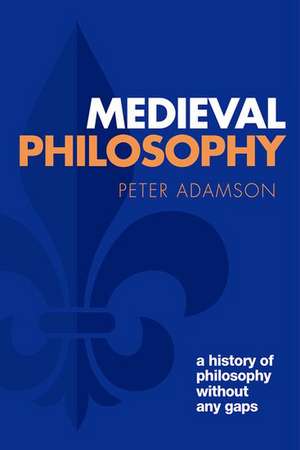
Medieval Philosophy: A history of philosophy without any gaps, Volume 4: A History of Philosophy
Autor Peter Adamsonen Limba Engleză Paperback – 27 ian 2022

Preț: 95.56 lei
Preț vechi: 108.21 lei
-12%
Puncte Express: 143
Carte disponibilă
Livrare economică 13-24 noiembrie
Livrare express 31 octombrie-06 noiembrie pentru 62.100 lei
Livrare prin curier în România Termenul estimat este afișat lângă disponibilitate.
Transport gratuit de la 400.00 lei Plată online sau ramburs, în funcție de opțiunile comenzii.
Retur gratuit în 14 zile Comandă securizată și suport în română.
Specificații
ISBN-13: 9780192856739
ISBN-10: 0192856731
Pagini: 672
Dimensiuni: 156 x 234 x 48 mm
Greutate: 0.86 kg
Editura: OUP OXFORD
Colecția OUP Oxford
Seria A History of Philosophy
Locul publicării:Oxford, United Kingdom
ISBN-10: 0192856731
Pagini: 672
Dimensiuni: 156 x 234 x 48 mm
Greutate: 0.86 kg
Editura: OUP OXFORD
Colecția OUP Oxford
Seria A History of Philosophy
Locul publicării:Oxford, United Kingdom
Recenzii
Accessible and comprehensive.
Peter Adamson's Medieval Philosophy gives fantastically compendious account of medieval philosophy. Adamson manages to be accessible, lucid, witty, incisive; luminously conveying the rambunctious ambivalences of the logic-chopping, devout, doubting, bawdy, bloodthirsty, mystical medievals.
a volume that— despite its weight and heft—one could easily give to a non-philosopher as a first introduction to the field. For even the most obscure authors (such as that most prolific of medieval philosophers, Anon) and the most arcane of topics comes to life under Adamson's magic touch. But what is most impressive about the book is its sheer scope of knowledge. . . . If you want a good, light-touch, yet still not glossing over the difficulties, introduction to medieval philosophy, this is the book for you.
Adamson's history of medieval philosophy has, among its many merits, two great ones. First, is very clearly written and philosophically acute. . . .A second merit is that it proposes an updated interpretation of medieval philosophy, obtained by taking into account the most dominant trends present in literature. This makes Peter Adamson's volume a fine piece of work and a recommended volume. The history of medieval philosophy is investigated in its depth and full development, no significant gap can be found indeed in the proposed reconstruction.
Let me say at once on the evidence of this volume, [Adamson] succeeds brilliantly. Over some 78 sections he covers a huge range of figures ... Special attention is given - and rightly so - to female philosophers, such as Catherine of Siena ... This book (and the others in the series), which are a delight to read, will be of great interest to general readers, aside from students of culture.
Adamson writes with a light style, beginning each short chapter with an anecdote, which rewards both sticking with the long narrative and dipping in and out.
A staggering philosophical achievement ... the clarity of the animated text is further enhanced by the authors humour, bringing a light touch to complex matters ... This volume will surely attain classic status, and can be read either sequentially or consulted as a detailed encyclopaedia of mediaeval philosophy and its variegated personalities.
Peter Adamson's Medieval Philosophy gives fantastically compendious account of medieval philosophy. Adamson manages to be accessible, lucid, witty, incisive; luminously conveying the rambunctious ambivalences of the logic-chopping, devout, doubting, bawdy, bloodthirsty, mystical medievals.
a volume that— despite its weight and heft—one could easily give to a non-philosopher as a first introduction to the field. For even the most obscure authors (such as that most prolific of medieval philosophers, Anon) and the most arcane of topics comes to life under Adamson's magic touch. But what is most impressive about the book is its sheer scope of knowledge. . . . If you want a good, light-touch, yet still not glossing over the difficulties, introduction to medieval philosophy, this is the book for you.
Adamson's history of medieval philosophy has, among its many merits, two great ones. First, is very clearly written and philosophically acute. . . .A second merit is that it proposes an updated interpretation of medieval philosophy, obtained by taking into account the most dominant trends present in literature. This makes Peter Adamson's volume a fine piece of work and a recommended volume. The history of medieval philosophy is investigated in its depth and full development, no significant gap can be found indeed in the proposed reconstruction.
Let me say at once on the evidence of this volume, [Adamson] succeeds brilliantly. Over some 78 sections he covers a huge range of figures ... Special attention is given - and rightly so - to female philosophers, such as Catherine of Siena ... This book (and the others in the series), which are a delight to read, will be of great interest to general readers, aside from students of culture.
Adamson writes with a light style, beginning each short chapter with an anecdote, which rewards both sticking with the long narrative and dipping in and out.
A staggering philosophical achievement ... the clarity of the animated text is further enhanced by the authors humour, bringing a light touch to complex matters ... This volume will surely attain classic status, and can be read either sequentially or consulted as a detailed encyclopaedia of mediaeval philosophy and its variegated personalities.
Notă biografică
Peter Adamson took his doctorate from the University of Notre Dame and first worked at King's College London. In 2012 he moved to the Ludwig-Maximilians-Universität München, where he is Professor of Late Ancient and Arabic Philosophy. He has published widely in ancient and medieval philosophy, especially on Neoplatonism and on philosophy in the Islamic world.