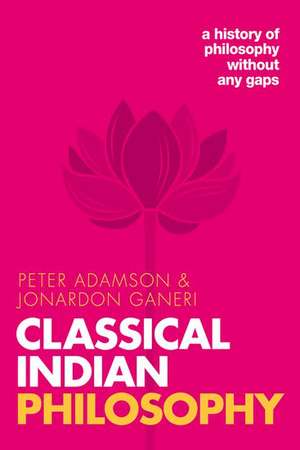
Classical Indian Philosophy: A history of philosophy without any gaps, Volume 5: A History of Philosophy
Autor Peter Adamson, Jonardon Ganerien Limba Engleză Paperback – 27 ian 2022

Preț: 88.20 lei
Preț vechi: 104.13 lei
-15%
Puncte Express: 132
Carte disponibilă
Livrare economică 13-24 noiembrie
Livrare express 31 octombrie-06 noiembrie pentru 51.38 lei
Livrare prin curier în România Termenul estimat este afișat lângă disponibilitate.
Transport gratuit de la 400.00 lei Plată online sau ramburs, în funcție de opțiunile comenzii.
Retur gratuit în 14 zile Comandă securizată și suport în română.
Specificații
ISBN-13: 9780192856746
ISBN-10: 019285674X
Pagini: 432
Dimensiuni: 156 x 235 x 31 mm
Greutate: 0.54 kg
Editura: OUP OXFORD
Colecția OUP Oxford
Seria A History of Philosophy
Locul publicării:Oxford, United Kingdom
ISBN-10: 019285674X
Pagini: 432
Dimensiuni: 156 x 235 x 31 mm
Greutate: 0.54 kg
Editura: OUP OXFORD
Colecția OUP Oxford
Seria A History of Philosophy
Locul publicării:Oxford, United Kingdom
V-ar putea interesa
-
 -30%Preț: 765.66 lei1095.34 lei
 -
 The Religious Thought of Chu HsiJulia Ching-30%Preț: 1244.30 lei1781.79 lei
 -
 Classic Asian Philosophy: A Guide to the Essential TextsJoel Kupperman-10%Preț: 345.47 lei385.51 lei
 -
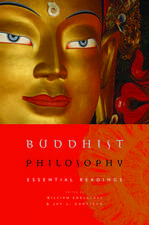 Buddhist Philosophy: Essential ReadingsJay Garfield-11%Preț: 301.14 lei338.99 lei
 -
 The Self: Naturalism, Consciousness, and the First-Person StanceJonardon Ganeri-19%Preț: 317.30 lei389.48 lei
 -
 Attention, Not SelfJonardon Ganeri-27%Preț: 460.64 lei627.66 lei
 -
 -19%Preț: 81.30 lei100.06 lei
 -
 Mind, Language and World: The Collected Essays of Bimal Krishna Matilal Volume IBimal Krishna MatilalPreț: 275.28 lei
 -
 -12%Preț: 267.49 lei305.62 lei
 -
 -20%Preț: 398.37 lei496.21 lei
 -
 Sagehood: The Contemporary Significance of Neo-Confucian PhilosophyStephen C. Angle-10%Preț: 395.36 lei439.14 lei
 -
 Free Will, Agency, and Selfhood in Indian PhilosophyMatthew R. Dasti-21%Preț: 373.03 lei473.60 lei
 -
 The Cambridge Companion to Arabic PhilosophyPeter AdamsonPreț: 284.20 lei
 -
 Indian Logic: A ReaderDr Jonardon Ganeri-15%Preț: 433.41 lei509.90 lei
 -
 Thomas JeffersonSuneel DhandPreț: 100.75 lei
 -
 The Hidden Talent of Albert Otter: Reducido a PolvoDavid HaywoodPreț: 94.84 lei
 -
 Nonsense: A Cultural Mediations on the BeyondKuang-ming Wu-26%Preț: 1223.23 lei1663.29 lei
 -
 Preț: 124.44 lei
 -
 Preț: 134.23 lei
 -
 Preț: 138.28 lei
 -
 Srimad-Bhagavad-GitaNeal Gorton DelmonicoPreț: 91.00 lei
 -
 A Sunrise of Joy: The Lost Darshans of Swami KripaluSwami KripaluPreț: 195.05 lei
Recenzii
An astonishing intellectual tour de force written in an accessible and engaging style.
Notă biografică
Peter Adamson received his BA from Williams College and PhD in Philosophy from the University of Notre Dame. He worked at King's College London from 2000 until 2012. He subsequently moved to the Ludwig-Maximilians-Universität München, where he is Professor of Late Ancient and Arabic Philosophy. He has published widely in ancient and medieval philosophy, and is the host of the History of Philosophy podcast.Jonardon Ganeri is a Fellow of the British Academy. He is the author of Attention, Not Self (2017), The Self (2012), The Lost Age of Reason (2011), and The Concealed Art of the Soul (2007). Ganeri's work draws on a variety of philosophical traditions to construct new positions in the philosophy of mind, metaphysics, and epistemology. He became the first philosopher to win the Infosys Prize in the Humanities in 2015.