
Mathematics in Industrial Problems: The IMA Volumes in Mathematics and its Applications, cartea 38
Autor Avner Friedmanen Limba Engleză Paperback – 14 oct 2011
Din seria The IMA Volumes in Mathematics and its Applications
- 15%
 Preț: 612.76 lei
 - 15%
 Preț: 661.17 lei
 - 15%
 Preț: 617.25 lei
 - 15%
 Preț: 611.95 lei
 -
 Preț: 377.32 lei
 - 15%
 Preț: 618.03 lei
 - 15%
 Preț: 626.52 lei
 - 15%
 Preț: 626.06 lei
 - 15%
 Preț: 641.72 lei
 - 15%
 Preț: 609.96 lei
 - 15%
 Preț: 671.64 lei
 -
 Preț: 372.95 lei
 -
 Preț: 373.76 lei
 - 20%
 Preț: 320.72 lei
 - 15%
 Preț: 620.07 lei
 -
 Preț: 367.28 lei
 -
 Preț: 364.92 lei
 -
 Preț: 381.94 lei
 - 5%
 Preț: 1354.83 lei
 -
 Preț: 366.79 lei
 -
 Preț: 364.68 lei
 -
 Preț: 384.54 lei
 - 15%
 Preț: 616.82 lei
 -
 Preț: 374.13 lei
 - 18%
 Preț: 956.40 lei
 - 18%
 Preț: 905.11 lei
 - 18%
 Preț: 907.54 lei
 - 20%
 Preț: 331.30 lei
 - 18%
 Preț: 903.55 lei
 - 18%
 Preț: 959.24 lei
 - 18%
 Preț: 900.03 lei
 - 15%
 Preț: 616.15 lei
 - 15%
 Preț: 607.34 lei
 - 15%
 Preț: 625.90 lei
 - 18%
 Preț: 908.57 lei
Preț: 701.55 lei
Preț vechi: 876.94 lei
-20%
Puncte Express: 1052
Carte tipărită la comandă
Livrare economică 17 noiembrie-01 decembrie
Livrare prin curier în România Termenul estimat este afișat lângă disponibilitate.
Transport gratuit pentru acest produs Plată online sau ramburs, în funcție de opțiunile comenzii.
Retur gratuit în 14 zile Comandă securizată și suport în română.
Specificații
ISBN-13: 9781461391791
ISBN-10: 1461391792
Pagini: 216
Ilustrații: XIV, 197 p.
Dimensiuni: 155 x 235 x 12 mm
Greutate: 0.34 kg
Ediția:Softcover reprint of the original 1st ed. 1991
Editura: Springer
Colecția The IMA Volumes in Mathematics and its Applications
Seria The IMA Volumes in Mathematics and its Applications
Locul publicării:New York, NY, United States
ISBN-10: 1461391792
Pagini: 216
Ilustrații: XIV, 197 p.
Dimensiuni: 155 x 235 x 12 mm
Greutate: 0.34 kg
Ediția:Softcover reprint of the original 1st ed. 1991
Editura: Springer
Colecția The IMA Volumes in Mathematics and its Applications
Seria The IMA Volumes in Mathematics and its Applications
Locul publicării:New York, NY, United States
V-ar putea interesa
-
 -19%Preț: 515.21 lei637.25 lei
 -
 SpeedVaclav SmilPreț: 137.30 lei
 -
 Partial Differential Equations for Scientists and EngineersStanley J FarlowPreț: 147.84 lei
 -
 -23%Preț: 1210.14 lei1571.62 lei
 -
 MicrobubblesSnigdha Khuntia-23%Preț: 984.54 lei1278.62 lei
 -
 Assignment ProblemsRainer Burkard-9%Preț: 721.94 lei793.34 lei
 -
 DoctoredCharles PillerPreț: 113.26 lei
 -
 Packing Problems in Soft Matter PhysicsHo-Kei Chan-14%Preț: 1710.60 lei1989.06 lei
 -
 -24%Preț: 1028.17 lei1352.86 lei
 -
 More UK Success Stories in Industrial MathematicsPhilip J. Aston-18%Preț: 1124.25 lei1371.04 lei
 -
 Select Ideas in Partial Differential EquationsPeter J. Costa-15%Preț: 566.78 lei666.80 lei
 -
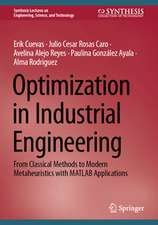 Optimization in Industrial EngineeringErik CuevasPreț: 441.45 lei
 -
 Advanced Control Methods for Industrial ProcessesPablo A. López-Pérez-23%Preț: 689.31 lei895.20 lei
 -
 Mathematical Modeling and SimulationKai Velten-23%Preț: 686.90 lei892.08 lei
 -
 Production Factor MathematicsMartin GrötschelPreț: 401.66 lei
 -
 -24%Preț: 729.90 lei960.39 lei
 -
 -24%Preț: 865.56 lei1138.89 lei
 -
 Optimization Methods and AlgorithmsAnand J. Kulkarni-15%Preț: 559.55 lei658.30 lei
 -
 -18%Preț: 1236.71 lei1508.18 lei
Public țintă
ResearchCuprins
1 Real-world free boundary problems.- 1.1 Hypersonic flow.- 1.2 Problems with free boundaries close to fixed boundaries.- 1.3 Free boundary problems in superconductors.- 1.4 Elastic contact.- 1.5 Partial solution.- 1.6 References.- 2 Terminally attached polymer chains.- 2.1 Experiments and the MWC model.- 2.2 The SCF theory.- 2.3 Numerical results.- 2.4 Mathematical problems.- 2.5 References.- 3 Orientation of colloidal magnetically switchable particles.- 3.1 Ferrohydrodynamics.- 3.2 A statistical mechanics approach.- 3.3 References.- 4 Information, probability and learning from examples.- 4.1 Learning from examples.- 4.2 Simple geometric examples.- 4.3 The Vapnik and Chervonenkis theory.- 4.4 References.- 5 An augmented drift-diffusion formulation in semiconductor devices.- 5.1 Semiconductor device modeling.- 5.2 The augmented drift-diffusion model.- 5.3 Mathematical issues.- 5.4 Partial solution.- 5.5 References.- 6 Analytical and heuristic modeling of distributed algorithms.- 6.1 Examples and terminology.- 6.2 Analytic results.- 6.3 Markov mode for search tree.- 6.4 Search with multiprocessor.- 6.5 References.- 7 Modeling catalytic converter performance.- 7.1 Chemical reactions.- 7.2 The differential equations.- 7.3 Numerical approach.- 7.4 Control problems.- 7.5 References.- 8 A model for titanium silicide film growth.- 8.1 Description of the process.- 8.2 A model with interfaces.- 8.3 A two-dimensional model.- 8.4 References.- 9 A three-state model for gel electrophoresis.- 9.1 Polymer reptation and the repton model.- 9.2 A biased repton model.- 9.3 Mapping into a discrete pseudospin model.- 9.4 Mean field approximation.- 9.5 Open problems.- 9.6 References.- 10 A limited coalescence problem.- 10.1 The model.- 10.2 Asymptotic distribution.- 10.3 The Monte Carlo method.- 10.4 Mathematical results.- 10.5 References.- 11 High field semiconductor equations.- 11.1 Motivation.- 11.2 Scaling.- 11.3 Moderate force.- 11.4 Strong force.- 11.5 The semiconductor case.- 11.6 Open problems.- 11.7 References.- 12 Structured singular values and invariant theory.- 12.1 FDLTI systems.- 12.2 Feedback under parametric uncertainty.- 12.3 Structured singular value.- 12.4 A new approach.- 12.5 Open problems.- 12.6 References.- 13 Signal design with an amplitude constraint.- 13.1 Lp/Lq signal design.- 13.2 Necessary optimality condition.- 13.3 The fixed-point problem.- 13.4 Open problems.- 13.5 References.- 14 Head-disk interface in magnetic storage device.- 14.1 Modified Reynolds equation.- 14.2 Free molecular flow.- 14.3 The limiting process as h?0.- 14.4 References.- 15 Parameter identification in a reaction diffusion model.- 15.1 The direct problem.- 15.2 The inverse problem.- 15.3 Modification of the model.- 15.4 A related problem.- 15.5 Existence and uniqueness.- 15.6 References.- 16 Linear analysis of megastructures.- 16.1 The three bar truss.- 16.2 The hypercircle method.- 16.3 References.- 17 Aerodynamic design with cfd.- 17.1 Vehicle drag.- 17.2 Governing equations.- 17.3 Simplifications.- 17.4 Research areas.- 17.5 References.- 18 Experimental design and quality loss function.- 18.1 Experimental design.- 18.2 Motivation.- 18.3 Sampling.- 18.4 The quality loss function.- 18.5 References.- 19 Numerical simulations for industrial chemical research.- 19.1 Computational approach to chemical research.- 19.2 Theoretical concepts.- 19.3 Requirements for atomistic computations.- 19.4 References.- 20 An adaptive feedforward approach to robot control.- 20.1 Mathematical model.- 20.2 Nonlinear feedforward.- 20.3 Path planning.- 20.4 Mathematicalissues.- 20.5 References.- 21 Solutions to problems from part 3.- 21.1 References.