
Mathematics for Machine Learning
Autor Marc Peter Deisenroth, A. Aldo Faisal, Cheng Soon Ongen Limba Engleză Paperback – 31 mar 2020
| Toate formatele și edițiile | Preț | Express |
|---|---|---|
| Paperback (1) | 340.76 lei 3-5 săpt. | +39.23 lei 4-10 zile |
| Cambridge University Pr. – 31 mar 2020 | 340.76 lei 3-5 săpt. | +39.23 lei 4-10 zile |
| Hardback (1) | 600.68 lei 3-5 săpt. | +38.39 lei 4-10 zile |
| Cambridge University Press – 22 apr 2020 | 600.68 lei 3-5 săpt. | +38.39 lei 4-10 zile |
Preț: 340.76 lei
60.33€ • 70.25$ • 52.41£
Carte disponibilă
Livrare economică 02-16 februarie
Livrare express 16-22 ianuarie pentru 49.22 lei
Specificații
ISBN-10: 110845514X
Pagini: 398
Ilustrații: Worked examples or Exercises; 106 Halftones, color; 3 Halftones, black and white; Worked examples or Exercises; 106 Halftones, color; 3 Halftones, black and white
Dimensiuni: 180 x 254 x 21 mm
Greutate: 0.84 kg
Editura: Cambridge University Pr.
Locul publicării:New York, United States
V-ar putea interesa
-
 I Wish I Knew This EarlierToni TonePreț: 54.06 lei
 -
 -11%Preț: 118.28 lei133.49 lei
 -
 Refactoring: Improving the Design of Existing CodeMartin Fowler-20%Preț: 345.73 lei432.17 lei
 -
 Database Design for Mere MortalsMichael J Hernandez-20%Preț: 271.88 lei339.86 lei
 -
 Deep LearningIan Goodfellow-20%Preț: 604.72 lei755.90 lei
 -
 The Code BookSimon SinghPreț: 108.97 lei
 -
 Pattern Recognition and Machine LearningChristopher M Bishop-20%Preț: 553.92 lei692.41 lei
 -
 Artificial Intelligence EnginesJames V. Stone-20%Preț: 187.92 lei234.90 lei
 -
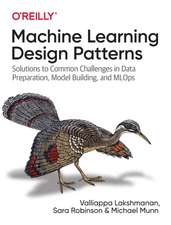 Machine Learning Design PatternsValliappa Lakshmanan-20%Preț: 304.83 lei381.03 lei
 -
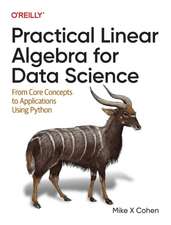 Practical Linear Algebra for Data ScienceMike X. Cohen-8%Preț: 391.99 lei426.07 lei
 -
 -20%Preț: 570.14 lei712.68 lei
 -
 Mathematical Aspects of Deep LearningPhilipp Grohs-11%Preț: 553.09 lei621.46 lei
 -
 -39%Preț: 138.03 lei228.01 lei
 -
 Serious Cryptography: A Practical Introduction to Modern EncryptionJean-Philippe Aumasson-37%Preț: 232.81 lei372.08 lei
 -
 -39%Preț: 181.88 lei296.55 lei
 -
 The Hardware Hacking HandbookJasper van Woudenberg-36%Preț: 240.50 lei377.91 lei
 -
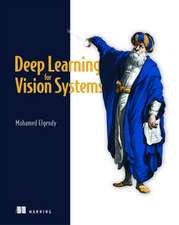 Deep Learning for Vision SystemsMohamed Elgendy-20%Preț: 282.94 lei353.68 lei
 -
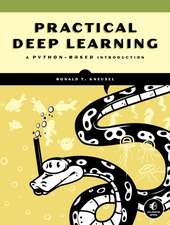 Practical Deep LearningRonald T. Kneusel-37%Preț: 278.40 lei442.89 lei
 -
 Practical IoT HackingFotios Chantzis-37%Preț: 267.22 lei422.33 lei
 -
 Math for Deep LearningRonald T. Kneusel-31%Preț: 234.83 lei340.90 lei
 -
 When the Body Says NoGabor Mate-21%Preț: 69.84 lei88.53 lei
 -
 Hands-On Design Patterns with C++Fedor G. Pikus-20%Preț: 302.20 lei377.74 lei
 -
 Expert Python Programming - Fourth EditionMichal Jaworski-20%Preț: 279.83 lei349.79 lei
 -
 Hands-On Mathematics for Deep LearningJay Dawani-20%Preț: 240.16 lei300.20 lei
 -
 Modern Computer Vision with PyTorchV Kishore Ayyadevara-20%Preț: 373.73 lei467.15 lei
 -
 Machine LearningPaul WilmottPreț: 127.43 lei
Cuprins
1. Introduction and motivation; 2. Linear algebra; 3. Analytic geometry; 4. Matrix decompositions; 5. Vector calculus; 6. Probability and distribution; 7. Optimization; 8. When models meet data; 9. Linear regression; 10. Dimensionality reduction with principal component analysis; 11. Density estimation with Gaussian mixture models; 12. Classification with support vector machines.
Recenzii
'This book provides a beautiful exposition of the mathematics underpinning modern machine learning. Highly recommended for anyone wanting a one-stop-shop to acquire a deep understanding of machine learning foundations.' Pieter Abbeel, University of California, Berkeley
Descriere
The fundamental mathematical tools needed to understand machine learning include linear algebra, analytic geometry, matrix decompositions, vector calculus, optimization, probability and statistics. These topics are traditionally taught in disparate courses, making it hard for data science or computer science students, or professionals, to efficiently learn the mathematics. This self-contained textbook bridges the gap between mathematical and machine learning texts, introducing the mathematical concepts with a minimum of prerequisites. It uses these concepts to derive four central machine learning methods: linear regression, principal component analysis, Gaussian mixture models and support vector machines. For students and others with a mathematical background, these derivations provide a starting point to machine learning texts. For those learning the mathematics for the first time, the methods help build intuition and practical experience with applying mathematical concepts. Every chapter includes worked examples and exercises to test understanding. Programming tutorials are offered on the book's web site.