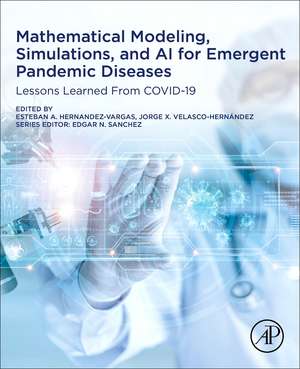
Mathematical Modeling, Simulations, and AI for Emergent Pandemic Diseases: Lessons Learned From COVID-19
Editat de Esteban A. Hernandez-Vargas, Jorge X. Velasco-Hernandez Edgar N. Sanchezen Limba Engleză Paperback – 30 mar 2023
Readers will benefit from learning how to apply advanced mathematical modeling to a variety of topics of practical interest, including optimal allocations of masks and vaccines but also more theoretical problems such as the evolution of viral variants.
- Provides a comprehensive overview of the state-of-the-art in mathematical modeling and computational simulations for emerging pandemics
- Presents modeling techniques that go beyond COVID-19, and that can be applied to tailoring interventions to attenuate high death tolls
- Includes illustrations, tables and dialog boxes to explain highly specialized concepts and insights with complex algorithms, along with links to programming code
Preț: 827.89 lei
Preț vechi: 1139.13 lei
-27% Nou
Puncte Express: 1242
Preț estimativ în valută:
146.54€ • 170.63$ • 127.98£
146.54€ • 170.63$ • 127.98£
Carte tipărită la comandă
Livrare economică 14-28 ianuarie 26
Preluare comenzi: 021 569.72.76
Specificații
ISBN-13: 9780323950640
ISBN-10: 0323950647
Pagini: 348
Dimensiuni: 191 x 235 x 19 mm
Greutate: 0.6 kg
Editura: ELSEVIER SCIENCE
ISBN-10: 0323950647
Pagini: 348
Dimensiuni: 191 x 235 x 19 mm
Greutate: 0.6 kg
Editura: ELSEVIER SCIENCE
V-ar putea interesa
-
 -20%Preț: 618.76 lei773.45 lei
 -
 Modeling and Control of Infectious Diseases in the Host: With MATLAB and REsteban A. Hernandez-Vargas-19%Preț: 523.62 lei649.43 lei
 -
 -38%Preț: 735.01 lei1181.25 lei
 -
 Feedback Control for Personalized MedicineEsteban A. Hernandez-Vargas-5%Preț: 766.79 lei807.15 lei
 -
 -20%Preț: 383.98 lei479.98 lei
 -
 Discrete-Time Inverse Optimal Control for Nonlinear SystemsEdgar N. Sanchez-31%Preț: 470.17 lei679.55 lei
 -
 GPU PRO 360 Guide to GPGPUWolfgang Engel-26%Preț: 824.65 lei1117.66 lei
 -
 PDF ExplainedJohn Whitington-20%Preț: 111.64 lei139.55 lei
 -
 -23%Preț: 1329.58 lei1726.73 lei
 -
 Dictionary of Computer and Internet TermsJohn C. Rigdon-20%Preț: 394.27 lei492.84 lei
 -
 -18%Preț: 2846.33 lei3471.14 lei
 -
 Deployment with DockerSrdjan Grubor-20%Preț: 237.90 lei297.37 lei
 -
 ServiceNow Application DevelopmentSagar Gupta-20%Preț: 296.18 lei370.23 lei
 -
 The Agile Developer's HandbookPaul Flewelling-20%Preț: 241.90 lei302.38 lei
 -
 Learning Microsoft Publisher 2010Juanita TischendorfPreț: 233.34 lei
 -
 -20%Preț: 3306.53 lei4133.17 lei
 -
 -15%Preț: 607.34 lei714.52 lei
 -
 Robot-Vision SystemeMaria Sagrebin-Mitzel-20%Preț: 433.27 lei541.58 lei
 -
 Augmented RealityAndrew Yeh Ching Nee-20%Preț: 830.87 lei1038.58 lei
 -
 -20%Preț: 828.53 lei1035.66 lei
 -
 Digital Image ProcessingStefan G. Stanciu-20%Preț: 826.38 lei1032.98 lei
 -
 Human Machine InteractionInaki Maurtua-20%Preț: 830.16 lei1037.69 lei
 -
 Haptics Rendering and ApplicationsAbdulmotaleb El Saddik-20%Preț: 828.73 lei1035.91 lei
 -
 -20%Preț: 958.77 lei1198.47 lei
 -
 Principal Component AnalysisParinya Sanguansat-20%Preț: 826.55 lei1033.19 lei
Public țintă
Researchers, developers, and industry professionals in Mathematical Modeling in Life Sciences, Mathematical Biology, Infection Biology, Mathematical Epidemiology, Computer Science, Applied Informatics, Bioinformatics, and Computational Biology and/or Control Systems.Cuprins
1. Modeling during an unprecedented pandemic
2. Global epidemiology and impact of the SARS-CoV-2 pandemic
3. Analysis of an ongoing epidemic: Advantages and limitations of COVID-19 modeling
4. On spatial heterogeneity of COVID-19 using shape analysis of pandemic curves
5. Pandemic response: Isolationism or solidarity?
6. Optimizing contact tracing: Leveraging contact network structure
7. Applications of deep learning in forecasting COVID-19 pandemic and county-level risk warning
8. COVID-19 population dynamics neural control from a complex network perspective
9. An agent-based model for COVID-19 and its interventions and impact in different social phenomena
10. Implementation of mitigation measures and modeling of in-hospital dynamics depending on the COVID-19 infection status
11. A mathematical model for the reopening of schools in Mexico
12. Mathematical assessment of the role of vaccination against COVID-19 in the United States
13. Ascertainment and biased testing rates in surveillance of emerging infectious diseases
14. Dynamical study of SARS-CoV-2 mathematical models under antiviral treatments
15. Statistical modeling to understand the COVID-19 pandemic
16. After COVID-19: Mathematical models, epidemic preparedness, and external factors in epidemic management
2. Global epidemiology and impact of the SARS-CoV-2 pandemic
3. Analysis of an ongoing epidemic: Advantages and limitations of COVID-19 modeling
4. On spatial heterogeneity of COVID-19 using shape analysis of pandemic curves
5. Pandemic response: Isolationism or solidarity?
6. Optimizing contact tracing: Leveraging contact network structure
7. Applications of deep learning in forecasting COVID-19 pandemic and county-level risk warning
8. COVID-19 population dynamics neural control from a complex network perspective
9. An agent-based model for COVID-19 and its interventions and impact in different social phenomena
10. Implementation of mitigation measures and modeling of in-hospital dynamics depending on the COVID-19 infection status
11. A mathematical model for the reopening of schools in Mexico
12. Mathematical assessment of the role of vaccination against COVID-19 in the United States
13. Ascertainment and biased testing rates in surveillance of emerging infectious diseases
14. Dynamical study of SARS-CoV-2 mathematical models under antiviral treatments
15. Statistical modeling to understand the COVID-19 pandemic
16. After COVID-19: Mathematical models, epidemic preparedness, and external factors in epidemic management