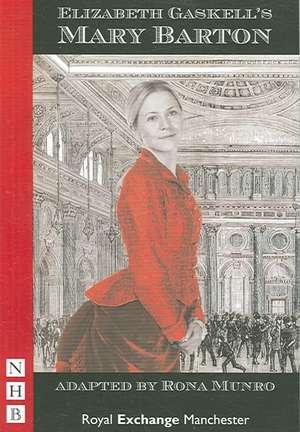
Mary Barton
Autor Elizabeth Gaskellen Limba Engleză Paperback – apr 2007
Set in Manchester between 1837 and 1842, Elizabeth Gaskell’s first novel paints a powerful and moving picture of working-class life in Victorian England. It concerns Mary Barton, a mill worker’s daughter eager to rise through the ranks, and her father, who shoots dead the mill owner’s son. This adaptation offers a stirring narrative with real insight into the lives of the Victorian working classes.
| Toate formatele și edițiile | Preț | Express |
|---|---|---|
| Paperback (11) | 24.60 lei 2 zile | |
| WordsWorth Editions – 8 aug 2012 | 24.60 lei 2 zile | |
| Penguin Books – 30 oct 1996 | 51.80 lei 25-31 zile | +32.47 lei 5-11 zile |
| Oxford University Press – 11 dec 2008 | 52.01 lei 19-30 zile | +26.10 lei 5-11 zile |
| Vintage Publishing – 6 mar 2008 | 52.76 lei 25-31 zile | +34.18 lei 5-11 zile |
| BROADVIEW PR – 21 mar 2000 | 135.06 lei 22-36 zile | |
| e-artnow – 2 iul 2022 | 70.80 lei 22-36 zile | |
| CreateSpace Independent Publishing Platform – | 87.68 lei 43-57 zile | |
| Digireads.com – 19 dec 2019 | 103.55 lei 43-57 zile | |
| – | 112.51 lei 22-36 zile | |
| Sharp Ink – 6 dec 2023 | 129.08 lei 38-44 zile | |
| Norilana Books – 7 apr 2008 | 165.07 lei 43-57 zile | |
| Hardback (1) | 237.32 lei 43-57 zile | |
| Marion Zimmer Bradley Literary Works Trust – apr 2008 | 237.32 lei 43-57 zile |
Preț: 68.02 lei
Puncte Express: 102
Preț estimativ în valută:
12.03€ • 14.19$ • 10.45£
12.03€ • 14.19$ • 10.45£
Carte indisponibilă temporar
Doresc să fiu notificat când acest titlu va fi disponibil:
Se trimite...
Specificații
ISBN-13: 9781854599513
ISBN-10: 1854599518
Pagini: 64
Dimensiuni: 133 x 199 x 7 mm
Greutate: 0.13 kg
Editura: Theatre Communications Group
Locul publicării:United Kingdom
ISBN-10: 1854599518
Pagini: 64
Dimensiuni: 133 x 199 x 7 mm
Greutate: 0.13 kg
Editura: Theatre Communications Group
Locul publicării:United Kingdom
V-ar putea interesa
-
 NORTH & SOUTH UK/EElizabeth GaskellPreț: 33.91 lei
 -
 Physics DemystifiedStan Gibilisco-26%Preț: 103.52 lei140.00 lei
 -
 North and SouthElizabeth Gaskell-16%Preț: 48.48 lei57.63 lei
 -
 Wives and DaughtersElizabeth Gaskell-17%Preț: 59.02 lei71.31 lei
 -
 The Condition of the Working Class in EnglandFriedrich Engels-20%Preț: 65.51 lei82.31 lei
 -
 North and SouthElizabeth GaskellPreț: 104.38 lei
 -
 The Making of the English Working ClassE. P. ThompsonPreț: 148.73 lei
 -
 Jane EyreCharlotte BrontëPreț: 42.31 lei
 -
 Elizabeth GaskellJenny UglowPreț: 121.28 lei
 -
 CranfordElizabeth Cleghorn GaskellPreț: 41.26 lei
 -
 The Moorland CottageElizabeth Cleghorn GaskellPreț: 40.29 lei
 -
 Wives and DaughtersElizabeth Cleghorn GaskellPreț: 88.76 lei
 -
 Mary BartonElizabeth Cleghorn GaskellPreț: 58.31 lei
 -
 CranfordElizabeth GaskellPreț: 41.64 lei
 -
 Das Ewige LichtKarl August Von HeigelPreț: 68.66 lei
 -
 HaschischOscar a. H. SchmitzPreț: 50.33 lei
 -
 MelusineOscar a. H. SchmitzPreț: 89.12 lei
 -
 Die Sohne Des SenatorsTheodor StormPreț: 37.13 lei
 -
 AbseitsTheodor StormPreț: 36.35 lei
 -
 Abseits (Grodruck)Theodor StormPreț: 37.32 lei
 -
 Preț: 129.22 lei
 -
 -26%Preț: 46.03 lei62.56 lei
 -
 Wives and DaughtersElizabeth GaskellPreț: 37.91 lei
 -
 The Ragged Trousered PhilanthropistsRobert TressellPreț: 24.60 lei
 -
 North and SouthElizabeth GaskellPreț: 50.88 lei
Descriere
New, large-scale dramatization of this famous, early Victorian novel for Manchester Royal Exchange.
Notă biografică
Elizabeth
Gaskell
(1810
-
65)
was
born
in
London,
but
grew
up
in
the
north
of
England.
In
1832
she
married
the
Rev.
William
Gaskell.
Published
in
Dickens'Household
Worksand
a
lifelong
friend
of
Charlotte
Bronte,
Gaskell's
finest
novel
isNorth
and
South,
also
published
by
Penguin.
Macdonald Daly is Lecturer in Modern Literature at Nottingham University. He has also edited DH Lawrence'sSons and LoversandKangaroofor Penguin Classics.
Macdonald Daly is Lecturer in Modern Literature at Nottingham University. He has also edited DH Lawrence'sSons and LoversandKangaroofor Penguin Classics.
Recenzii
Mary Barton first appeared in 1848, and has since become one of the best known novels on the ‘condition of England,’ part of a nineteenth-century British trend to understand the enormous cultural, economic and social changes wrought by industrialization. Gaskell’s work had great importance to the labour and reform movements, and it influenced writers such as Charles Dickens, Thomas Carlyle and Charlotte Brontë.
The plot of Mary Barton concerns the poverty and desperation of England’s industrial workers. Fundamentally, however, it revolves around Mary’s personal conflicts. She is already divided between an affection for an industrialist’s son, Henry Carson, and for a man of her own class, Jem Wilson. But Mary’s conflict escalates when her father, a committed trade unionist, is asked to assassinate Henry, who is the son of his unjust employer.
“Another splendid edition from Broadview with the usual high standard of helpful footnotes. Among the appendices in this volume are Gaskell’s letters about writing the novel; contemporary reviews; essays and reports from the 1840s on industrialization, Chartism, emigration, prostitution and conditions in Manchester; brief selections from related fiction and poetry; and a very intelligible short summary of dates and events that shape the novel’s politics.” — Sally Mitchell, Temple University
The plot of Mary Barton concerns the poverty and desperation of England’s industrial workers. Fundamentally, however, it revolves around Mary’s personal conflicts. She is already divided between an affection for an industrialist’s son, Henry Carson, and for a man of her own class, Jem Wilson. But Mary’s conflict escalates when her father, a committed trade unionist, is asked to assassinate Henry, who is the son of his unjust employer.
“Another splendid edition from Broadview with the usual high standard of helpful footnotes. Among the appendices in this volume are Gaskell’s letters about writing the novel; contemporary reviews; essays and reports from the 1840s on industrialization, Chartism, emigration, prostitution and conditions in Manchester; brief selections from related fiction and poetry; and a very intelligible short summary of dates and events that shape the novel’s politics.” — Sally Mitchell, Temple University
Cuprins
Acknowledgements
Introduction
Elizabeth Gaskell: A Brief Chronology
A Note on the Text
Mary Barton
Appendix A:
The Composition of the Novel
Contemporary Reviews of the Novel
Social Commentary on Industrialization
Related Fiction and Poetry
Chartism and Free Trade
Select Bibliography
Introduction
Elizabeth Gaskell: A Brief Chronology
A Note on the Text
Mary Barton
Appendix A:
The Composition of the Novel
- Excerpts from Gaskell’s Letters
- Parable of Dives and Lazarus
Contemporary Reviews of the Novel
- Athenaeum (21 October 1848)
- Examiner (4 November 1848)
- Christian Examiner (March 1849)
- Edinburgh Review (April 1849)
- Fraser’s Magazine (April 1849)
Social Commentary on Industrialization
- Thomas Carlyle, Chapter I, Chartism (1840)
- “Emigration—Report of the Poor-Law Commissioners on the Subject,” Chambers’ Edinburgh Journal (15 February 1840)
- Joseph Adshead, Distress in Manchester. Evidence (Tabular and Otherwise) of the State of the Labouring Classes in 1840-42 (1842)
- Leon Faucher, Manchester in 1844: Its PresentCondition and Future Prospects (1844)
- Ralph Barnes Grindrod, The Slaves of the Needle(1844)
- Friedrich Engels, The Condition of the Working Class in England (1845)
- Charles Kingsley, Appeal to the Chartists (12 April 1848)
- Caroline Norton, Letters to the Mob (1848)
- Morning Chronicle (Thursday, 1 November 1849)
- William Rathbone Greg, Employers and Employed (1853)
Related Fiction and Poetry
- Thomas Hood, “Song of the Shirt” (1843)
- Charlotte Brontë, Chapters 8 and 19, Shirley (1849)
- Charles Dickens, Chapter 4, Hard Times (1854)
- George Eliot, Chapter 31, Felix Holt (1866)
Chartism and Free Trade
Select Bibliography