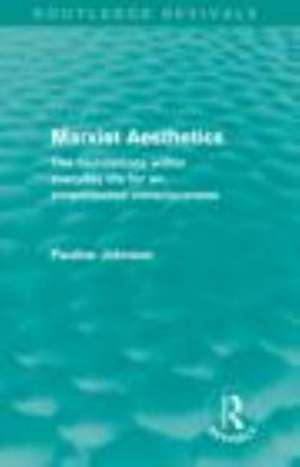
Marxist Aesthetics: The foundations within everyday life for an emancipated consciousness: Routledge Revivals
Autor Pauline Johnsonen Limba Engleză Hardback – 31 mar 2011
Din seria Routledge Revivals
-
 Preț: 333.46 lei
 - 14%
 Preț: 1006.04 lei
 - 11%
 Preț: 379.69 lei
 - 9%
 Preț: 983.67 lei
 - 9%
 Preț: 1328.90 lei
 -
 Preț: 323.55 lei
 - 14%
 Preț: 680.54 lei
 - 5%
 Preț: 308.82 lei
 - 9%
 Preț: 981.60 lei
 - 9%
 Preț: 1328.58 lei
 - 14%
 Preț: 1045.20 lei
 - 9%
 Preț: 1353.30 lei
 - 14%
 Preț: 952.58 lei
 - 14%
 Preț: 683.64 lei
 - 14%
 Preț: 717.93 lei
 -
 Preț: 334.61 lei
 -
 Preț: 322.28 lei
 - 14%
 Preț: 660.83 lei
 -
 Preț: 337.05 lei
 - 9%
 Preț: 1330.09 lei
 -
 Preț: 433.09 lei
 - 9%
 Preț: 1653.26 lei
 - 9%
 Preț: 1329.58 lei
 - 9%
 Preț: 6718.93 lei
 - 9%
 Preț: 1352.98 lei
 - 14%
 Preț: 685.76 lei
 - 9%
 Preț: 1351.57 lei
 - 14%
 Preț: 683.87 lei
 - 9%
 Preț: 1150.27 lei
 - 9%
 Preț: 820.78 lei
 -
 Preț: 316.43 lei
 - 9%
 Preț: 988.08 lei
 - 14%
 Preț: 851.74 lei
 - 9%
 Preț: 968.34 lei
 -
 Preț: 328.42 lei
 -
 Preț: 332.63 lei
 -
 Preț: 319.42 lei
 -
 Preț: 332.93 lei
 -
 Preț: 242.30 lei
 -
 Preț: 330.98 lei
 - 9%
 Preț: 1628.13 lei
 -
 Preț: 257.81 lei
 -
 Preț: 372.87 lei
 -
 Preț: 370.52 lei
 -
 Preț: 319.18 lei
 - 9%
 Preț: 810.04 lei
 - 9%
 Preț: 1149.18 lei
 - 9%
 Preț: 1329.13 lei
 - 9%
 Preț: 1328.58 lei
 - 9%
 Preț: 3516.85 lei
Preț: 1151.53 lei
Preț vechi: 1404.31 lei
-18%
Puncte Express: 1727
Carte tipărită la comandă
Livrare economică 07-21 decembrie
Livrare prin curier în România Termenul estimat este afișat lângă disponibilitate.
Transport gratuit pentru acest produs Plată online sau ramburs, în funcție de opțiunile comenzii.
Retur gratuit în 14 zile Comandă securizată și suport în română.
Specificații
ISBN-13: 9780415609081
ISBN-10: 0415609089
Pagini: 178
Dimensiuni: 138 x 216 x 11 mm
Greutate: 0.49 kg
Ediția:1
Editura: Taylor & Francis
Colecția Routledge
Seria Routledge Revivals
Locul publicării:Oxford, United Kingdom
ISBN-10: 0415609089
Pagini: 178
Dimensiuni: 138 x 216 x 11 mm
Greutate: 0.49 kg
Ediția:1
Editura: Taylor & Francis
Colecția Routledge
Seria Routledge Revivals
Locul publicării:Oxford, United Kingdom
V-ar putea interesa
-
 The State and RevolutionVladimir Il'Ich Lenin-25%Preț: 68.78 lei92.17 lei
 -
 Trouble in ParadiseSlavoj Zizek-31%Preț: 64.27 lei92.97 lei
 -
 Marx and EthicsPhilip J. Kain-27%Preț: 369.61 lei508.81 lei
 -
 -34%Preț: 838.31 lei1267.35 lei
 -
 Chinese Foreign Policy: Theory and PracticeThomas W. Robinson-31%Preț: 709.30 lei1028.94 lei
 -
 Karl Marx: Selected WritingsKarl Marx-57%Preț: 421.16 lei987.72 lei
 -
 Communism in India: Events, Processes and IdeologiesBidyut Chakrabarty-34%Preț: 649.51 lei978.40 lei
 -
 Preț: 124.73 lei
 -
 Marxism and Literary CriticismTerry EagletonPreț: 108.84 lei
 -
 The Essential MarxKarl MarxPreț: 84.22 lei
 -
 Marx's Capital IllustratedDavid SmithPreț: 86.00 lei
 -
 A Companion To Marx's Capital, Volume 2David HarveyPreț: 229.00 lei
 -
 State, Power, SocialismNicos PoulantzasPreț: 145.42 lei
 -
 Willing Slaves Of CapitalFrederic LordonPreț: 152.31 lei
 -
 Utopia or BustBenjamin KunkelPreț: 136.80 lei
 -
 -11%Preț: 78.45 lei88.53 lei
 -
 The Communist HypothesisAlain BadiouPreț: 168.96 lei
 -
 First Measures of the Coming InsurrectionEric Hazan-23%Preț: 94.22 lei121.97 lei
 -
 Fear of MirrorsTariq AliPreț: 170.61 lei
 -
 Late MarxismFredric JamesonPreț: 115.76 lei
 -
 The Prophet OutcastIsaac DeutscherPreț: 289.81 lei
 -
 -18%Preț: 152.54 lei185.65 lei
Cuprins
Part One Luckac: reification and its overcoming 1. History and class consciousness 2. Luckac's theory of realism 3 .Die Eigenart des Aesthetischen (the specificity of the Aesthetic) Part Two The role of modern capitalism 4. Benjamin 5. Brecht 6. Adorno 7. Marcuse Part Three Althusserian Marxism and the problem of ideological struggle 8. Althusser on ideology 9. Macherey and Eagleton Conclusion
Descriere
Originally published in 1984, this study deals with a number of influential figures in the European tradition of Marxist theories of aesthetics, ranging from Lukacs to Benjamin, through the Frankfurt School, to Brecht and the Althusserians. Pauline Johnson shows that, despite the great diversity in these theories about art, they all formulate a common problem, and she argues that an adequate response to this problem must be based on account of the practical foundations within the recipient's own experience for a changed consciousness.