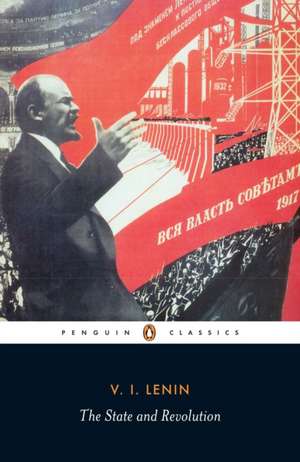
The State and Revolution
Autor Vladimir Il'Ich Lenin Editat de Robert Serviceen Limba Engleză Paperback – 4 mai 1993
Bazându-ne pe analiza ediției revizuite publicate de Penguin Books, observăm că The State and Revolution rămâne documentul teoretic fundamental pentru înțelegerea regimului sovietic. Scrisă într-un moment critic de clandestinitate, între iulie și octombrie 1917, lucrarea reprezintă justificarea ideologică a lui Vladimir Lenin pentru răsturnarea ordinii capitaliste. Remarcăm rigoarea cu care istoricul Robert Service contextualizează textul în introducere, explorând nu doar condițiile politice ale scrierii, ci și destinul ulterior al ideilor leniniste. Structura volumului urmărește o progresie logică de la definirea statului ca instrument de exploatare (Capitolul I), până la analiza eșecurilor și lecțiilor oferite de momente revoluționare anterioare, precum Comuna din Paris. Subliniem că, spre deosebire de Imperialism: The Highest Stage of Capitalism, unde autorul se concentrează pe dinamica economică a monopolurilor, aici accentul cade pe mecanismele de forță — armată, închisori și birocrație. Este o alternativă teoretică la Revolution Manifesto pentru cursurile de științe politice, cu avantajul de a oferi perspectiva directă a arhitectului revoluției, nu doar o analiză contemporană. Comparativ cu edițiile incluse în Essential Works of Lenin, acest volum individual permite o imersiune mai profundă în polemica autorului cu oponenții săi politici. Textul este marcat de un ton tranșant, reflectând urgența momentului istoric. Deși a rămas neterminată, lucrarea sintetizează trecerea de la teoria marxistă la practica politică ce avea să definească secolul XX, fiind esențială pentru studiul ideologiilor totalitare.
Preț: 68.40 lei
Preț vechi: 92.17 lei
-26%
Carte disponibilă
Livrare economică 12-18 noiembrie
Livrare express 24-30 octombrie pentru 40.98 lei
Specificații
ISBN-10: 014018435X
Pagini: 192
Ilustrații: glossary
Dimensiuni: 128 x 196 x 12 mm
Greutate: 0.15 kg
Ediția:Revised edition
Editura: Penguin Publishing Group
Locul publicării:London, United Kingdom
V-ar putea interesa
-
 The Subtle Art of Not Giving a F*ckMark MansonPreț: 135.88 lei
 -
 The Frock-Coated CommunistTristram Hunt-18%Preț: 88.76 lei108.47 lei
 -
 Imperialism: The Highest Stage of CapitalismVladimir LeninPreț: 55.88 lei
 -
 The Communist ManifestoFriedrich Engels-39%Preț: 17.49 lei28.48 lei
 -
 Trouble in ParadiseSlavoj Zizek-31%Preț: 64.27 lei92.97 lei
 -
 Chinese Foreign Policy: Theory and PracticeThomas W. Robinson-32%Preț: 686.17 lei1011.05 lei
 -
 The Diary of a Young GirlAnne Frank-26%Preț: 54.16 lei72.71 lei
 -
 -18%Preț: 82.79 lei101.22 lei
 -
 State, Power, SocialismNicos PoulantzasPreț: 145.42 lei
 -
 -11%Preț: 78.45 lei88.53 lei
 -
 First Measures of the Coming InsurrectionEric Hazan-23%Preț: 94.22 lei121.97 lei
 -
 Preț: 158.77 lei
 -
 Fear of MirrorsTariq AliPreț: 170.61 lei
 -
 Late MarxismFredric JamesonPreț: 115.76 lei
 -
 The Prophet OutcastIsaac DeutscherPreț: 289.81 lei
 -
 Mein KampfAdolf HitlerPreț: 349.34 lei
 -
 Preț: 174.95 lei
 -
 Preț: 216.05 lei
 -
 Preț: 206.68 lei
 -
 Preț: 198.98 lei
 -
 Mémoires de la Ctesse Potocka: 1794-1820 (Éd.1897)Anna PotockaPreț: 216.15 lei
 -
 Mémoires de la vie de Jacques-Auguste de Thou, ouvrage meslé de prose et de vers (Éd.1711)Jacques-Auguste De ThouPreț: 169.36 lei
 -
 Preț: 239.88 lei
 -
 Preț: 182.76 lei
 -
 -18%Preț: 152.54 lei185.65 lei
De ce să citești această carte
Recomandăm această ediție studenților la istorie și științe politice care doresc să înțeleagă fundamentele ideologice ale comunismului. Cititorul câștigă o perspectivă clară asupra modului în care Lenin a reinterpretat marxismul pentru a justifica violența revoluționară. Este un document istoric indispensabil, oferit într-o traducere critică semnată de Robert Service, care explică mecanismele puterii și conceptul de „dispariție a statului”.
Despre autor
Vladimir Lenin (1870–1924) a fost principalul lider al Revoluției Ruse și fondatorul statului sovietic. Teoretician marxist influent, opera sa este marcată de adaptarea ideilor lui Marx la realitățile politice ale Rusiei imperiale. Printre lucrările sale majore se numără What Is To Be Done?, unde propune crearea unui nucleu de revoluționari profesioniști, și Imperialism: The Highest Stage of Capitalism. Scrierile sale au format baza ideologică a leninismului, influențând decisiv mișcările politice globale din secolul XX. Această ediție beneficiază de expertiza lui Robert Service, unul dintre cei mai respectați biografi ai lui Lenin.
Notă biografică
Descriere scurtă
Translated and edited with an introduction by Robert Service
Cuprins
Introduction:
The Writing of the Book
The Contents
The Style
A Marxist Interpretation?
The Book and Political Theory
Political Conditions at the Time
The Book is Published
The Uses of the Book
The Book and Its Fate
THE STATE AND REVOLUTION
Preface to the First Edition
Preface to the Second Edition
Chapter I: Class Society and the State
1. The State as the Product of the Irreconcilability of Class Contradictions
2. Special Bodies of Armed Men, Prisons, Etc.
3. The State as an Instrument for the Exploitation of the Oppressed Class
4. The "Withering Away" of the State and Violent Revolution
Chapter II: The State and Revolution—The Experience of 1848-51
1. The Eve of the Revolution
2. The Revolution in Summary
3. The Presentation of the Question by Marx in 1852
Chapter III: The State and Revolution—The Experience of the Paris Commune of 1871—Marx's Analysis
1. What was Heroic about the Communards' Attempt?
2. With What is the Smashed State Machine to be Replaced?
3. The Eradication of Parliamentarianism
4. Organization of the Unity of the Nation
5. The Destruction of the Parasite State
Chapter IV: Continuation: Supplementary Clarifications by Engels
1. The Housing Question
2. The Polemic with the Anarchists
3. Letter to Bebel
4. Critique of the Draft of the Erfurt Programme
5. The 1891 Preface to Marx's The Civil War in France
6. Engels on the Overpowering of Democracy
Chapter V: The Economic Basis for the Withering Away of the State
1. The Presentation of the Question by Marx
2. The Transition from Capitalism to Communism
3. The First Phase of Communist Society
4. The Higher Phase of Communist Society
Chapter VI: The Vulgarization of Marxism by the Opportunists
1. Plekhanov's Polemic with the Anarchists
2. Kautsky's Polemic with the Opportunists
3. Kautsky's Polemic with Pannekoek
Chapter VII: The Experience of the Russian Revolutions of 1905 and 1917 #unfinished text#
Postscript to the First EditionGlossary