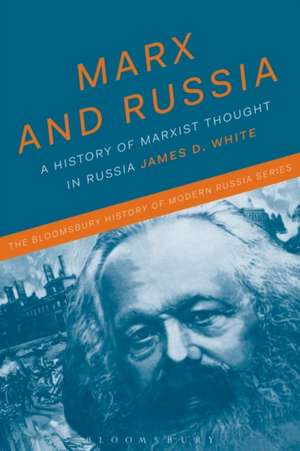
Marx and Russia: The Fate of a Doctrine: The Bloomsbury History of Modern Russia Series
Autor Honorary Professor James D. Whiteen Limba Engleză Paperback – 6 sep 2018
Starting from Marx's own connections with Russian revolutionaries and scholars, James D. White examines the contributions of such figures as Sieber, Plekhanov, Lenin, Bogdanov, Trotsky, Bukharin and Stalin to Marxist ideology in Russia. Using primary documents, biographical sketches and a helpful timeline, the book provides a useful guide for students to orientate themselves among the various Marxist ideologies which they encounter in modern Russian history. White also incorporates valuable new research for Russian history specialists in a vital volume for anyone interested in the history of Marxism, Soviet history and the history of Russia across the modern period.






Preț: 193.57 lei
Preț vechi: 241.38 lei
-20%
Puncte Express: 290
Carte tipărită la comandă
Livrare economică 16-30 noiembrie
Livrare prin curier în România Termenul estimat este afișat lângă disponibilitate.
Transport gratuit de la 400.00 lei Plată online sau ramburs, în funcție de opțiunile comenzii.
Retur gratuit în 14 zile Comandă securizată și suport în română.
Specificații
ISBN-13: 9781474224062
ISBN-10: 1474224067
Pagini: 240
Dimensiuni: 232 x 156 x 20 mm
Greutate: 0.36 kg
Editura: Bloomsbury Publishing
Colecția Bloomsbury Academic
Seria The Bloomsbury History of Modern Russia Series
Locul publicării:London, United Kingdom
ISBN-10: 1474224067
Pagini: 240
Dimensiuni: 232 x 156 x 20 mm
Greutate: 0.36 kg
Editura: Bloomsbury Publishing
Colecția Bloomsbury Academic
Seria The Bloomsbury History of Modern Russia Series
Locul publicării:London, United Kingdom
Cuprins
Preface
1. Marx and Russia
2. Marx's Russian 'Scientific Friends'
3. Engels
4. Plekhanov
5. Lenin
6. Bogdanov
7. Trotsky and Permanent Revolution
8. Theories of Imperialism
9. Marxism and Revolution
10. Towards the 'Short Course'
Conclusion
Bibliography
Index
1. Marx and Russia
2. Marx's Russian 'Scientific Friends'
3. Engels
4. Plekhanov
5. Lenin
6. Bogdanov
7. Trotsky and Permanent Revolution
8. Theories of Imperialism
9. Marxism and Revolution
10. Towards the 'Short Course'
Conclusion
Bibliography
Index
Recenzii
This fascinating study should be read by students and scholars of modern Russian history and those with an interest in Marx. Summing Up: Recommended. Lower-division undergraduates through faculty.
This is a lucid, well-informed, conceptually nuanced, and sensible study of a topic on which these qualities are often in short supply . This is a fine book, which will be interesting both to specialists and to students seeking a reliable guide to the ways in which Marx's work was understood and misunderstood in Russia.
By building on his years of research ... White has produced the best account to date of how Marxist ideas reached and developed in Russia ... Despite the large amount of material written on Lenin, Trotsky and, to a lesser extent, Plekhanov, White's straightforward analysis and lucid writing style keep his discussions of these towering individuals fresh and engaging.
An excellent survey of an important historical theme.
In this beautifully written and thoroughly researched tour de force, White presents the findings of a whole life's work on several connected themes: Marx's thought, Marx and Russia, Marx's reception in Russia, the Russian and European revolutionary movement, and the Russian Revolution. With characteristic clarity and wit, White demonstrates how inopportune deaths (Marx, Sieber), left the field open for a fundamental misconception of Marx's work to take hold in Russia via Engels, Plekhanov and Lenin.
White is a master of lucid presentation of complex ideas. His new book discusses Karl Marx's (and Friedrich Engels's) thinking on Russia and how the main Russian Marxists (Plekhanov, Lenin, Bogdanov, Trotsky and others) picked up his ideas while providing them with their own twist. The book is packed with new insights and original ideas. It convincingly shows the centrality of Russia in Marx's thought. The study of Russian conditions finally forced him to abandon the idea of capitalism as a universal system destined to absorb the world. The book continues with an elegant exposé of the main tenets of the Russian Marxists on workers and intelligentsia; permanent revolution; imperialism; state and democracy; and dialectical philosophy. No doubt, this is the best and most complete introduction to Marxism and Russia in existence.
James White's Marx and Russia is a major and indispensable contribution to the topic of whether the Soviet Union was "Marxist". In easy prose, the author provides the reader with the fate of a doctrine in one country that has worldwide implications to this day.
[A] brilliant exposition ... has much to offer those who have already mastered the original literature and are looking to expand their understanding
This is a lucid, well-informed, conceptually nuanced, and sensible study of a topic on which these qualities are often in short supply . This is a fine book, which will be interesting both to specialists and to students seeking a reliable guide to the ways in which Marx's work was understood and misunderstood in Russia.
By building on his years of research ... White has produced the best account to date of how Marxist ideas reached and developed in Russia ... Despite the large amount of material written on Lenin, Trotsky and, to a lesser extent, Plekhanov, White's straightforward analysis and lucid writing style keep his discussions of these towering individuals fresh and engaging.
An excellent survey of an important historical theme.
In this beautifully written and thoroughly researched tour de force, White presents the findings of a whole life's work on several connected themes: Marx's thought, Marx and Russia, Marx's reception in Russia, the Russian and European revolutionary movement, and the Russian Revolution. With characteristic clarity and wit, White demonstrates how inopportune deaths (Marx, Sieber), left the field open for a fundamental misconception of Marx's work to take hold in Russia via Engels, Plekhanov and Lenin.
White is a master of lucid presentation of complex ideas. His new book discusses Karl Marx's (and Friedrich Engels's) thinking on Russia and how the main Russian Marxists (Plekhanov, Lenin, Bogdanov, Trotsky and others) picked up his ideas while providing them with their own twist. The book is packed with new insights and original ideas. It convincingly shows the centrality of Russia in Marx's thought. The study of Russian conditions finally forced him to abandon the idea of capitalism as a universal system destined to absorb the world. The book continues with an elegant exposé of the main tenets of the Russian Marxists on workers and intelligentsia; permanent revolution; imperialism; state and democracy; and dialectical philosophy. No doubt, this is the best and most complete introduction to Marxism and Russia in existence.
James White's Marx and Russia is a major and indispensable contribution to the topic of whether the Soviet Union was "Marxist". In easy prose, the author provides the reader with the fate of a doctrine in one country that has worldwide implications to this day.
[A] brilliant exposition ... has much to offer those who have already mastered the original literature and are looking to expand their understanding