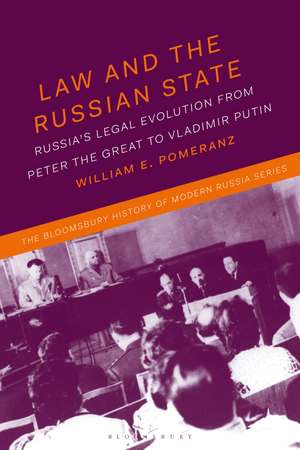
Law and the Russian State: Russia’s Legal Evolution from Peter the Great to Vladimir Putin: The Bloomsbury History of Modern Russia Series
Autor Dr William E. Pomeranzen Limba Engleză Paperback – 25 iun 2020
* Law and empire
* Law and modernization
* The politicization of law
* The role of intellectuals and dissidents in mobilizing the law
* The evolution of Russian legal institutions
* The struggle for human rights
* The rule-of-law
* The quest to establish the law-based state
It also analyzes legal culture and how Russians understand and use the law. With a detailed bibliography, this is an important text for anyone seeking a sophisticated understanding of how Russian society and the Russian state have developed in the last 350 years.








Preț: 231.05 lei
Preț vechi: 312.42 lei
-26%
Puncte Express: 347
Carte tipărită la comandă
Livrare economică 16-30 noiembrie
Livrare prin curier în România Termenul estimat este afișat lângă disponibilitate.
Transport gratuit de la 400.00 lei Plată online sau ramburs, în funcție de opțiunile comenzii.
Retur gratuit în 14 zile Comandă securizată și suport în română.
Specificații
ISBN-13: 9781350170537
ISBN-10: 1350170534
Pagini: 240
Dimensiuni: 154 x 232 x 16 mm
Greutate: 0.36 kg
Editura: Bloomsbury Publishing
Colecția Bloomsbury Academic
Seria The Bloomsbury History of Modern Russia Series
Locul publicării:London, United Kingdom
ISBN-10: 1350170534
Pagini: 240
Dimensiuni: 154 x 232 x 16 mm
Greutate: 0.36 kg
Editura: Bloomsbury Publishing
Colecția Bloomsbury Academic
Seria The Bloomsbury History of Modern Russia Series
Locul publicării:London, United Kingdom
Cuprins
Acknowledgements
Introduction
1. Law and Empire under Peter the Great
2. The Expansion of Russian Legality
3. The Judicial Reforms of 1864 and the Modernization of Russian Law
4. Law, Politics, and Revolution
5. Filling in the Blanks: The Creation of Socialist Law
6. Socialist Legality and Illegality
7. Russia's Long Constitutional Crisis: 1985-1993
8. The 1993 Constitution and Russia's Liberal Experiment
9. Vladimir Putin and the Restoration of State and Law
Conclusion
Bibliography
Introduction
1. Law and Empire under Peter the Great
2. The Expansion of Russian Legality
3. The Judicial Reforms of 1864 and the Modernization of Russian Law
4. Law, Politics, and Revolution
5. Filling in the Blanks: The Creation of Socialist Law
6. Socialist Legality and Illegality
7. Russia's Long Constitutional Crisis: 1985-1993
8. The 1993 Constitution and Russia's Liberal Experiment
9. Vladimir Putin and the Restoration of State and Law
Conclusion
Bibliography
Recenzii
This is what all Russia scholars need to know about Russian law . This is an outstanding piece of work. It is concise at 169 pages of text, with good international and Russian references and delightful quotes. It offers an even treatment of three centuries and an uncommonly nuanced analysis with a good eye for what is formal and what is real.
William Pomeranz, Deputy Director of the Kennan Institute, has written a masterful history of Russia through a legal lens . Readers whose primary interests lie well outside the field of Russian law will find important insights here into Russia's political, social, and economic development . Revealing with unusual clarity the conservative vs. modernizing strands of Russia's legal development, Law and the Russian State provides a superb introduction to the field of Russian law.
Pomeranz's book is a treat for anyone interested in learning about the fundamental changes and continuities of Russian law ... , Pomeranz's book is highly recommendable. It does what good legal history sometimes succeeds in doing: it helps us to understand the contemporary world.
It is no small feat to encapsulate major points of 350 years of legal history into 169 pages of text, and this is done fluently, with good balance among the salient subjects. . . This is a volume well worthy of adoption for advanced undergraduate courses on Russian affairs and an excellent addition to a promising series.
Pomeranz is at his best when covering the period since formation of the Russian Federation. Nonetheless, by harking back to Peter the Great's reign, he provides just enough historical context to demonstrate continuity and change within a country that has both followed and curiously departed from the West's legal trajectory. All of which makes Law and the Russian State a valuable addition to the literature. It is recommended for undergraduate and graduate students of history and law, and for experts in these fields.
A lively and engaging account of law and legal development in Russia, past and present. It is unique in its emphasis on how law throughout Russian history has served the state.
Most Westerners consider the Russian state lawless, but William Pomeranz shows the great importance Russians attribute to law. This is a scholarly and thoughtful guide to law, a little understood but crucial aspect of Russia's long history. It should become the standard work on its subject.
William Pomeranz, Deputy Director of the Kennan Institute, has written a masterful history of Russia through a legal lens . Readers whose primary interests lie well outside the field of Russian law will find important insights here into Russia's political, social, and economic development . Revealing with unusual clarity the conservative vs. modernizing strands of Russia's legal development, Law and the Russian State provides a superb introduction to the field of Russian law.
Pomeranz's book is a treat for anyone interested in learning about the fundamental changes and continuities of Russian law ... , Pomeranz's book is highly recommendable. It does what good legal history sometimes succeeds in doing: it helps us to understand the contemporary world.
It is no small feat to encapsulate major points of 350 years of legal history into 169 pages of text, and this is done fluently, with good balance among the salient subjects. . . This is a volume well worthy of adoption for advanced undergraduate courses on Russian affairs and an excellent addition to a promising series.
Pomeranz is at his best when covering the period since formation of the Russian Federation. Nonetheless, by harking back to Peter the Great's reign, he provides just enough historical context to demonstrate continuity and change within a country that has both followed and curiously departed from the West's legal trajectory. All of which makes Law and the Russian State a valuable addition to the literature. It is recommended for undergraduate and graduate students of history and law, and for experts in these fields.
A lively and engaging account of law and legal development in Russia, past and present. It is unique in its emphasis on how law throughout Russian history has served the state.
Most Westerners consider the Russian state lawless, but William Pomeranz shows the great importance Russians attribute to law. This is a scholarly and thoughtful guide to law, a little understood but crucial aspect of Russia's long history. It should become the standard work on its subject.