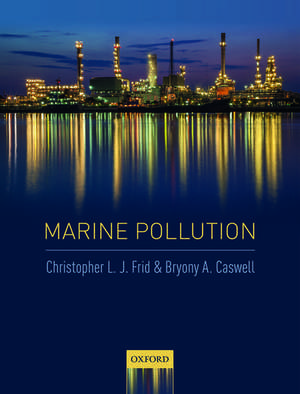
Marine Pollution
Autor Christopher L. J. Frid, Bryony A. Caswellen Limba Engleză Paperback – 31 aug 2017
Preț: 411.28 lei
Preț vechi: 527.62 lei
-22%
Puncte Express: 617
Carte disponibilă
Livrare economică 30 octombrie-04 noiembrie
Livrare prin curier în România Termenul estimat este afișat lângă disponibilitate.
Transport gratuit pentru acest produs Plată online sau ramburs, în funcție de opțiunile comenzii.
Retur gratuit în 14 zile Comandă securizată și suport în română.
Specificații
ISBN-13: 9780198726296
ISBN-10: 0198726295
Pagini: 288
Ilustrații: 116 illustrations
Dimensiuni: 197 x 248 x 15 mm
Greutate: 0.65 kg
Editura: OUP OXFORD
Colecția OUP Oxford
Locul publicării:Oxford, United Kingdom
ISBN-10: 0198726295
Pagini: 288
Ilustrații: 116 illustrations
Dimensiuni: 197 x 248 x 15 mm
Greutate: 0.65 kg
Editura: OUP OXFORD
Colecția OUP Oxford
Locul publicării:Oxford, United Kingdom
V-ar putea interesa
-
 Marine Biology: A Very Short IntroductionPhilip V. Mladenov-19%Preț: 58.42 lei71.88 lei
 -
 Marine Pollution: What Everyone Needs to Know®Judith S. Weis-19%Preț: 63.88 lei79.01 lei
 -
 WreckersSimon ParkPreț: 188.88 lei
 -
 Ocean of LifeCallum Roberts-37%Preț: 98.67 lei156.81 lei
 -
 Environmental Problems in Marine Biology: Methodological Aspects and ApplicationsTamara Garcia BarreraPreț: 500.94 lei
 -
 PooBen Hoare-15%Preț: 106.07 lei125.50 lei
 -
 -36%Preț: 52.68 lei82.03 lei
 -
 The Oceans Explored: Ocean LifeClaudia Martin-38%Preț: 43.85 lei70.57 lei
 -
 Advances in Environmental Research: Volume 18Justin A Daniels-26%Preț: 730.58 lei992.26 lei
 -
 The Problem with PlasticJudith EnckPreț: 153.83 lei
 -
 Marine Pollution: Types, Environmental Significance & Management StrategiesDominic E Jefferson-27%Preț: 1520.03 lei2073.75 lei
 -
 Plastic Soup: An Atlas of Ocean PollutionMichiel Roscam AbbingPreț: 158.23 lei
 -
 Marine Pollution - Monitoring, Management and MitigationAmanda Reichelt-BrushettPreț: 388.40 lei
 -
 -18%Preț: 924.22 lei1127.09 lei
 -
 Pollutants and Recent Trends in Wastewater TreatmentAli Müfit Bahadir-18%Preț: 906.84 lei1105.89 lei
 -
 Marine Bioprospecting for Sustainable Blue-bioeconomySesan Abiodun Aransiola-18%Preț: 1125.74 lei1372.86 lei
 -
 -14%Preț: 1916.44 lei2228.41 lei
 -
 Life on a Little-Known PlanetElizabeth KolbertPreț: 192.22 lei
 -
 They Poisoned the WorldMariah BlakePreț: 136.89 lei
Recenzii
This book would be a good asset to any marine pollution course, as well as a good reference for students, researchers, professionals, or even nonspecialists with a keen interest to learn more about pollution in the sea.
Notă biografică
Professor Chris Frid is internationally renowned for his knowledge of marine ecosystem dynamics and the application of ecosystem approaches to marine management. A benthic ecologist by background Chris has been involved in marine pollution science and management since the 1980s working with industry, government agencies and international bodies to apply robust science to the challenges of managing human impacts on marine ecosystems. Chris is currently the Head of the Griffith School of Environment, one of the largest centres of multi-disciplinary environmental research and teaching in the World. Previously he was professor of marine biology at the University of Liverpool (UK) and prior to that at the University of Newcastle upon Tyne where he was also the Director of the Dove Marine Laboratory.Dr Bryony Caswell is a research fellow at Griffith University, Australia, previously a lecturer in marine biology for five years at the University of Liverpool, UK and a researcher on aquatic ecotoxicology with a focus on agrochemicals and highway runoff at the universities of Reading and London. Bryony is an interdisciplinary marine scientist who conducts research into the impacts of environmental change on contemporary and ancient marine ecosystems. She is a leading authority on the long-term impacts of hypoxia on marine benthic ecosystems. Her research into marine ecological change bridges historical and geological timescales (100s-1000s years) and is driving forward our knowledge of the long-term impacts of climate change.