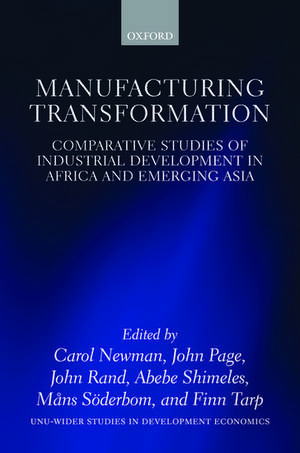
Manufacturing Transformation: Comparative Studies of Industrial Development in Africa and Emerging Asia: WIDER Studies in Development Economics
Editat de Carol Newman, John Page, John Rand, Abebe Shimeles, Måns Söderbom, Finn Tarpen Limba Engleză Hardback – 28 iul 2016
Din seria WIDER Studies in Development Economics
- 32%
 Preț: 653.96 lei
 - 32%
 Preț: 545.13 lei
 - 32%
 Preț: 714.62 lei
 - 33%
 Preț: 545.09 lei
 - 33%
 Preț: 576.12 lei
 - 32%
 Preț: 615.87 lei
 - 32%
 Preț: 824.47 lei
 - 32%
 Preț: 581.66 lei
 - 33%
 Preț: 538.29 lei
 - 33%
 Preț: 642.98 lei
 - 14%
 Preț: 875.04 lei
 - 16%
 Preț: 182.83 lei
 - 19%
 Preț: 682.02 lei
 - 33%
 Preț: 871.22 lei
 - 30%
 Preț: 521.71 lei
 - 21%
 Preț: 399.94 lei
 - 33%
 Preț: 1011.35 lei
 - 33%
 Preț: 1010.47 lei
 - 33%
 Preț: 962.98 lei
 - 33%
 Preț: 1124.84 lei
 - 33%
 Preț: 1059.37 lei
 - 22%
 Preț: 214.91 lei
 - 31%
 Preț: 729.89 lei
 - 21%
 Preț: 400.12 lei
 - 28%
 Preț: 454.43 lei
 - 33%
 Preț: 1248.59 lei
 - 33%
 Preț: 1253.02 lei
 - 28%
 Preț: 395.18 lei
 - 33%
 Preț: 1537.97 lei
 - 22%
 Preț: 1454.48 lei
 - 33%
 Preț: 1044.64 lei
 - 24%
 Preț: 580.26 lei
 - 33%
 Preț: 1248.79 lei
 - 33%
 Preț: 1058.40 lei
 - 28%
 Preț: 531.51 lei
 - 25%
 Preț: 606.73 lei
 - 33%
 Preț: 1081.18 lei
 - 33%
 Preț: 1188.06 lei
 - 30%
 Preț: 480.16 lei
 - 18%
 Preț: 490.29 lei
 - 33%
 Preț: 1409.72 lei
 - 33%
 Preț: 977.70 lei
 - 31%
 Preț: 1204.48 lei
 - 20%
 Preț: 366.44 lei
 - 30%
 Preț: 535.16 lei
Preț: 711.17 lei
Preț vechi: 1031.27 lei
-31%
Puncte Express: 1067
Carte tipărită la comandă
Livrare economică 19-25 noiembrie
Livrare prin curier în România Termenul estimat este afișat lângă disponibilitate.
Transport gratuit pentru acest produs Plată online sau ramburs, în funcție de opțiunile comenzii.
Retur gratuit în 14 zile Comandă securizată și suport în română.
Specificații
ISBN-13: 9780198776987
ISBN-10: 0198776985
Pagini: 324
Ilustrații: 20 Figures and 60 Tables
Dimensiuni: 163 x 234 x 23 mm
Greutate: 0.61 kg
Editura: OUP OXFORD
Colecția OUP Oxford
Seria WIDER Studies in Development Economics
Locul publicării:Oxford, United Kingdom
ISBN-10: 0198776985
Pagini: 324
Ilustrații: 20 Figures and 60 Tables
Dimensiuni: 163 x 234 x 23 mm
Greutate: 0.61 kg
Editura: OUP OXFORD
Colecția OUP Oxford
Seria WIDER Studies in Development Economics
Locul publicării:Oxford, United Kingdom
V-ar putea interesa
-
 -18%Preț: 380.57 lei461.75 lei
 -
 -53%Preț: 305.29 lei648.01 lei
 -
 -32%Preț: 719.98 lei1059.76 lei
 -
 Commodity Prices and DevelopmentRoman Grynberg-31%Preț: 775.86 lei1128.96 lei
 -
 Development Economics: From the Poverty to the Wealth of NationsThe late Yujiro Hayami-28%Preț: 527.69 lei735.45 lei
 -
 -15%Preț: 519.15 lei610.77 lei
 -
 Taxation in a Low-Income Economy: The case of MozambiqueChanning ArndtPreț: 356.85 lei
 -
 Made in Africa: Learning to Compete in IndustryCarol Newman-24%Preț: 221.84 lei293.74 lei
 -
 Two Roads DivergeChristopher HartwellPreț: 336.85 lei
 -
 Japan's Development AssistanceYasutami Shimomura-18%Preț: 1043.36 lei1272.38 lei
 -
 -18%Preț: 1252.37 lei1527.28 lei
 -
 Building to Last: The challenge for business leadersColin HutchinsonPreț: 311.10 lei
 -
 Preț: 465.26 lei
 -
 Preț: 470.92 lei
 -
 -14%Preț: 259.00 lei301.12 lei
 -
 -18%Preț: 663.97 lei809.72 lei
 -
 The Road to Anywhere But HereCarol NewmanPreț: 72.44 lei
 -
 Preț: 225.72 lei
Notă biografică
Carol Newman is Associate Professor at the Department of Economics, Trinity College Dublin and a non-resident Senior Research Fellow at UNU-WIDER. Her research is the microeconomics of development with a focus on both household and enterprise behaviour. She has published widely in the fields of development economics and agricultural economics, in particular in the area of enterprise dynamics and performance in developing countries.John Page is a Senior Fellow in the Global Economy and Development Program at the Brookings Institution and a Non-resident Senior Fellow of the World Institute for Development Economics Research (UNU-WIDER). He is also visiting professor at the National Graduate Institute for Policy Studies, Tokyo, Japan and a Research Associate of the Centre for the Study of African Economies at Oxford University. From 1980 to 2008 he was at the World Bank where his senior positions included: Director, Poverty Reduction, Director, Economic Policy, and Chief Economist, Africa. He is the author of several books and more than 100 published papers on economic development.John Rand is a professor of development economics at the University of Copenhagen. His research focus includes industrial policy and firm dynamics, quantitative impact evaluation of development projects, and macroeconomics of international capital flows. He has significant research experience through project involvement in Bangladesh, Cambodia, Egypt, Ethiopia, Ghana, Kenya, Mozambique Nicaragua, Rwanda, Senegal, Tanzania, Tunisia, Uganda, and Vietnam. He is co-editor of the European Journal of Development Research, member of the Steering Committee of the Joint MFS II Evaluations Programme in Holland, and since 2015, Deputy Director of the Development Economics Research Group (DERG), Department of Economics, University of Copenhagen.Abebe Shimeles received his postgraduate degrees in economics from Gothenburg University and the Delhi School of economics and a BA from Addis Ababa University. He is Acting Director, Development Research Department at the African Development Bank. He is also Research Fellow at IZA, and Adjunct Associate Professor at University of Cape Town. He has worked for the World Bank, UNECA, ActionAid, and Addis Ababa University in different capacities. His current research focuses on labour markets, impact evaluation of tax policies, community-based health insurance, and on inequality, market distortions and domestic violence.Måns Söderbom is Professor of Economics in the Department of Economics at the University of Gothenburg. He is also a Research Associate at the Centre for the Study of African Economies (CSAE), Department of Economics, University of Oxford, a Fellow of the European Development Research Network, and a non-resident Senior Research Fellow at UNU-WIDER. His research has been published by leading international journals and he has also contributed to several books on economic development. Industrial development is his main area of interest, but he has also worked on civil conflict, labour markets, and schooling.Finn Tarp has some 37 years of experience in academic and applied development economics research and teaching. His field experience covers more than 20 years of in-country work in 35 countries across Africa and the developing world more generally. Professor Tarp is a leading international expert on issues of development strategy and foreign aid, with an interest in poverty, income distribution and growth, micro- and macroeconomic policy and modeling, agricultural sector policy and planning, household and enterprise development, and economic adjustment and reform. He has published almost 90 articles in international academic journals alongside various books. He is a member of the World Bank Chief Economist's 15 member 'Council of Eminent Persons'.