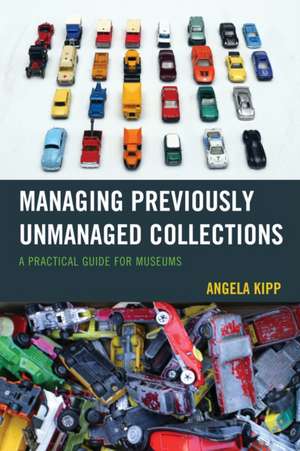
Managing Previously Unmanaged Collections
Autor Angela Kippen Limba Engleză Hardback – iul 2016
| Toate formatele și edițiile | Preț | Express |
|---|---|---|
| Paperback (2) | 211.19 lei 6-8 săpt. | |
| Bloomsbury Publishing – 19 dec 2024 | 211.19 lei 6-8 săpt. | |
| Rowman & Littlefield – iul 2016 | 306.35 lei 3-5 săpt. | +71.78 lei 4-10 zile |
| Hardback (2) | 468.49 lei 6-8 săpt. | |
| Bloomsbury Publishing – 19 dec 2024 | 468.49 lei 6-8 săpt. | |
| Rowman & Littlefield – iul 2016 | 576.63 lei 6-8 săpt. |
Preț: 576.63 lei
Preț vechi: 711.90 lei
-19%
Puncte Express: 865
Preț estimativ în valută:
101.97€ • 120.91$ • 88.78£
101.97€ • 120.91$ • 88.78£
Carte tipărită la comandă
Livrare economică 30 martie-13 aprilie
Specificații
ISBN-13: 9781442263475
ISBN-10: 1442263474
Pagini: 150
Dimensiuni: 152 x 229 x 20 mm
Greutate: 0.48 kg
Editura: Rowman & Littlefield
ISBN-10: 1442263474
Pagini: 150
Dimensiuni: 152 x 229 x 20 mm
Greutate: 0.48 kg
Editura: Rowman & Littlefield
V-ar putea interesa
-
 Museum ManagementKevin MoorePreț: 252.36 lei
 -
 Museums and Digital Maturity: Consideration, Capability, and ChangeLauren M. Vargas-8%Preț: 429.91 lei467.30 lei
 -
 Collecting Social Media in MuseumsCraig MiddletonPreț: 318.65 lei
 -
 The Leader's Guide to CollaborationGuy LubitshPreț: 135.64 lei
 -
 The Work Smarter Guide for New Managers: Achieve Management MasteryMaria Morozova-Duthoit-30%Preț: 70.83 lei100.55 lei
 -
 -23%Preț: 150.42 lei195.08 leiRecomandat
 -
 Organizing Archival Records: A Guide for Both Physical and Digital CollectionsDavid W. Carmicheal-23%Preț: 200.82 lei259.64 lei
 -
 Practical Project Management for LibrariansKirsten Clark-18%Preț: 156.58 lei191.43 lei
 -
 Digital Asset Management for MuseumsMargaret C. McKee-27%Preț: 421.61 lei580.34 lei
 -
 Preț: 340.57 lei
 -
 The Special Collections HandbookAlison Cullingford-19%Preț: 519.24 lei641.03 lei
 -
 Fundamentals of Collection Development and ManagementPeggy Johnson-19%Preț: 560.98 lei692.57 lei
 -
 Reframing the Ethnographic Museum: Histories, Politics and FuturesMichael RowlandsPreț: 233.17 lei
 -
 Towards the Ethical Art MuseumGareth HarrisPreț: 155.94 lei
 -
 Looking After Your BooksFrancesca GalliganPreț: 125.54 lei
 -
 Museum Collections Management: A HandbookFreda Matassa-19%Preț: 596.45 lei736.35 lei
 -
 A New Museum and the Impermanent CanonJoanna Mytkowska-19%Preț: 436.52 lei538.91 lei
 -
 Collection Management BasicsG. Edward Evans-18%Preț: 374.45 lei454.30 lei
 -
 Foundations of Museum StudiesKiersten F Latham-18%Preț: 322.75 lei395.95 lei
Notă biografică
Angela Kipp is the Collections Manager of the TECHNOSEUM in Mannheim, Germany and an independent museum consultant with a special focus on science, technology, farming and history collections. She holds the German Museum Studies degree of Diplom-Museologin (FH) and has worked in the museum field since 1998. She worked for various institutions including large museums like the Museum für Kommunikation (museum for communication) in Berlin and the Deutsches Museum in Munich, as well as for many smaller museums and cultural projects. She specializes in logistics, project management and the adaption of technology for the special needs of museums.
She is especially interested in finding affordable ways to improve collections care in smaller institutions. One way she does that is through her blog project Registrar Trek, aimed at raising awareness for collections care in general and fostering exchange between collections specialists around the world. Another way is this book in which she gathered her own experiences and those of several colleagues to develop a framework for people confronted with a previously unmanaged, only partly managed or just neglected collection.
Descriere
Descriere de la o altă ediție sau format:
This book is a practical guide for everyone who is confronted with a collection that hasn't seen any preventive conservation or cataloging before. It helps gaining an overview, defining priorities, and organizing the work in a way it is safe for the objects and the people involved. It defines "logical exits", goals to work towards where the collection is in a state the next steps can wait without risking the progress made. Later on, readers learn to define their own "logical exits" that fit their specific situation.
Compared to other books about collections management it doesn't focus on the details of collections care, but rather on the big picture of managing such a project. It assumes that at the beginning there is nothing but the reader and an unmanaged collection, so that part of the project is to source money, material, and people to help.
The second edition has a new chapter on setting up collections management systems, the original text was reworked and in parts enhanced, there are additional success stories in the last chapter with references to them in the text, and the bibliography now contains some resources for natural history, indigenous, and archaeological collections.
This book is a practical guide for everyone who is confronted with a collection that hasn't seen any preventive conservation or cataloging before. It helps gaining an overview, defining priorities, and organizing the work in a way it is safe for the objects and the people involved. It defines "logical exits", goals to work towards where the collection is in a state the next steps can wait without risking the progress made. Later on, readers learn to define their own "logical exits" that fit their specific situation.
Compared to other books about collections management it doesn't focus on the details of collections care, but rather on the big picture of managing such a project. It assumes that at the beginning there is nothing but the reader and an unmanaged collection, so that part of the project is to source money, material, and people to help.
The second edition has a new chapter on setting up collections management systems, the original text was reworked and in parts enhanced, there are additional success stories in the last chapter with references to them in the text, and the bibliography now contains some resources for natural history, indigenous, and archaeological collections.