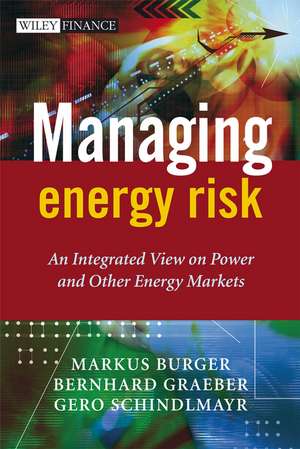
Managing Energy Risk
Autor Markus Burger, Bernhard Graeber, Gero Schindlmayren Limba Engleză Hardback – 2008
Problema centrală în managementul energetic actual nu este doar volatilitatea prețurilor, ci interdependența complexă dintre combustibilii fosili, noile surse regenerabile și reglementările privind emisiile de carbon. În volumul Managing Energy Risk, autorii Markus Burger, Bernhard Graeber și Gero Schindlmayr oferă o soluție riguroasă pentru profesioniștii care trebuie să navigheze într-un peisaj transformat radical de evenimente precum accidentul de la Fukushima sau boom-ul gazelor de șist. Subliniem faptul că această a doua ediție aduce un plus de 30% de conținut nou, adaptat piețelor moderne de utilități. Structura cărții este concepută pentru a asigura o progresie logică de la fundamente la aplicații complexe. Primele capitole stabilesc baza tranzacționării pe piețele de spot, forward și opțiuni, explorând specificul fiecărei resurse: petrol, gaze, cărbune și electricitate. Reținem introducerea capitolului dedicat energiei regenerabile, care analizează nu doar tehnologia, ci și impactul subvențiilor asupra mecanismelor de piață. Complementar lucrării Handbook of Risk Management in Energy Production and Trading, care se concentrează masiv pe riscurile tehnice și operaționale de producție, volumul de față acoperă zona evaluării financiare și a modelelor de optimizare pentru portofolii multi-commodity. De asemenea, spre deosebire de Energy Price Risk, care pune accent pe strategii de hedging bazate pe derivate, Managing Energy Risk oferă o perspectivă integrată între economia energiei și ingineria financiară. Credem că valoarea acestui text rezidă în capacitatea de a explica interacțiunile dintre mărfuri. Cititorul va învăța cum să aplice modele de evaluare pentru stocarea gazelor și cum să gestioneze contractele de tip swing, elemente esențiale pentru stabilitatea financiară a unei companii de utilități în contextul actual al Uniunii Europene.
Preț: 954.86 lei
Preț vechi: 1049.29 lei
-9%
Carte tipărită la comandă
Livrare economică 28 decembrie 26 - 11 ianuarie 27
Specificații
ISBN-10: 0470029625
Pagini: 320
Dimensiuni: 175 x 250 x 22 mm
Greutate: 0.74 kg
Editura: Wiley
Locul publicării:Chichester, United Kingdom
V-ar putea interesa
-
 Preț: 192.25 lei
-
 Financial Times Guide to Using the Financial Pages, TheRomesh Vaitilingam-20%Preț: 226.76 lei283.45 lei
-
 Mastering Derivatives MarketsFrancesca Taylor-15%Preț: 467.61 lei550.13 lei
-
 Intermediate Financial TheoryJean-Pierre Danthine-33%Preț: 444.06 lei666.40 lei
-
 Commodity DerivativesNeil C. Schofield-19%Preț: 530.40 lei654.82 lei
-
 Modeling and Valuation of Energy StructuresDaniel Mahoney-11%Preț: 738.75 lei830.06 lei
-
 Investing in Commodities For Dummies, 2nd EditionAmine BouchentoufPreț: 107.48 lei
-
 Advanced Analytical Methods for Climate Risk and ESG Risk ManagementJorge R. US Los Alamos National Laboratory Moody's Investors Service CASA) Sobehart-19%Preț: 552.00 lei681.48 lei
-
 Preț: 225.41 lei
-
 The New Nature of BusinessAndre HoffmannPreț: 116.19 lei
-
 -18%Preț: 100.09 lei121.92 lei
-
 -18%Preț: 99.79 lei121.73 lei
-
 Going NuclearTim GregoryPreț: 124.00 lei
-
 Virtual BarrelsIlia Bouchouev-17%Preț: 415.01 lei500.01 lei
-
 International Oil Markets in the Age of Climate ChangeAdi ImsirovicPreț: 397.17 lei
-
 -36%Preț: 1219.12 lei1892.89 lei
-
 -24%Preț: 804.35 lei1058.35 lei
Public țintă
Utility companies Energy trading departments of investment banks – Energy Traders & Analysts (Dresdner, Goldmans, Deutsche, Comnmerzbank, UBS etc all have energy desks)Academic research institutions for finance or energy economics
De ce să citești această carte
Această carte este esențială pentru managerii de risc și analiștii din sectorul utilităților care au nevoie de un cadru de lucru actualizat pentru piețele de gaze și electricitate. Veți câștiga o înțelegere profundă a modului în care certificatele de emisii și energia regenerabilă influențează prețurile tradiționale, primind instrumente matematice concrete pentru a evalua riscul într-un portofoliu energetic diversificat.
Notă biografică
Gero Schindlmayr is Head of Market Risk and Valuation Models at EnBW Trading GmbH. before joining EnBW he worked as a quantitative analyst for equity derivatives at Deutsche Bank A.G. He holds a PhD in mathematics and a Master's degree in operations research from the RWTH Aachen, Germany and an M.Sc degree in mathematics from Warwick University, UK. He is co-author of a book titled Equity Derivatives: Theory and Applications and of several papers in the area of energy derivatives and energy risk. His main field of work includes stochastic pricing models for electricity and gas, commodity forward curve modeling, value-at-risk models and multi-commodity risk.
Cuprins
1 Energy Markets.
1.1 The oil market.
1.1.1 Consumption, production and reserves.
1.1.2 Crude oil trading.
1.1.3 Refined oil products.
1.2 The natural gas market.
1.2.1 Consumption, production and reserves.
1.2.2 Natural gas trading.
1.2.3 Price formulas with oil indexation.
1.2.4 Liquefied natural gas.
1.3 The coal market.
1.3.1 Consumption, production and reserves.
1.3.2 Coal trading.
1.3.3 Freight.
1.3.4 Coal subsidies in Germany: BAFA-indexed prices.
1.4 The electricity market.
1.4.1 Consumption and production.
1.4.2 Electricity trading.
1.4.3 Products in the electricity markets.
1.4.4 Energy exchanges.
1.5 The emissions market.
1.5.1 Kyoto Protocol.
1.5.2 EU emissions trading scheme.
1.5.3 Flexible mechanisms.
1.5.4 Products and market places.
1.5.5 Emissions trading in North America.
2 Energy Derivatives.
2.1 Forwards, futures and swaps.
2.1.1 Forward contracts.
2.1.2 Futures contracts.
2.1.3 Swaps.
2.2 "Plain vanilla" options.
2.2.1 The put-call parity and option strategies.
2.2.2 Black's futures price model.
2.2.3 Option pricing formulas.
2.2.4 Hedging options: the "Greeks".
2.2.5 Implied volatilities and the "volatility smile".
2.2.6 Swaptions.
2.3 American and Asian options.
2.3.1 American options.
2.3.2 Asian options.
2.4 Commodity bonds and loans.
2.5 Multi-underlying options.
2.5.1 Basket options.
2.5.2 Spread options.
2.5.3 Quanto and composite options.
2.6 Spot price options.
2.6.1 Pricing spot price options.
2.6.2 Caps and floors.
2.6.3 Swing options.
2.6.4 Virtual storage.
3 Commodity Price Models.
3.1 Forward curves and the market price of risk.
3.1.1 Investment assets.
3.1.2 Consumption assets and convenience yield.
3.1.3 Contango, backwardation and seasonality.
3.1.4 The market price of risk.
3.1.5 Derivatives pricing and the risk-neutral measure.
3.2 Commodity spot price models.
3.2.1 Geometric Brownian motion.
3.2.2 The one-factor Schwartz model.
3.2.3 The Schwartz-Smith model.
3.3 Stochastic forward curve models.
3.3.1 One-factor forward curve models.
3.3.2 A two-factor forward curve model.
3.3.3 A multi-factor exponential model.
3.4 Electricity price models.
3.4.1 The hourly forward curve.
3.4.2 The SMaPS model.
3.4.3 Regime-switching model.
3.5 Multi-commodity models.
3.5.1 Regression analysis.
3.5.2 Correlation analysis.
3.5.3 Cointegration.
3.5.4 Model building.
4 Fundamental Market Models.
4.1 Fundamental price drivers in electricity markets.
4.1.1 Demand side.
4.1.2 Supply side.
4.1.3 Interconnections.
4.2 Economic power plant dispatch.
4.2.1 Thermal power plants.
4.2.2 Hydro power plants.
4.2.3 Optimisation methods.
4.3 Methodological approaches.
4.3.1 Merit order curve.
4.3.2 Optimisation models.
4.3.3 System dynamics.
4.3.4 Game theory.
4.4 Relevant system information for electricity market modelling.
4.4.1 Demand side.
4.4.2 Supply side.
4.4.3 Transmission system.
4.4.4 Historical data for backtesting.
4.4.5 Information sources.
4.5 Application of electricity market models.
4.6 Gas market models.
4.6.1 Demand side.
4.6.2 Supply side.
4.6.3 Transport.
4.6.4 Storage.
4.6.5 Portfolio optimisation.
4.6.6 Formulation of the market model.
4.6.7 Application of gas market models.
4.7 Market models for oil, coal, and CO2 markets.
5 Electricity Retail Products.
5.1 Interaction of wholesale and retail markets.
5.2 Retail products.
5.2.1 Common full service contracts.
5.2.2 Indexed contracts.
5.2.3 Partial delivery contracts.
5.2.4 Portfolio management.
5.2.5 Supplementary products.
5.3 Sourcing.
5.3.1 Business-to-business (B2B).
5.3.2 Business-to-consumer (B2C).
5.3.3 Small accounts.
5.3.4 Municipalities and reseller.
5.4 Load forecasting.
5.5 Risk premium.
5.5.1 Price validity period.
5.5.2 Balancing power.
5.5.3 Credit risk.
5.5.4 Price-volume correlation.
5.5.5 Strict risk premiums.
5.5.6 Hourly price profile risk.
5.5.7 Volume risk.
5.5.8 Operational risk.
5.5.9 Risk premium summary.
6 Risk Management.
6.1 Market price exposure.
6.1.1 Delta position.
6.1.2 Variance minimising hedging.
6.2 Value-at-Risk and further risk measures.
6.2.1 Definition of Value-at-Risk.
6.2.2 Parameters of the Value-at-Risk measure.
6.2.3 Computation methods.
6.2.4 Liquidity-adjusted Value-at-Risk.
6.2.5 Estimating volatilities and correlations.
6.2.6 Backtesting.
6.2.7 Further risk measures.
6.3 Credit risk.
6.3.1 Legal risk.
6.3.2 Quantifying credit risk.
6.3.3 Credit rating.
Appendices.
A Mathematical background.
A.1 Econometric methods.
A.1.1 Linear regression.
A.1.2 Stationary time series and unit root tests.
A.1.3 Principal component analysis.
A.1.4 Kalman filtering method.
A.1.5 Regime-switching models.
A.2 Stochastic processes.
A.2.1 Conditional expectation and martingales.
A.2.2 Brownian motion.
A.2.3 Stochastic integration and Itô's lemma.
A.2.4 The Feynman-Kac theorem.
A.2.5 Monte Carlo simulation.
Bibliography.
Index.
Descriere
An overview of today's energy markets from a multi-commodity perspective As global warming takes center stage in the public and private sectors, new debates on the future of energy markets and electricity generation have emerged around the world. The Second Edition of Managing Energy Risk has been updated to reflect the latest products, approaches, and energy market evolution. A full 30% of the content accounts for changes that have occurred since the publication of the first edition. Practitioners will appreciate this contemporary approach to energy and the comprehensive information on recent market influences. A new chapter is devoted to the growing importance of renewable energy sources, related subsidy schemes and their impact on energy markets. Carbon emissions certificates, post-Fukushima market shifts, and improvements in renewable energy generation are all included. Further, due to the unprecedented growth in shale gas production in recent years, a significant amount of material on gas markets has been added in this edition. Managing Energy Risk is now a complete guide to both gas and electricity markets, and gas-specific models like gas storage and swing contracts are given their due. The unique, practical approach to energy trading includes a comprehensive explanation of the interactions and relations between all energy commodities. Thoroughly revised to reflect recent changes in renewable energy, impacts of the financial crisis, and market fluctuations in the wake of Fukushima Emphasizes both electricity and gas, with all-new gas valuation models and a thorough description of the gas market Written by a team of authors with theoretical and practical expertise, blending mathematical finance and technical optimization Covers developments in the European Union Emissions Trading Scheme, as well as coal, oil, natural gas, and renewables The latest developments in gas and power markets have demonstrated the growing importance of energy risk management for utility companies and energy intensive industry. By combining energy economics models and financial engineering, Managing Energy Risk delivers a balanced perspective that captures the nuances in the exciting world of energy.