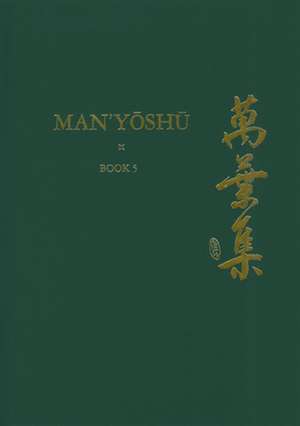
Man'yōshū (Book 5)
Editat de Alexander Vovinen Limba Engleză Hardback – 25 ian 2011
Notăm cu interes publicarea celui de-al doilea volum din seria monumentală de 20 de cărți dedicată antologiei Man'yōshū (Book 5). Această ediție se concentrează pe o perioadă de o omogenitate remarcabilă, anii 724-733 AD, oferind o perspectivă riguroasă asupra evoluției literare din epoca Nara. Spre deosebire de primele patru volume, această unitate cronologică restrânsă permite o analiză lingvistică și stilistică mult mai profundă a textelor. Apreciem în mod deosebit includerea celor 114 poeme — 104 tanka și 10 choka — însoțite de introduceri ample în limba chineză, care clarifică contextul socio-cultural al epocii. Din punct de vedere lingvistic, volumul este esențial, deoarece sistemul de scriere fonografic utilizat reflectă varianta timpurie a japonezei vechi occidentale, o trăsătură evidențiată prin aparatul critic riguros. Extinde cadrul propus de Man’yōshū (Book 10) cu date noi din perioada de apogeu a poetului Yamanoue-no Okura, oferind o interpretare filologică ce lipsește din antologiile mai generale. Credem că această lucrare se poziționează central în opera lui Alexander Vovin, continuând cercetările sale din A Descriptive and Comparative Grammar of Western Old Japanese. Dacă lucrările sale anterioare stabileau bazele gramaticale, acest volum aplică acele principii pe un corpus poetic concret, facilitând înțelegerea tranziției de la genul zoka la benka (poezia de doliu). Structura este una academică, cu un accent puternic pe fidelitatea traducerii și pe analiza sistemului de scriere, fiind un instrument indispensabil pentru studiul literaturii clasice japoneze.
Preț: 859.64 lei
Preț vechi: 1116.42 lei
-23%
Carte tipărită la comandă
Livrare economică 22 octombrie-05 noiembrie
Specificații
ISBN-10: 1906876207
Pagini: 184
Dimensiuni: 157 x 239 x 15 mm
Greutate: 0.34 kg
Ediția:New.
Editura: Brill
V-ar putea interesa
-
 Tales of IsePeter Macmillan-19%Preț: 75.19 lei92.44 lei
 -
 Aristophanes' FrogsMark Griffith-13%Preț: 301.22 lei346.15 lei
 -
 -22%Preț: 293.84 lei378.74 lei
 -
 Love and Providence: Recognition in the Ancient NovelSilvia Montiglio-31%Preț: 693.21 lei1006.84 lei
 -
 The Elegiac Passion: Jealousy in Roman Love ElegyRuth Rothaus Caston-31%Preț: 691.37 lei1005.72 lei
 -
 Virgil, A Poet in Augustan RomeJames MorwoodPreț: 212.75 lei
 -
 The Fabliaux: A New Verse TranslationR. Howard BlochPreț: 201.44 lei
 -
 Preț: 229.78 lei
 -
 Antigone, InterruptedBonnie HonigPreț: 194.33 lei
 -
 The Orphic HymnsApostolos N AthanassakisPreț: 210.53 lei
 -
 The Comedian as Critic: Greek Old Comedy and PoeticsDr Matthew Wright-25%Preț: 278.06 lei369.55 lei
 -
 SatiresHorace-17%Preț: 107.00 lei129.43 lei
 -
 HomerJonathan S. Burgess-15%Preț: 143.97 lei169.46 lei
 -
 SenecaChristopher Star-21%Preț: 157.11 lei200.06 lei
 -
 OvidCarole E. Newlands-16%Preț: 141.69 lei169.51 lei
De ce să citești această carte
Recomandăm acest volum cercetătorilor și studenților interesați de filologia japoneză și de poezia epocii Nara. Cititorul câștigă acces la o traducere precisă a operelor lui Yamanoue-no Okura, beneficiind de expertiza lingvistică a lui Alexander Vovin. Este un motiv concret de achiziție pentru cei care doresc să înțeleagă rădăcinile limbii japoneze vechi printr-un text care îmbină rigoarea academică cu analiza literară a genurilor tanka și choka.
Despre autor
Alexander Vovin este profesor de limbi est-asiatice la Universitatea din Hawai'i și un specialist de renume mondial în filologie japoneză și lingvistică comparată. Cariera sa s-a concentrat pe reconstrucția limbii japoneze vechi și pe studiul limbilor tunguze și coreene. Expertiza sa este reflectată în lucrări fundamentale precum The Eastern Old Japanese Corpus and Dictionary și The Tungusic Languages. Prin coordonarea traducerii integrale a antologiei Man'yōshū, Vovin oferă comunității academice internaționale o resursă fără precedent pentru studiul perioadelor Asuka și Nara, bazată pe o înțelegere profundă a gramaticii istorice.