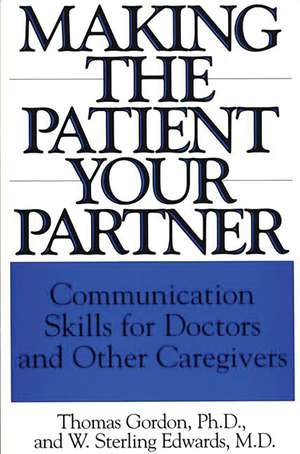
Making the Patient Your Partner: Communication Skills for Doctors and Other Caregivers
Autor W. Sterling Edwardsen Limba Engleză Paperback – 30 iul 1997
Gordon is a psychologist who has pioneered internationally recognized effectiveness training programs widely used by teachers, parents, salesmen, managers, and other professionals. He has published six books that have sold over five million copies in 17 languages. In this work, he has enlisted the expertise of Edwards, a highly respected medical doctor and educator, to provide the necessary insider's view of the health profession. Together they make a convincing case for doctors to develop closer and more collaborative relationships with patients.
Preț: 231.05 lei
Preț vechi: 312.42 lei
-26%
Puncte Express: 347
Carte tipărită la comandă
Livrare economică 06-20 iunie
Specificații
ISBN-13: 9780865692732
ISBN-10: 0865692734
Pagini: 238
Ilustrații: Illustrations
Dimensiuni: 148 x 228 x 16 mm
Greutate: 0.36 kg
Editura: Bloomsbury Publishing
Colecția Praeger
Locul publicării:New York, United States
ISBN-10: 0865692734
Pagini: 238
Ilustrații: Illustrations
Dimensiuni: 148 x 228 x 16 mm
Greutate: 0.36 kg
Editura: Bloomsbury Publishing
Colecția Praeger
Locul publicării:New York, United States
V-ar putea interesa
-
 -28%Preț: 351.65 lei487.63 lei
 -
 Physical Rehabilitation for the Physical Therapist AssistantLinda G Monroe-13%Preț: 401.24 lei458.60 lei
 -
 Spirituality in Patient CareHarold G Koenig-5%Preț: 207.37 lei218.28 lei
 -
 Rehabilitation von spezifischem GewebeThomas Koller-5%Preț: 112.85 lei118.79 lei
 -
 -5%Preț: 112.85 lei118.79 lei
 -
 Tiefdermale Defekte bei VerbrennungenThomas Koller-5%Preț: 112.85 lei118.79 lei
 -
 -5%Preț: 113.04 lei118.99 lei
 -
 100 Krankheitsbilder in der PhysiotherapieChristine Mayer-5%Preț: 415.48 lei437.35 lei
 -
 Motorische Entwicklung und SteuerungPaul Geraedts-5%Preț: 248.58 lei261.67 lei
 -
 Untersuchen und Befunden in der PhysiotherapieKay Bartrow-5%Preț: 391.84 lei412.46 lei
 -
 -5%Preț: 357.96 lei376.80 lei
 -
 Kommunikation im GesundheitswesenHeike Hoos-Leistner-5%Preț: 259.85 lei273.53 lei
 -
 HippotherapieAnnette Soehnle-5%Preț: 446.30 lei469.79 lei
 -
 -5%Preț: 175.05 lei184.26 lei
 -
 Handboek pijnrevalidatieJ. A. Verbunt-5%Preț: 510.98 lei537.87 lei
 -
 Oefenprogramma's voor de knieKoos Van Nugteren-5%Preț: 338.56 lei356.38 lei
Cuprins
Dissatisfaction with Relationships with Patients
A Collaborative Model for Relating to Patients
Empathic Listening: Applications and Benefits
Roadblocks to Patient Communication
Self-Disclosure Skills for Health Care Professionals
Dealing Effectively with Conflicts
Helping Patients Cope with an Adverse Diagnosis
Special Problems Dealing with AIDS Patients
Helping Patients Maintain Hope
Helping Patients Find Meaning
Helping the Terminal Patient
Other Applications of Interpersonal Skills
A Collaborative Model for Relating to Patients
Empathic Listening: Applications and Benefits
Roadblocks to Patient Communication
Self-Disclosure Skills for Health Care Professionals
Dealing Effectively with Conflicts
Helping Patients Cope with an Adverse Diagnosis
Special Problems Dealing with AIDS Patients
Helping Patients Maintain Hope
Helping Patients Find Meaning
Helping the Terminal Patient
Other Applications of Interpersonal Skills
Recenzii
Strongly recommended for physicians and especially for office, clinic, and hospital staff caregivers. Patient advocates (ombudsmen) should find the style and content appealing.
[T]he authors suggest ways in which health care providers can improve skills in such areas as active listening, identifying and overcoming barriers to communication, dealing with conflicts with patients, and helping persons with terminal illnesses. The book is well organized and can be read quickly, and a busy professional can take away new ideas or expand on existing skills after a relatively small time investment. The book also includes a concise list of some of the best resources available for health care workers who want more training in communication skills. . . . [T]he book is an easy-to-read summary of an approach to communicating with patients. It can reinvigorate physicians who already believe that the physician-patient relationship is a powerful tool, and it can inspire those who seek more collaboration with patients.
This is a useful book that will help healthcare practitioners at all levels sharpen their communication skills and, in doing so, encourage a trusting, collaborative relationship with the patient. The authors remind us that our primary goal in healthcare is to care for and comfort our patients.
[T]he authors suggest ways in which health care providers can improve skills in such areas as active listening, identifying and overcoming barriers to communication, dealing with conflicts with patients, and helping persons with terminal illnesses. The book is well organized and can be read quickly, and a busy professional can take away new ideas or expand on existing skills after a relatively small time investment. The book also includes a concise list of some of the best resources available for health care workers who want more training in communication skills. . . . [T]he book is an easy-to-read summary of an approach to communicating with patients. It can reinvigorate physicians who already believe that the physician-patient relationship is a powerful tool, and it can inspire those who seek more collaboration with patients.
This is a useful book that will help healthcare practitioners at all levels sharpen their communication skills and, in doing so, encourage a trusting, collaborative relationship with the patient. The authors remind us that our primary goal in healthcare is to care for and comfort our patients.