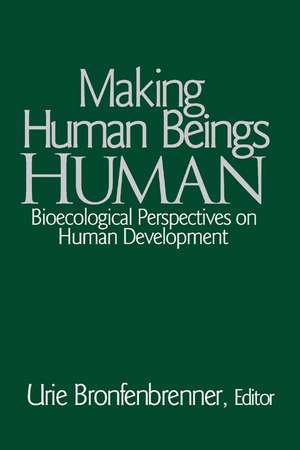
Making Human Beings Human
Autor Urie Bronfenbrenneren Limba Engleză Hardback – iul 2004
Această monografie fundamentală reprezintă sinteza teoretică a unei cariere de peste șase decenii dedicate înțelegerii modului în care mediul modelează individul. Considerăm că Making Human Beings Human nu este doar o simplă culegere de studii, ci un testament intelectual care documentează evoluția de la ecologia dezvoltării umane către modelul bioecologic matur. Structura cărții este organizată cronologic în două secțiuni majore, prima fiind dedicată naturii teoriei și cercetării, unde regăsim articole esențiale publicate între 1942 și 2001. Această progresie îi permite cititorului să urmărească modul în care Urie Bronfenbrenner și-a rafinat conceptele, trecând de la analiza spațiului lewinian la modelul Proces-Persoană-Context-Timp (PPCT). Recomandăm acest volum deoarece extinde cadrul conceptual propus inițial în The Ecology of Human Development, oferind o perspectivă mult mai bogată asupra interacțiunii dintre ereditate și mediu. Față de lucrări precum The Bronfenbrenner Primer de Lawrence G. Shelton, care funcționează ca un ghid introductiv pentru studenți, volumul de față oferă acces direct la textul sursă și la nuanțele gâdirii autorului. De asemenea, spre deosebire de Understanding and Teaching Bronfenbrenner's Bioecological Theory de Jessica L. Navarro, care se concentrează pe corectarea interpretărilor greșite în pedagogie, lucrarea de față ancorează teoria în politici publice concrete, reflectând experiența autorului ca fondator al programului Head Start. Textul demonstrează cum sistemele interconectate — de la familie la structurile macro-sociale — influențează direct potențialul uman, făcând din această lectură o resursă indispensabilă pentru înțelegerea psihologiei dezvoltării contemporane.
Preț: 1113.12 lei
Preț vechi: 1357.46 lei
-18%
Carte tipărită la comandă
Livrare economică 17 noiembrie-01 decembrie
Specificații
ISBN-10: 0761927115
Pagini: 338
Dimensiuni: 196 x 241 x 23 mm
Greutate: 0.83 kg
Ediția:1
Editura: SAGE Publications
Locul publicării:Thousand Oaks, United States
V-ar putea interesa
-
 The Oxford Handbook of the Development of PlayAnthony D. Pellegrini-29%Preț: 398.47 lei563.33 lei
 -
 The Uses of Enchantment (National Book Award Winner)Bruno Bettelheim-5%Preț: 93.63 lei98.56 lei
 -
 Rutter's Child and Adolescent PsychiatryAnita Thapar-5%Preț: 1999.35 lei2104.58 lei
 -
 Social Cognition in Middle Childhood and AdolescenceSandra BosackiPreț: 389.31 lei
 -
 Preț: 233.68 lei
 -
 Preț: 230.86 lei
 -
 The Development of Children's ThinkingJeremy Carpendale-19%Preț: 421.97 lei520.95 lei
De ce să citești această carte
Recomandăm această carte oricărui specialist în psihologie, educație sau politici publice care dorește să înțeleagă rădăcinile modelului bioecologic direct de la sursă. Cititorul câștigă o perspectivă istorică unică asupra modului în care mediul social dictează dezvoltarea umană. Este o resursă critică pentru cei care vor să aplice teoria sistemelor în intervenții educaționale sau sociale, oferind fundamentul teoretic necesar pentru a transforma cercetarea în practică.
Despre autor
Urie Bronfenbrenner (1917–2005) a fost unul dintre cei mai influenți psihologi ai dezvoltării din secolul XX, deținând titlul de Profesor Emeritus la Cornell University în cadrul departamentelor de Psihologie și Dezvoltare Umană. Este recunoscut la nivel mondial ca fiind co-fondatorul programului federal Head Start din Statele Unite, o inițiativă revoluționară destinată sprijinirii copiilor din medii defavorizate. Opera sa, care include titluri de referință precum The Ecology of Human Development și The State of Americans, a redefinit modul în care comunitatea științifică abordează studiul copilului, mutând accentul din laborator către contextul social real și interacțiunile complexe dintre individ și mediu.
Descriere scurtă
The book is rich in cultural and historical comparisons. The concepts of the bioecological model and the ecology of human development represent a unique contribution to the field of developmental psychology.
Features contributions and commentary by distinguished scholars: a Foreword by Richard M. Lerner of Tufts University and an Afterword by Stephen F. Hamilton and Stephen J. Ceci of Cornell University.
Recenzii
"This volume is a remarkable compilation of several critical writings of one of the most influential developmental psychologists of the 20th, and now 21st, century. Making Human Beings Human is an essential reader for all students of human development, whether they are undergraduates, graduate students, teachers, practitioners, or policy makers. . . . To read this book is to be a passenger on an exhilarating six-decade-long journey of discovery which, for those interested in the landscape of human development, is every bit as exciting as a Lewis and Clark expedition."
In his latest book, Dr. Bronfenbrenner’s bioecological theory of human development offers an important framework upon which to examine the effectiveness of our early childhood policies, programs, and practices on the lives of America’s children and families. In the unfolding of his theory, we find evidence that what, when, and how we do our work does make a critical difference in the developmental outcomes of young children and their families, especially those who are most vulnerable. As a result, we are honor bound to examine our own beliefs and practices in whatever field we find ourselves in the realm of human development work to ensure that our approaches respect and recognize the unlimited potential of all human beings and provide the resources and support that all families need to engage in healthy and productive lives.
Cuprins
Dedication
Foreword - Richard M. Lerner
Introduction
Section I: ON THE NATURE OF BIOECOLOGICAL THEORY AND RESEARCH
Section Introduction
Article 1. The Bioecological Theory of Human Development (2001)
Article 2. Social Ecology over Time and Space (1995)
Article 3. Social Status, Structure, and Development in the Classroom Group (1942)
Article 4. Social Ecology of Human Development (1973)
Article 5. Lewinian Space and Ecological Substance (1977)
Article 6. A Future Perspective (1979)
Article 7. Toward a Critical History of Development. A Propaedeutic Discussion (1986)
Article 8. Interacting Systems in Human Development. ResearchParadigms: Present and Future (1988)
Article 9. Developing Ecology (1989)
Article 10. Ecological Systems Theory (1992)
Article 11. Heredity, Environment and the Question "How." A First Approximation (1993)
Section II: USING THE ECOLOGY OF HUMAN DEVELOPMENT TO ENHANCE THE HUMAN CONDITION
Section Introduction
Article 12. Growing Chaos in the Lives of Children and Families. How Can We Turn it Around? (2001)
Article 13. The Split Level American Family (1967)
Article 14. Minority Report of Forum 15- 1970 White House Conference on Children (1970)
Article 15. Two Worlds of Childhood: U.S. and U.S.S.R. (1970)
Article 16. Is 80% of Intelligence Genetically Determined? (1975)
Article 17. The Future of Childhood (1985)
Article 18. Strengthening Family Systems (1988)
Article 19. Child Care in the Anglo-Saxon Mode (1992)
Afterword - Stephen F. Hamilton and Stephen J. Ceci