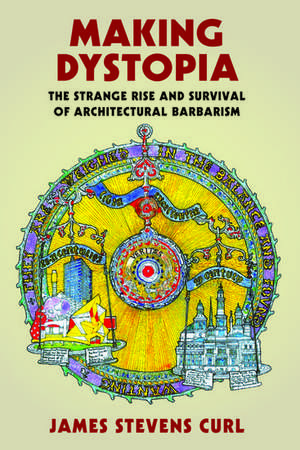
Making Dystopia: The Strange Rise and Survival of Architectural Barbarism
Autor James Stevens Curlen Limba Engleză Paperback – 22 aug 2019
Preț: 213.36 lei
Preț vechi: 253.70 lei
-16%
Puncte Express: 320
Carte disponibilă
Livrare economică 05-11 noiembrie
Livrare express 21-27 octombrie pentru 111.49 lei
Livrare prin curier în România Termenul estimat este afișat lângă disponibilitate.
Transport gratuit de la 400.00 lei Plată online sau ramburs, în funcție de opțiunile comenzii.
Retur gratuit în 14 zile Comandă securizată și suport în română.
Specificații
ISBN-13: 9780198820864
ISBN-10: 0198820860
Pagini: 592
Ilustrații: 72 black & white illustrations and 39 figures
Dimensiuni: 156 x 234 x 29 mm
Greutate: 1.23 kg
Editura: OUP OXFORD
Colecția OUP Oxford
Locul publicării:Oxford, United Kingdom
ISBN-10: 0198820860
Pagini: 592
Ilustrații: 72 black & white illustrations and 39 figures
Dimensiuni: 156 x 234 x 29 mm
Greutate: 1.23 kg
Editura: OUP OXFORD
Colecția OUP Oxford
Locul publicării:Oxford, United Kingdom
V-ar putea interesa
-
 The Age of SpectacleTom DyckhoffPreț: 120.60 lei
 -
 -21%Preț: 55.66 lei70.23 lei
 -
 The Alienation EffectOwen HatherleyPreț: 278.51 lei
 -
 Aureli, P: POSSIBILITY OF AN ABSOLUTE ARCPier Vittorio AureliPreț: 197.87 lei
 -
 The Other Modern Movement: Architecture, 1920–1970Kenneth FramptonPreț: 363.24 lei
 -
 Modernism: A Literature in CrisisTerry EagletonPreț: 144.14 lei
 -
 Architecture after ModernismDiane Ghirardo-17%Preț: 78.29 lei94.29 lei
 -
 Modern ArchitectureKenneth Frampton-12%Preț: 137.74 lei156.18 lei
 -
 The City of Today is a Dying ThingDes FitzgeraldPreț: 72.34 lei
 -
 Modern Architecture Since 1900William J R Curtis-13%Preț: 381.65 lei437.50 lei
 -
 Architreasures: A Journey Through 20th-Century ArchitectureGeoffrey Goddard-8%Preț: 406.60 lei441.96 lei
 -
 Robert Venturi: Complexity and Contradiction in ArchitectureRobert Venturi-23%Preț: 148.54 lei193.15 lei
 -
 Modern Architecture: The BasicsGraham LiveseyPreț: 181.19 lei
 -
 SpainDavid CohnPreț: 252.95 lei
 -
 Up in the AirHolly SmithPreț: 151.38 lei
 -
 Modern Architecture in a Post-Modern EraElie G HaddadPreț: 451.16 lei
 -
 Art Nouveau: The Architecture of Modern LifePaul GreenhalghPreț: 348.31 lei
 -
 Preț: 140.91 lei
 -
 Tashkent Modernism XX/XXIBoris ChukhovichPreț: 394.96 lei
 -
 The Stones of Fernand PouillonAdam CarusoPreț: 554.07 lei
Recenzii
in this remarkable work [Curl] sets the historical record straight by demythologizing architectural Modernism, its progenitors and heroes...This is a book that needed to be written... superb writing and meticulous research.
Curl's Making Dystopia is a wake-up call to architects and urbanists to reexamine what we hold true in light of the dystopias we claim as our heritage in the making. Every committed architect and urbanist interested in the roots of their profession needs to read Curl's book now.
Almost perfect analysis of how modernism in Western cities ended in a huge flop.
An important and necessary book... Professor Curl has dug behind and chiseled away at the details of a history veneered over by decades of received modernist mythmaking.
Curl's magnum opus... a polemical, but deeply scholarly, history of architectural modernism, its antecedents and its results.
A book that will stimulate and provoke, and also inform through its awe-inspiring scholarship... It has all the punch and immediacy of the best of campaigning eighteenth-century pamphlets and at the same time is an intellectually forceful work of scholarship.
Excellent book... Prof. Curl traces the history of dystopian modernism from its origins in the early 20th century up to the present day, giving numerous examples of its horrendous consequences. But Curl's book is not merely a lament... he makes some important suggestions for reforming the syllabus in schools of architecture so as to lay the basis for a better built environment in the future. It is to be hoped that his message will be heeded, as much is at stake here for the future of our civilisation.
Anyone interested in the ideological foundations, as well as effects, of architectural modernism should read James Stevens Curl's recently published Making Dystopia... a magisterial and to me unanswerable account of one of the greatest aesthetic disasters to have befallen Europe in all its history
Stevens Curl gets his teeth into "the disaster that has been post-1945 British architecture and town planning", tackling the thorny subject with verve, wit and tremendous erudition... This great book, in showing categorically, and cogently, what went wrong, makes an unarguable case for the conservation of the little that remains.
... an essential, uncompromising, learned ... critique of one of the worst and most significant legacies of the 20th century
Written with passion and eloquence, Making Dystopia is a work of rare intellectual magnitude, to be recognized as an important ... contribution to the culture of our times. It promises to become essential reading to students of architecture...
An impassioned but informed case... meticulously researched and convincingly argued: it is an undoubtedly controversial book that empties out the contents of modernism for all to see and holds them up to the light for judgement... This book is a must-read for students of architecture: a contentious, highly thought-provoking study...
Curl, a veteran architectural historian with a string of big books to his name, certainly tells us what he thinks...
Whatever you may think of its argument, this book's scholarship is precise.
A storm is brewing in the world of architecture thanks to James Stevens Curl's lightning bolt of a book ... although Curl's polemic is fierce, and well-written to boot, it is far from a blinkered rant.
... a scholarly, encyclopaedic, meaningful, and exceptionally frank book that is lucidly written, meticulously researched... it pulls forcefully on our own relationship with buildings and design, and raises our consciousness as to whether modern architecture lacks empathy and fails to respect its surroundings. It is much more than the age-old pilaster vs pilotis debate, and as such it should be mandatory reading for all students of architecture or design. [It] lets a thousand cats out of a thousand bags. Of that there can be no doubt.
Polemic, impassioned plea or potent sting of an angry wasp with an interest in architectural history - describe it how you will but this is a book to be read, discussed and debated by anyone with an interest in our built environment... This is a full-blooded, no-holds-barred, scholarly treatise stemming from a lifetime of study and experience... a passionate argument meticulously backed up by detailed notes and a vast range of source material much of which is new...
Can a text on architectural history, however thoroughly researched and brilliantly written, trigger an architectural revolution? For a discipline in ferment, this might just provide the jolt to set off an avalanche... This iconoclastic landmark book might change the way we build from now on. Its an outstanding work of scholarship that needs to be read by every architect and architecture student who still possesses a conscience.
Making Dystopia, the most gripping and complete account of how architecture and urban planning were corrupted in the 20th and 21st century leading to a catastrophic deterioration of the built environment, is a brilliant, thoroughly researched, and completely novel book... This book, surely the greatest of the many written by Professor Stevens Curl, should be read by staff and students in all schools of architecture who are still pursuing destructive, irrelevant, outdated paths, as well as by everyone concerned about the erosion of civilisation itself.
This is a book to be read, discussed and debated by anyone with an interest in our built environment... This is a full-blooded, no-holds-barred, scholarly treatise stemming from a lifetime of study and experience and an unwillingness to bow down to popular but often unsubstantiated opinion. [He] ramps up the debate with a passionate argument meticulously backed up by detailed notes and a vast range of source material much of which is new... This scholarly and challenging book deserves to be widely read.
One of the strengths of this book is reflected in the fact that a traditional review format is not a fitting one to communicate either the scale of the authority on offer here or the challenges laid down ... [The] author forensically dissects [his] target and mercilessly promotes [his position] across a raft of informed, erudite and insightful historically led deconstructions of the dominant architectural languages of [his] day. His position is boldly stated and argued in depth. The scale of scholarship is easily recognisable.
This brilliant text is a timely marvel... Making Dystopia is unquestionably a major contribution to the history of architecture and quite possibly the most important publication in Stevens Curl's enormously prodigious oeuvre.
A coruscating, driven, and passionately committed book which should be read by anyone who believes that a house is more than a machine for living.
I just finished reading Making Dystopia and I want to thank you for an excellent book. I've often wondered why dreadful architecture became so popular and influential. Your explanations of the history of the Modern Movement, especially of its spread to America and its bullying attitude, were very helpful. I applaud your frankness and willingness to confront many sacred cows.
Curl's Making Dystopia is a wake-up call to architects and urbanists to reexamine what we hold true in light of the dystopias we claim as our heritage in the making. Every committed architect and urbanist interested in the roots of their profession needs to read Curl's book now.
Almost perfect analysis of how modernism in Western cities ended in a huge flop.
An important and necessary book... Professor Curl has dug behind and chiseled away at the details of a history veneered over by decades of received modernist mythmaking.
Curl's magnum opus... a polemical, but deeply scholarly, history of architectural modernism, its antecedents and its results.
A book that will stimulate and provoke, and also inform through its awe-inspiring scholarship... It has all the punch and immediacy of the best of campaigning eighteenth-century pamphlets and at the same time is an intellectually forceful work of scholarship.
Excellent book... Prof. Curl traces the history of dystopian modernism from its origins in the early 20th century up to the present day, giving numerous examples of its horrendous consequences. But Curl's book is not merely a lament... he makes some important suggestions for reforming the syllabus in schools of architecture so as to lay the basis for a better built environment in the future. It is to be hoped that his message will be heeded, as much is at stake here for the future of our civilisation.
Anyone interested in the ideological foundations, as well as effects, of architectural modernism should read James Stevens Curl's recently published Making Dystopia... a magisterial and to me unanswerable account of one of the greatest aesthetic disasters to have befallen Europe in all its history
Stevens Curl gets his teeth into "the disaster that has been post-1945 British architecture and town planning", tackling the thorny subject with verve, wit and tremendous erudition... This great book, in showing categorically, and cogently, what went wrong, makes an unarguable case for the conservation of the little that remains.
... an essential, uncompromising, learned ... critique of one of the worst and most significant legacies of the 20th century
Written with passion and eloquence, Making Dystopia is a work of rare intellectual magnitude, to be recognized as an important ... contribution to the culture of our times. It promises to become essential reading to students of architecture...
An impassioned but informed case... meticulously researched and convincingly argued: it is an undoubtedly controversial book that empties out the contents of modernism for all to see and holds them up to the light for judgement... This book is a must-read for students of architecture: a contentious, highly thought-provoking study...
Curl, a veteran architectural historian with a string of big books to his name, certainly tells us what he thinks...
Whatever you may think of its argument, this book's scholarship is precise.
A storm is brewing in the world of architecture thanks to James Stevens Curl's lightning bolt of a book ... although Curl's polemic is fierce, and well-written to boot, it is far from a blinkered rant.
... a scholarly, encyclopaedic, meaningful, and exceptionally frank book that is lucidly written, meticulously researched... it pulls forcefully on our own relationship with buildings and design, and raises our consciousness as to whether modern architecture lacks empathy and fails to respect its surroundings. It is much more than the age-old pilaster vs pilotis debate, and as such it should be mandatory reading for all students of architecture or design. [It] lets a thousand cats out of a thousand bags. Of that there can be no doubt.
Polemic, impassioned plea or potent sting of an angry wasp with an interest in architectural history - describe it how you will but this is a book to be read, discussed and debated by anyone with an interest in our built environment... This is a full-blooded, no-holds-barred, scholarly treatise stemming from a lifetime of study and experience... a passionate argument meticulously backed up by detailed notes and a vast range of source material much of which is new...
Can a text on architectural history, however thoroughly researched and brilliantly written, trigger an architectural revolution? For a discipline in ferment, this might just provide the jolt to set off an avalanche... This iconoclastic landmark book might change the way we build from now on. Its an outstanding work of scholarship that needs to be read by every architect and architecture student who still possesses a conscience.
Making Dystopia, the most gripping and complete account of how architecture and urban planning were corrupted in the 20th and 21st century leading to a catastrophic deterioration of the built environment, is a brilliant, thoroughly researched, and completely novel book... This book, surely the greatest of the many written by Professor Stevens Curl, should be read by staff and students in all schools of architecture who are still pursuing destructive, irrelevant, outdated paths, as well as by everyone concerned about the erosion of civilisation itself.
This is a book to be read, discussed and debated by anyone with an interest in our built environment... This is a full-blooded, no-holds-barred, scholarly treatise stemming from a lifetime of study and experience and an unwillingness to bow down to popular but often unsubstantiated opinion. [He] ramps up the debate with a passionate argument meticulously backed up by detailed notes and a vast range of source material much of which is new... This scholarly and challenging book deserves to be widely read.
One of the strengths of this book is reflected in the fact that a traditional review format is not a fitting one to communicate either the scale of the authority on offer here or the challenges laid down ... [The] author forensically dissects [his] target and mercilessly promotes [his position] across a raft of informed, erudite and insightful historically led deconstructions of the dominant architectural languages of [his] day. His position is boldly stated and argued in depth. The scale of scholarship is easily recognisable.
This brilliant text is a timely marvel... Making Dystopia is unquestionably a major contribution to the history of architecture and quite possibly the most important publication in Stevens Curl's enormously prodigious oeuvre.
A coruscating, driven, and passionately committed book which should be read by anyone who believes that a house is more than a machine for living.
I just finished reading Making Dystopia and I want to thank you for an excellent book. I've often wondered why dreadful architecture became so popular and influential. Your explanations of the history of the Modern Movement, especially of its spread to America and its bullying attitude, were very helpful. I applaud your frankness and willingness to confront many sacred cows.
Notă biografică
Professor James Stevens Curl has been Visiting Fellow at Peterhouse, Cambridge, and is a Member of the Royal Irish Academy, a Fellow of the Society of Antiquaries of London, and a Fellow of the Royal Incorporation of Architects in Scotland. In 2014, De Montfort University awarded him an Honorary Doctorate of Arts in recognition of his 'distinctive contribution... to the intellectual and cultural life of the nation and region'. His many publications include studies of Classical, Georgian, and Victorian architecture, and the most recent edition of his Oxford Dictionary of Architecture (with contributions on landscape from Susan Wilson) was published by Oxford University Press in 2015. In 2017 he was awarded the British Academy President's Medal for 'outstanding service to the cause of the humanities and social sciences' in his wider study of the History of Architecture in Britain and Ireland.
Cuprins
- Prolegomenon
- Preface and Acknowledgements
- 1: Origins of a Catastrophe
- 2: Makers of Mythologies and False Analogies
- 3: Modernism in Germany in the Aftermath of the 1914-18 War
- 4: The International Style 1920s and 1930s
- 5: The International Style Truly International
- 6: Universal Acceptance of the International Style: A Surprising Aftermath of 1945
- 7: Descent to Deformity
- 8: Dangerous Signals
- 9: Some Further Reflections
- 10: Epilogue
- Select Glossary
- Bibliography
- Index