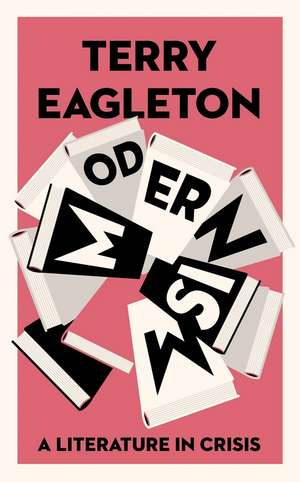
Modernism: A Literature in Crisis
Autor Terry Eagletonen Limba Engleză Hardback – 30 sep 2025
Modernism represented an astonishing outbreak of cultural innovation, spanning artforms and nations. It was centred around feelings of growing alienation in an industrial world, and a desire to change how people live together in society. Art, architecture, literature, and music all underwent a radical revolution.
Although it was confined to small coteries of artists and lasted no more than thirty years, its techniques were appropriated by mass culture and became familiar to millions of citizens who have never heard of Paul Klee or Gertrude Stein. It represents one of the most productive moments in art since the Renaissance, which in its scope, originality, and imaginative audacity has never been equalled.
Terry Eagleton presents a compelling and entertaining guide to modernism. From Ezra Pound to Virginia Woolf, James Joyce to H.D., Eagleton explores the literature and ideas of prominent modernists, emphasising the profound impact they had on subsequent generations.
Preț: 144.14 lei
Puncte Express: 216
Carte disponibilă
Livrare economică 16-30 noiembrie
Livrare express 30 octombrie-05 noiembrie pentru 30.59 lei
Livrare prin curier în România Termenul estimat este afișat lângă disponibilitate.
Transport gratuit de la 400.00 lei Plată online sau ramburs, în funcție de opțiunile comenzii.
Retur gratuit în 14 zile Comandă securizată și suport în română.
Specificații
ISBN-13: 9780300284379
ISBN-10: 0300284373
Pagini: 208
Dimensiuni: 133 x 216 x 22 mm
Greutate: 0.34 kg
Editura: Yale University Press
Colecția Yale University Press
ISBN-10: 0300284373
Pagini: 208
Dimensiuni: 133 x 216 x 22 mm
Greutate: 0.34 kg
Editura: Yale University Press
Colecția Yale University Press
V-ar putea interesa
-
 To the LighthouseVirginia WoolfPreț: 28.01 lei
 -
 ModernismPeter Gay-21%Preț: 108.98 lei138.63 lei
 -
 ModernismMalcolm Bradbury-17%Preț: 102.35 lei123.99 lei
 -
 Postmodernism: A Very Short IntroductionChristopher Butler-19%Preț: 57.88 lei71.23 lei
 -
 Modernism: A Very Short IntroductionChristopher Butler-20%Preț: 56.62 lei70.82 lei
 -
 Sussex ModernismHope WolfPreț: 324.62 lei
 -
 The Real Thing: Reflections on a Literary FormTerry EagletonPreț: 149.49 lei
 -
 Rites of SpringModris EksteinsPreț: 118.02 lei
 -
 The Shock of the NewRobert Hughes-17%Preț: 238.67 lei286.84 lei
 -
 Romantic ModernsAlexandra Harris-17%Preț: 91.12 lei109.90 lei
 -
 The Dehumanization of Art and Other Essays on Art, Culture, and LiteratureJosé Ortega Y. GassetPreț: 93.58 lei
 -
 ModernismJane A. Goldman-15%Preț: 212.05 lei248.95 lei
 -
 Modernist LiteratureRachel Potter-16%Preț: 178.74 lei211.80 lei
 -
 Preț: 90.31 lei
 -
 Preț: 285.44 lei
 -
 Modernism, Media, and the Politics of Common LifeAleksandr PrigozhinPreț: 305.82 lei
 -
 Introducing ModernismChris RodriguesPreț: 64.47 lei
 -
 DublinersJames JoycePreț: 28.01 lei
 -
 Queer Modernism: 1900–1950Susanne Gaensheimer-15%Preț: 309.00 lei362.46 lei
 -
 American Modernism (Re)ConsideredRobert C. Hauhart-32%Preț: 631.01 lei928.40 lei
Recenzii
“Mr. Eagleton makes the reasonable point that ‘the new is not desirable in itself.’ . . . In one of many quips in Modernism, he remarks that ‘novelty is just the same old thing.’”—James Campbell, Wall Street Journal
Featured in Englewood Review of Books’ Christmas Gift Guide 2025
“Eagleton, alert to rash generalizations and simplistic explanations, is a tonic for lazy thinking and his new book Modernism is an intelligent and lively overview of the twentieth century’s artistic revolution.”—Sean Sheehan, The Prisma
“A finely judged, beautifully articulated, typically witty, and consistently surprising account of literary modernism written by one of contemporary criticism’s most trailblazing thinkers.”—Nathan Waddell, author of A Bright Cold Day: The Wonder of George Orwell
“To read Terry Eagleton on modernism is to be in such good and gentle company as almost to feel you are encountering one of modernism’s own most compelling figures, a figure to whom Eagleton himself in passing refers—namely, the one who, in The Waste Land, is said to be always ‘walking beside you.’”—John Schad, author of Paris Bride: A Modernist Life
“Through its deft and vivid account, Eagleton’s Modernism brilliantly interweaves literature with its political, economic and philosophical hinterland as it measures modernism against alternative avant-gardes. The book is written and shaped to make the period startlingly fresh for all readers.”—Steven Matthews, author of On Magnetism
“This is the sort of light-footed dash through the meanings of modernism that is only available to those with decades of scholarly experience. . . . A vital account of the crises to which modernism responded, its own exhaustion and disillusionment, and its cementing in contemporary teaching and the wider imagination.”—Abbie Garrington, author of Haptic Modernism: Touch and the Tactile in Modernist Writing
Featured in Englewood Review of Books’ Christmas Gift Guide 2025
“Eagleton, alert to rash generalizations and simplistic explanations, is a tonic for lazy thinking and his new book Modernism is an intelligent and lively overview of the twentieth century’s artistic revolution.”—Sean Sheehan, The Prisma
“A finely judged, beautifully articulated, typically witty, and consistently surprising account of literary modernism written by one of contemporary criticism’s most trailblazing thinkers.”—Nathan Waddell, author of A Bright Cold Day: The Wonder of George Orwell
“To read Terry Eagleton on modernism is to be in such good and gentle company as almost to feel you are encountering one of modernism’s own most compelling figures, a figure to whom Eagleton himself in passing refers—namely, the one who, in The Waste Land, is said to be always ‘walking beside you.’”—John Schad, author of Paris Bride: A Modernist Life
“Through its deft and vivid account, Eagleton’s Modernism brilliantly interweaves literature with its political, economic and philosophical hinterland as it measures modernism against alternative avant-gardes. The book is written and shaped to make the period startlingly fresh for all readers.”—Steven Matthews, author of On Magnetism
“This is the sort of light-footed dash through the meanings of modernism that is only available to those with decades of scholarly experience. . . . A vital account of the crises to which modernism responded, its own exhaustion and disillusionment, and its cementing in contemporary teaching and the wider imagination.”—Abbie Garrington, author of Haptic Modernism: Touch and the Tactile in Modernist Writing
Notă biografică
Terry Eagleton has been the Warton Professor of English Literature at Oxford University and is the author of more than fifty books in the fields of literary theory, postmodernism, politics, ideology, and religion.