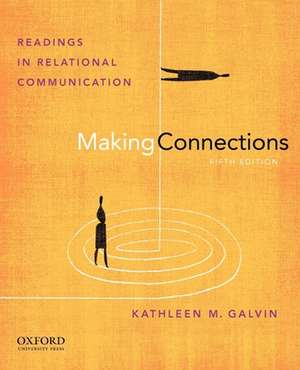
Making Connections
en Limba Engleză Paperback – 30 apr 2010
FEATURES
* Employs the "lenses" of gender, family, and culture to view and make sense of relational communication
* Offers a well-rounded discussion of the links between communication competencies and relationships
* Features a developmental approach to relationships that addresses initiating, sustaining, and ending them
* Reflects direct applications of relational issues within contexts of family, friendships, and technology
* Explores issues relating to computer-mediated communication and new technologies in everyday life
* Provides detailed introductions to each section and articles that describe relevant theories or research
* Presents discussion questions at the end of each reading, helping students integrate and apply key points
NEW TO THE FIFTH EDITION
* Includes ten new articles and nine updated articles
* Updates the technology section with all new essays about presenting the self online, the impact of the Internet on social tolerance, and living a wired life
* Updates the Instructor's Companion Website (www.oup.com/us/galvin), which contains an Instructor's Manual and Test Bank written by Courtney Waite Miller at Elmhurst College
Preț: 918.46 lei
Preț vechi: 1258.16 lei
-27%
Puncte Express: 1378
Carte tipărită la comandă
Livrare economică 03-17 decembrie
Livrare prin curier în România Termenul estimat este afișat lângă disponibilitate.
Transport gratuit pentru acest produs Plată online sau ramburs, în funcție de opțiunile comenzii.
Retur gratuit în 14 zile Comandă securizată și suport în română.
Specificații
ISBN-13: 9780199733811
ISBN-10: 0199733813
Pagini: 432
Dimensiuni: 191 x 234 x 20 mm
Greutate: 0.75 kg
Ediția:Revised
Editura: Oxford University Press
ISBN-10: 0199733813
Pagini: 432
Dimensiuni: 191 x 234 x 20 mm
Greutate: 0.75 kg
Ediția:Revised
Editura: Oxford University Press
V-ar putea interesa
-
 Preț: 395.86 lei
 -
 Teaching the Early Modern PeriodD. ConroyPreț: 387.19 lei
 -
 Preț: 322.04 lei
 -
 Handbook of Global Education PolicyKaren Mundy-9%Preț: 1251.87 lei1375.68 lei
 -
 Dyslexia - A Practitioner¿s Handbook 5eGavin ReidPreț: 348.63 lei
 -
 Assessment in Student AffairsJohn H SchuhPreț: 318.00 lei
 -
 Teaching DefianceNewmanPreț: 295.32 lei
 -
 Bloomsbury CPD Library: Middle LeadershipPaul K. Ainsworth-45%Preț: 122.63 lei224.26 lei
 -
 Don't Like Mondays?: Make School Work for YouSonia Blandford-13%Preț: 97.32 lei112.27 lei
 -
 Transaktionsanalyse für DummiesPaul GamberPreț: 117.48 lei
 -
 Preț: 388.34 lei
 -
 Preț: 299.43 lei
Descriere
Descriere de la o altă ediție sau format:
In this book, comparisons are made between the practices of classrooms in a variety of different school systems around the world. The abiding challenge for classroom research is the realization of structure in diversity. The structure in this case takes the form of patterns of participation: regularities in the social practices of mathematics classrooms. The expansion of our field of view to include international rather than just local classrooms increases the diversity and heightens the challenge of the search for structure, while increasing the significance of any structures, once found. In particular, this book reports on the use of ‘lesson events’ as an entry point for the analysis of lesson structure. International research offers opportunities to study settings and characteristics untenable in the researcher’s local situation. Importantly, international comparative studies can reveal possibilities for practice that would go unrecognized within the established norms of educational practice of one country or one culture. Our capacity to conceive of alternatives to our current practice is constrained by deep-rooted assumptions, reflecting cultural and societal values that we lack the perspective to question. The comparisons made possible by international research facilitate our identification and interrogation of these assumptions. Such interrogation opens up possibilities for innovation that might not otherwise be identified, expanding the repertoire of mathematics teachers internationally, and providing the basis for theory development.
In this book, comparisons are made between the practices of classrooms in a variety of different school systems around the world. The abiding challenge for classroom research is the realization of structure in diversity. The structure in this case takes the form of patterns of participation: regularities in the social practices of mathematics classrooms. The expansion of our field of view to include international rather than just local classrooms increases the diversity and heightens the challenge of the search for structure, while increasing the significance of any structures, once found. In particular, this book reports on the use of ‘lesson events’ as an entry point for the analysis of lesson structure. International research offers opportunities to study settings and characteristics untenable in the researcher’s local situation. Importantly, international comparative studies can reveal possibilities for practice that would go unrecognized within the established norms of educational practice of one country or one culture. Our capacity to conceive of alternatives to our current practice is constrained by deep-rooted assumptions, reflecting cultural and societal values that we lack the perspective to question. The comparisons made possible by international research facilitate our identification and interrogation of these assumptions. Such interrogation opens up possibilities for innovation that might not otherwise be identified, expanding the repertoire of mathematics teachers internationally, and providing the basis for theory development.