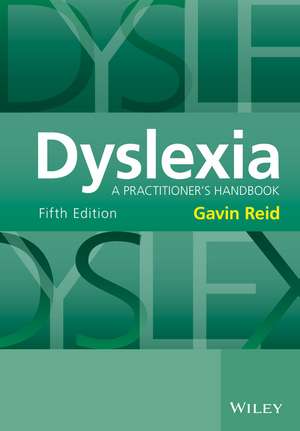
Dyslexia
Autor Gavin Reiden Limba Engleză Paperback – 18 mar 2016
Recomandăm Dyslexia ca o resursă fundamentală pentru cadrele didactice non-specialiste, studenții la psihopedagogie specială și practicienii care caută o bază teoretică solidă pentru intervențiile la clasă. Această a treia ediție, publicată de BLOOMSBURY ACADEMIC, a fost revizuită integral pentru a oferi o punte mai strânsă între cercetarea academică și aplicabilitatea imediată. Notăm cu interes faptul că Gavin Reid nu se limitează la soluții rapide, ci construiește un cadru de înțelegere a modului în care funcționează învățarea, oferind profesorilor argumentele necesare pentru a adopta strategii specifice. Structura volumului urmărește o progresie logică, de la perspectivele actuale și cercetarea în domeniu, către identificarea și evaluarea nevoilor specifice. Capitolele dedicate ortografiei, scrierii creative și stilurilor de învățare sunt completate de secțiuni vitale despre incluziunea în școlile secundare și gestionarea dificultăților de învățare pe un continuum educațional. Față de lucrările sale anterioare, precum 100 Ideas for Primary Teachers: Supporting Children with Dyslexia sau Write This Way – care sunt axate pe strategii punctuale și activități practice – volumul de față servește drept tratat teoretic și metodologic central. Descoperim aici o viziune incluzivă: autorul subliniază că metodele eficiente pentru elevii cu dislexie pot îmbunătăți experiența de învățare pentru întreaga clasă. Volumul include anexe valoroase cu teste utilizate în diagnosticare, resurse de contact și bibliografii actualizate, transformându-l într-un instrument de referință pentru dezvoltarea politicilor educaționale și colaborarea cu părinții.
Preț: 342.63 lei
Carte disponibilă
Livrare economică 23 septembrie-07 octombrie
Livrare express 08-12 septembrie pentru 62.25 lei
Specificații
ISBN-10: 1118980107
Pagini: 512
Dimensiuni: 169 x 244 x 27 mm
Greutate: 0.95 kg
Ediția:5. Auflage
Editura: John Wiley and Sons Ltd
Locul publicării:Chichester, United Kingdom
V-ar putea interesa
-
 International Review of Research in Mental RetardationNorman W. Bray-5%Preț: 1016.98 lei1070.51 lei
 -
 The Discovery of the ChildMaria MontessoriPreț: 64.19 lei
 -
 Preț: 139.38 lei
 -
 Preț: 471.14 lei
 -
 Dyslexia & LiteracyReid-23%Preț: 446.39 lei579.72 lei
 -
 Dyslexia in AdultsReidPreț: 426.99 lei
 -
 The Pictorial World of the ChildMaureen CoxPreț: 403.32 lei
 -
 Preț: 303.74 lei
 -
 Sandplay and Storytelling:Barbara A. TurnerPreț: 132.23 lei
 -
 A Survival Guide for New Special Educators, Grades K-12Bonnie S BillingsleyPreț: 195.20 lei
 -
 Handbook of Language Speech DiDonita D'AmicoPreț: 420.76 lei
 -
 Mathematics for Dyslexics and DyscalculicsRichard Edmund AshcroftPreț: 345.86 lei
 -
 Preț: 426.32 lei
 -
 Preț: 249.03 lei
 -
 The SAGE Handbook of DyslexiaGavin Reid-27%Preț: 1101.83 lei1509.36 lei
 -
 Storytelling HandbookAnne PellowskiPreț: 50.84 lei
 -
 Spontaneous Activity In EducationMaria MontessoriPreț: 146.16 lei
 -
 Accessibility HandbookKatie Cunningham-20%Preț: 114.00 lei142.49 lei
 -
 The Art And Craft Of StorytellingNancy LambPreț: 125.00 lei
 -
 The Advanced Montessori Method - The Montessori Elementary MaterialMaria MontessoriPreț: 151.24 lei
 -
 The Little Book of DyslexiaJoe BeechPreț: 94.81 lei
 -
 Dyslexia, Speech and Language 2eSnowlingPreț: 383.68 lei
 -
 Design is StorytellingEllen Lupton-19%Preț: 92.15 lei113.38 lei
 -
 Dr. Montessori's Own Handbook - IllustratedMaria MontessoriPreț: 77.38 lei
Public țintă
Graduate students and upper–level undergraduates taking courses on dyslexia and learning difficulties in departments of psychology and education; practitioners, including teachers and educational psychologistsDe ce să citești această carte
Această carte este esențială pentru profesorii care doresc să înțeleagă mecanismele dislexiei dincolo de simple exerciții. Cititorul câștigă o viziune de ansamblu asupra procesului de identificare și intervenție, sprijinită de date științifice. Este un ghid practic care transformă incluziunea dintr-un concept abstract într-o realitate pedagogică, oferind instrumente de evaluare și strategii care maximizează potențialul fiecărui elev din clasă.
Despre autor
Gavin Reid este un renumit psiholog educațional și consultant internațional, activ în Canada, Marea Britanie și Orientul Mijlociu. Cu o experiență vastă ca lector universitar și director al Red Rose School pentru copii cu dislexie, acesta a susținut seminare în peste 50 de țări. A fost profesor invitat la University of British Columbia și colaborează constant cu instituții de elită precum Helen Arkell Dyslexia Centre și ICEPE Europe. Expertiza sa vastă este reflectată în numeroasele lucrări publicate, axate pe sprijinirea învățării eficiente.
Descriere
Cuprins
Foreword xii
Preface xiv
Chapter 1 Dyslexia: The Context 1
Defining Dyslexia 1
Definition by Consensus 2
Positive Approaches to Dyslexia 4
Dyslexia: A Range of Characteristics 5
Definitions in Practice 6
How Definitions Can Be Useful 8
Research 10
Strengths 11
Education and Work Context 11
Barriers to Intervention 12
Training 12
Around the UK-Special Educational Needs and Disability (SEND) 13
SEND Provision 13
Scotland 15
Northern Ireland 15
Wales 16
Issues on Intervention 17
Comment 17
Points to Consider 17
Chapter 2 Dyslexia: The Range of Research 18
Neurological/Genetic 18
Genetic 19
Cognitive 20
Visual Processing 20
Procedural Timing 22
Phonological Processing 23
Morphological Processing 24
Environmental Factors 26
Summing Up Comments 27
Points for Reflection 28
Chapter 3 Identifying Needs-Cognitive, Educational, Social and Emotional 29
DARA (DysGuise Assessment Reports Assistant) 29
Monitoring Standards 30
Regulatory Considerations 30
Information Processing 31
Moving from Static to Dynamic 32
Factors That Can Prompt Concern 33
Linking Assessment with Intervention and Support 35
Assessment-Follow-up-Planning for Learning 35
Scotland 39
Assessments in Context 40
Early Identification 41
Further Points to Consider in Identifying Needs 43
Whose Responsibility? 46
Points for Reflection 46
Chapter 4 Assessment in Practice: Approaches and Resources 47
The Use of Tests-Some Considerations 48
Assessment and Processing 48
Ability Testing 48
Assessment of Attainment 49
Standardised/Psychometric Criteria 50
Standardisation 51
Psychometric 51
Screening 52
Points to Consider 52
Adult Screening 53
Curriculum Assessment 54
Metacognitive Assessment 55
Assisted Assessment 55
Observational Assessment 55
Observational Framework 56
Summary 59
Points for Reflection 60
Chapter 5 Reading: The Acquisition of Literacy 61
Introduction 61
Social and Cultural Aspects 62
Literacy in the UK Context 63
Literacy Acquisition 64
Phonological Awareness 65
Language as a Foundation for Reading 65
Alphabetic System 66
Stages of Reading Development 67
Limitations of the Stage Model of Reading 68
Reading Development 69
Reading Practice 70
Relationship Between Phonology and Orthography 72
Reading and Memory 73
Dyslexia and Different Orthographies 74
Key Points 76
Activities from the Companion Book 76
Chapter 6 Spelling 77
Stages of Spelling 77
Dealing with Spelling Difficulties 78
Reading and Spelling Correlation 79
Spelling Strategies 79
Phonological Awareness and Spelling 80
Spelling Effectiveness 81
Homophones 82
The Impact of Spelling on Classroom Attainments 82
Summary of Spelling Strategies (See Activities in Companion Book) 83
Sounds and Symbols-A Universal Approach 84
Morph Mastery 84
Use of Technology 84
Spelling Rules 85
Self-esteem and Spelling 85
Concluding Comments 85
Activities from the Companion Book 86
Chapter 7 Handwriting, Expressive Writing and Punctuation 87
Writing Challenges 87
Executive Function and Writing 88
Writing and Spelling 88
The Importance of Writing 89
Writing and the Curriculum 89
Cognitive Skills Associated with Writing 89
Handwriting 90
Handwriting-Some Points to Consider 91
Dysgraphia 92
Strategies for Writing 92
Creative Writing Types 93
Motivation and Writing 94
Planning 95
Developing Ideas 95
Concluding Comments 96
Activities from the Companion Book 96
Chapter 8 Teaching and Intervention: Issues, Concerns and Success 97
Issues 97
The Context 98
Accessing the Curriculum 99
The Learner 100
Programmes and Approaches-Some Considerations 101
Automaticity, Overlearning and Structure 101
Structure 102
Some Further Suggestions 103
Overlearning 104
Key Points of a Programme 105
Breaking Down Barriers 106
An Effective Teaching Programme 106
Points for Reflection 108
Chapter 9 The Learner: Processing, Strategies and Realising Potential 109
A Focus on Learning 109
Effective Learning 110
Key Points About Learning 111
Planning Learning 111
The Learning Process 112
Scaffolding 113
Learning Strategies 116
Transfer of Skills 117
Self-assessment 117
Study Skills/Learning Skills 117
Time Management and Organisation 119
Linking New Information to Prior Knowledge 119
Problem-solving Skills 120
Importance of Feedback 120
Memory Strategies 121
The Role of Self-esteem in Learning 122
Examination Preparation 122
Multiple-choice Questions 123
Summary 124
Points for Reflection 124
Activities from the Companion Book 125
Chapter 10 Inclusion: The Context-Policy and Practice 126
Introduction 126
Features of Inclusion 126
Areas of Discrimination and Challenges 127
Dyslexia: Five Key Points for Inclusion 127
Specialised Provision 129
Staff Support and Training 130
Advocacy 132
Self-advocacy: Challenge or Threat? 132
Dilemmas Encountered in a Project to Enhance
the Active Participation of Students 133
Dyslexia and Self-advocacy 133
Key Factors 133
Points for Reflection 134
Chapter 11 Inclusion in Practice 135
Practical Implications 135
Importance of Training 136
Challenges 137
Social Opportunities and Learning Progress 137
Secondary/High School 138
Barriers at Secondary School 139
Written Work 140
Additional Language Learning 141
Whole School Training 142
Points for Reflection 143
Chapter 12 The Role of Parents/Carers 144
Parental Issues-Facing the Challenge 144
Parenting 145
Challenges and Responses 145
Some Frustrating Experiences 146
School Partnerships 148
Parent Groups 149
Parental Concerns 150
Parents as Partners 153
Points for Reflection 154Activities from the Companion Book 154
Chapter 13 Dyslexia, Bil
ngualism and Social, Cultural, Linguistic
and Environmental Factors 155
Introduction 155
Key Areas 156
Social and Cultural Factors 156
Identification 158
Assessment Issues 159
Teaching Approaches 160
Key Principles 161
Environmental Factors 161
Socio-economic Factors 162
Early Reading 163
Concluding Points 163
Points for Reflection 164
Chapter 14 Neurodiversity, Executive Function and the Workplace: A Shifting Paradigm 165
Introduction 165
Evidence for Overlapping Conditions 166
Attention Difficulties 167
Attention Deficit Hyperactivity Disorder (ADHD) 167
Classroom Factors 168
Intervention 170
Key Strategies for Teachers 172
Exceptionally Able and Gifted Learners with Dyslexia 173
Executive Function 174
Backward Design 175
Self-regulation 175
Executive Functioning and Dyslexia 176
The Workplace-a Shifting Paradigm 177
Concluding Comments 178
Points for Reflection 179
Activities from the Companion Book 179
Chapter 15 Concluding Comment: Points for Reflection and Looking Ahead 180
Appendix 1 Assessment: Tests and Resources 182
Wechsler Intelligence Scale for Children, Fifth Edition (WISC-V) (2016) 182
Intelligence and Development Scales, Second Edition (IDS-2) UK Norms 183
Wechsler Individual Achievement Test (WIAT-III UK) 183
Wechsler Individual Achievement Test (WIAT-4 US and CDN, 2024) 184
Appendix 2 Teaching Approaches, Activities and Programmes 189
The Dyslexia Action Literacy Programme (DALP) 189
Jolly Phonics 189
SEN Literacy Kit-Builds Early Literacy Skills 190
The Reading Made Easy Collection of Books by Kathleen Paterson 191
Making Maths Visual and Tactile Toolkit by Judy Hornigold 192
Trugs 193
Appendix 3 Additional Texts and Resources 195
Stockists 196
Some Relevant Organisations/Contacts 196
References 198
Index 216
Recenzii
The excellent strategies provided throughout the book to support aspects of educational achievement are written in a manner that makes this book an invaluable source of reference for the classroom teacher.