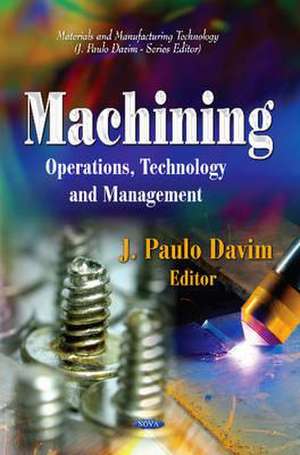
Machining
Editat de J. Paulo Davimen Limba Engleză Hardback – 30 iun 2013
| Toate formatele și edițiile | Preț | Express |
|---|---|---|
| Paperback (1) | 911.49 lei 43-57 zile | |
| SPRINGER LONDON – 12 oct 2010 | 911.49 lei 43-57 zile | |
| Hardback (2) | 919.50 lei 43-57 zile | |
| Nova Science Publishers Inc – 30 iun 2013 | 1111.20 lei 22-36 zile | |
| SPRINGER LONDON – 24 sep 2008 | 919.50 lei 43-57 zile |
Preț: 1111.20 lei
Preț vechi: 1603.30 lei
-31%
196.73€ • 229.07$ • 170.90£
Carte disponibilă
Livrare economică 02-16 februarie
Specificații
ISBN-10: 1621005798
Pagini: 194
Dimensiuni: 261 x 181 x 20 mm
Greutate: 0.64 kg
Editura: Nova Science Publishers Inc
V-ar putea interesa
-
 -24%Preț: 354.63 lei466.22 lei
 -
 The 5S Pocket GuideJames Peterson-16%Preț: 150.48 lei179.88 lei
 -
 Planning and Scheduling in Manufacturing and ServicesMichael L Pinedo-15%Preț: 635.34 lei747.46 lei
 -
 20 Keys to Workplace ImprovementIwao Kobayashi-15%Preț: 436.49 lei513.51 lei
 -
 Quick Changeover for Operators: The SMED SystemShigeo ShingoPreț: 301.50 lei
 -
 Kanban for the ShopfloorProductivity Press Development TeamPreț: 301.81 lei
 -
 Kaizen for the Shop Floor: A Zero-Waste Environment with Process AutomationProductivity Press Development Team-18%Preț: 234.48 lei284.22 lei
 -
 TPM: Collected Practices and CasesProductivity PressPreț: 193.36 lei
 -
 Transfer and Management of KnowledgeC Machado-9%Preț: 947.31 lei1041.00 lei
 -
 Efficiency and Innovation in LogisticsUwe Clausen-24%Preț: 851.17 lei1119.96 lei
 -
 -15%Preț: 623.52 lei733.55 lei
 -
 Preț: 369.36 lei
 -
 -15%Preț: 423.18 lei497.86 lei
Cuprins
Textul de pe ultima copertă
Machining is one of the most important manufacturing processes. Parts manufactured by others processes often require further operations before the product is ready for application. Machining is the broad term used to describe the removal of material from a work-piece. Machining processes can be applied to work metallic and non-metallic materials such as polymers, wood, ceramics and composites.
Machining: Fundamentals and Recent Advances is divided into two parts. The first part explains the fundamentals of machining, with special emphasis on three important aspects: mechanics of machining, tools, and work-piece integrity. The second part is dedicated to recent advances in machining, including: machining of hard materials, machining of metal matrix composites, drilling polymeric matrix composites, ecological machining (using the minimal quantity of lubrication), high-speed machining (sculptured surfaces), grinding technology and new grinding wheels, micro- and nano-machining, non-traditional machining processes, and intelligent machining (computational methods and optimization).
Professional engineers, researchers and advanced students interested or involved in modern manufacturing engineering will find Machining: Fundamentals and Recent Advances an invaluable reference.
Descriere
Machining is one of the most important manufacturing processes. Parts manufactured by other processes often require further operations before the product is ready for application. “Machining: Fundamentals and Recent Advances” is divided into two parts. Part I explains the fundamentals of machining, with special emphasis on three important aspects: mechanics of machining, tools, and work-piece integrity. Part II is dedicated to recent advances in machining, including: machining of hard materials, machining of metal matrix composites, drilling polymeric matrix composites, ecological machining (minimal quantity of lubrication), high-speed machining (sculptured surfaces), grinding technology and new grinding wheels, micro- and nano-machining, non-traditional machining processes, and intelligent machining (computational methods and optimization). Advanced students, researchers and professionals interested or involved in modern manufacturing engineering will find the book a useful reference.
Recenzii
Choice (July 2009) (Reviewer: K. Srinagesh, University of Massachusetts Dartmouth)
Notă biografică
Caracteristici
Includes supplementary material: sn.pub/extras