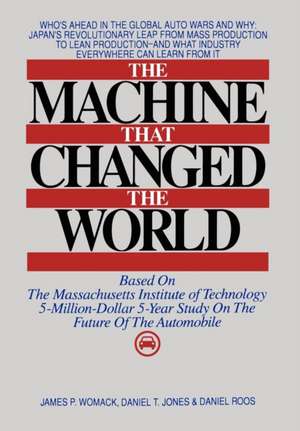
Machine that Changed the World
Autor James P. Womacken Limba Engleză Hardback – 10 oct 1990
Ne-a atras atenția modul în care The Machine That Changed the World redefinește eficiența industrială prin modelul de „lean production”. Acest sistem, propus de James P. Womack, nu este doar o metodă de asamblare, ci un cadru integrat care sudează activitățile de la managementul de vârf până la lucrătorii de linie și furnizori. Funcționează deoarece elimină risipa și permite o reacție aproape instantanee la cerințele pieței, dublând calitatea în timp ce reduce costurile. Recomandăm această lectură pentru rigoarea sa științifică, fiind rezultatul unui studiu masiv de cinci ani desfășurat de MIT în cadrul International Motor Vehicle Program. Ca și Thomas Janoski în The Cambridge International Handbook of Lean Production, autorul distilează experiență reală în principii acționabile, însă James P. Womack se concentrează aici pe tranziția istorică de la producția de masă a lui Ford la superioritatea modelului japonez. Merită menționat că această carte reprezintă punctul de plecare pentru întreaga operă a lui Womack; dacă Lean Thinking extinde aceste concepte către orice tip de afacere, iar Lean Solutions se apleacă asupra experienței consumatorului, titlul de față rămâne documentul programatic ce explică geneza sistemului. Structura cărții este una progresivă și extrem de logică. Primele capitole analizează ascensiunea și declinul producției de masă, pregătind terenul pentru secțiunea centrală dedicată elementelor practice: gestionarea fabricii, coordonarea lanțului de aprovizionare și relația cu clienții. Finalul oferă o perspectivă strategică asupra modului în care această tranziție poate fi completată la nivel global, transformând-o dintr-un manual auto într-un ghid de supraviețuire economică.
Preț: 377.00 lei
Carte disponibilă
Livrare economică 14-28 noiembrie
Specificații
ISBN-10: 0892563508
Pagini: 336
Dimensiuni: 157 x 235 x 24 mm
Greutate: 0.68 kg
Editura: Simon&Schuster
V-ar putea interesa
-
 The Toyota Way FieldbookJeffrey Liker-16%Preț: 226.11 lei269.66 lei
 -
 -17%Preț: 192.26 lei230.54 lei
 -
 -16%Preț: 215.03 lei257.01 lei
 -
 The Essential Deming: Leadership Principles from the Father of QualityW. Edwards Deming-17%Preț: 224.05 lei269.40 lei
 -
 -41%Preț: 215.05 lei364.88 lei
 -
 Taiichi Ohnos Workplace ManagementTaiichi OhnoPreț: 190.98 lei
 -
 Implementing Lean Software Development: From Concept to CashTom PoppendieckPreț: 329.78 lei
 -
 Lean ThinkingJames P. WomackPreț: 226.47 leiRecomandat
 -
 -24%Preț: 176.41 lei231.72 lei
 -
 Leading ChangeJohn P. KotterPreț: 204.20 lei
 -
 Andy & Me: Crisis & Transformation on the Lean JourneyPascal DennisPreț: 317.17 lei
 -
 Leading the Lean Enterprise TransformationGeorge Koenigsaecker-8%Preț: 445.07 lei483.77 lei
 -
 -15%Preț: 411.78 lei484.45 lei
 -
 Lean MarketingAllan DibPreț: 175.82 lei
 -
 The Machine That Changed the WorldJames P. Womack-18%Preț: 77.73 lei94.39 lei
 -
 The Origins of EfficiencyBrian PotterPreț: 248.00 lei
 -
 Lean & Green: Best PracticeDaniel ReichertPreț: 451.09 lei
 -
 -18%Preț: 891.11 lei1086.71 lei
 -
 This is Lean: Resolving the Efficiency ParadoxNiklas ModigPreț: 116.18 lei
 -
 Preț: 144.32 lei
De ce să citești această carte
Recomandăm această carte liderilor de organizații și managerilor operaționali care doresc să înțeleagă rădăcinile eficienței moderne. Veți învăța cum să implementați modelul „lean” pentru a crește productivitatea fără a sacrifica resursele. Este o resursă esențială pentru oricine vrea să transforme o structură rigidă de producție într-o entitate agilă, capabilă să concureze pe o piață globală dominată de standarde de calitate stricte.
Despre autor
James P. Womack a fost directorul de cercetare al International Motor Vehicle Program (IMVP) în cadrul Massachusetts Institute of Technology (MIT) și este o figură centrală în managementul modern. Este fondatorul și președintele Lean Enterprise Institute, o organizație non-profit dedicată explorării și diseminării principiilor gândirii Lean. Prin munca sa de cercetare desfășurată pe parcursul a zeci de ani, Womack a transformat modul în care companiile din întreaga lume abordează eficiența, devenind cel mai influent promotor al sistemului de producție Toyota în mediul de afaceri occidental.
Notă biografică
Daniel Roos, Ph.D. (in civil engineering, MIT), is Director of the International Motor Vehicle Program at MIT.
Descriere
Today, the industrial world is experiencing the most revolutionary change since Henry Ford's assembly line -- which forever changed the way things are made. Japanese companies are sweeping the world, as Western companies and governments struggle to find ways to emulate them.
The Machine That Changed the World points for the first time to a positive way out of this dilemma. It shows that being defeatist about the Japanese threat, and tougher protectionism, are not the answers.
This book outlines the enormous tasks facing Western companies in the 1990s and has cogent messages for Japanese firms as well, as they move abroad.
The Machine That Changed the World is based on the largest and most thorough study ever undertaken in any industry: the Massachusetts Institute of Technology five-million-dollar, five-year, fourteen-country International Motor Vehicle Program's study of the worldwide auto industry.
Twice in this century the auto industry has changed our most fundamental ideas about how to make things. Now it is doing it again. Just as mass production swept away craft production, so a new way of making things, called lean production, is now rapidly making mass production obsolete.
Lean production is the Japanese secret weapon in the industrial wars and is spreading throughout the world. If Western companies and their managers and workers are to survive in the 1990s, they must learn and adapt to lean production. Some of the smartest already have begun to do so.
Lean production welds the activities of everyone from top management to line workers, to suppliers, into a tightly integrated whole that can respond almost instantly to marketing demands from consumers. It can also double production and quality, while keeping costs down. Its adoption, as it inevitably spreads beyond the auto industry, will change almost every industry and consequently how we work, how we live, and the fate of companies and nations as they respond to its impact.
In clear and compelling terms, this book explains what lean production is, and its global implications for all of us.
Cuprins
Contents
ACKNOWLEDGMENTS
BEFORE YOU BEGIN THIS BOOK
1 THE INDUSTRY OF INDUSTRIES IN TRANSITION
THE ORIGINS OF LEAN PRODUCTION
2 THE RISE AND FALL OF MASS PRODUCTION
3 THE RISE OF LEAN PRODUCTION
THE ELEMENTS OF LEAN PRODUCTION
4 RUNNING THE FACTORY
5 DESIGNING THE CAR
6 COORDINATING THE SUPPLY CHAIN
7 DEALING WITH CUSTOMERS
8 MANAGING THE LEAN ENTERPRISE
DIFFUSING LEAN PRODUCTION
9 CONFUSION ABOUT DIFFUSION
10 COMPLETING THE TRANSITION
EPILOGUE
END NOTES
APPENDIXES
A INTERNATIONAL MOTOR VEHICLE
PROGRAM SPONSORING ORGANIZATIONS
B INTERNATIONAL MOTOR VEHICLE
PROGRAM RESEARCH AFFILIATE TEAM
C IMVP PROGRAM AND FORUM PARTICIPANTS
D IMVP PUBLICATIONS LIST
INDEX