
Machine Performance Degradation Assessment: Convex Optimization Models and Their Interpretable Data Fusion Applications
Autor Dong Wang, Tongtong Yanen Limba Engleză Paperback – 24 oct 2025
Real-world applications and examples demonstrate how these innovative methods can be applied in practice. By presenting novel concepts and analytical frameworks, this book offers fresh perspectives to help readers navigate the complexities of machine performance degradation assessment.
- Provides valuable insights on the evolving challenges in machinery performance monitoring and optimization
- Includes the background and roadmaps of machine performance degradation assessment technologies, which are described in-depth
- Presents real-world applications and examples of practical experience
Preț: 876.23 lei
Preț vechi: 1274.39 lei
-31%
Puncte Express: 1314
Carte tipărită la comandă
Livrare economică 14-28 noiembrie
Livrare prin curier în România Termenul estimat este afișat lângă disponibilitate.
Transport gratuit pentru acest produs Plată online sau ramburs, în funcție de opțiunile comenzii.
Retur gratuit în 14 zile Comandă securizată și suport în română.
Specificații
ISBN-13: 9780443440076
ISBN-10: 0443440077
Pagini: 152
Dimensiuni: 152 x 229 x 12 mm
Greutate: 0.3 kg
Editura: ELSEVIER SCIENCE
ISBN-10: 0443440077
Pagini: 152
Dimensiuni: 152 x 229 x 12 mm
Greutate: 0.3 kg
Editura: ELSEVIER SCIENCE
V-ar putea interesa
-
 Introduction to Optimum DesignJasbir Singh Arora-32%Preț: 717.69 lei1057.42 lei
 -
 -14%Preț: 411.69 lei478.71 lei
 -
 Sabiston Textbook of Surgery: The Biological Basis of Modern Surgical PracticeDouglas Scott Tyler-29%Preț: 1167.99 lei1644.95 leiRecomandat
 -
 -39%Preț: 391.86 lei645.65 lei
 -
 -31%Preț: 607.05 lei885.58 lei
 -
 The ScoreC. Thi NguyenPreț: 194.17 lei
 -
 Preț: 204.99 lei
 -
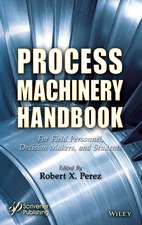 Process Machinery HandbookRobert X Perez-23%Preț: 1946.55 lei2527.99 lei
 -
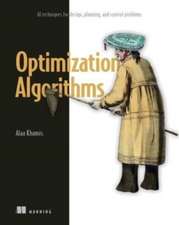 Optimization AlgorithmsAlaa Khamis-20%Preț: 405.89 lei507.37 lei
 -
 -5%Preț: 383.27 lei403.44 leiRecomandat
 -
 -18%Preț: 1281.64 lei1562.97 lei
 -
 -18%Preț: 2436.72 lei2971.60 lei
 -
 -18%Preț: 731.01 lei891.49 lei
 -
 -18%Preț: 1123.42 lei1370.02 lei
 -
 Optimization in Industrial EngineeringErik CuevasPreț: 442.22 lei
 -
 -18%Preț: 758.53 lei925.03 lei
 -
 Optimization Methods and AlgorithmsAnand J. Kulkarni-15%Preț: 559.55 lei658.30 lei
 -
 -18%Preț: 978.80 lei1193.66 lei
 -
 -21%Preț: 553.78 lei703.07 lei
 -
 Preț: 196.84 lei
Cuprins
1. Machine performance degradation assessment
2. Fundamentals of convex optimization
3. Machine degradation processes related mathematical properties
4. Generalized health index weight optimization models based on degradation properties and amplitude fusion in the frequency domain
5. Generalized health index weight optimization models based on fault feature sparsity and amplitude fusion in the envelope spectral domain
6. Conclusions
2. Fundamentals of convex optimization
3. Machine degradation processes related mathematical properties
4. Generalized health index weight optimization models based on degradation properties and amplitude fusion in the frequency domain
5. Generalized health index weight optimization models based on fault feature sparsity and amplitude fusion in the envelope spectral domain
6. Conclusions