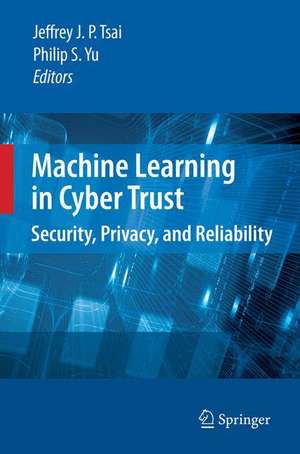
Machine Learning in Cyber Trust
Editat de Jeffrey J P Tsai, Philip S. Yuen Limba Engleză Hardback – 28 apr 2009
Lucrarea Machine Learning in Cyber Trust necesită un nivel de experiență avansat, fiind concepută pentru cititorii care stăpânesc deja fundamentele algoritmilor de învățare automată și doresc să le aplice în contextul critic al securității rețelelor. Recomandăm acest volum celor care caută o trecere de la teorie la implementări practice în sisteme cibernetice complexe. Pe linia practică a volumului Machine Learning for Cyber Physical System: Advances and Challenges, dar cu focus pe fiabilitatea și încrederea (trust) în sistemele distribuite, cartea oferă o perspectivă riguroasă asupra modului în care datele pot fi utilizate pentru a anticipa atacurile. Remarcăm continuitatea academică a editorului Jeffrey J P Tsai, care, spre deosebire de lucrarea sa Compositional Verification of Concurrent and Real-Time Systems — axată pe verificarea formală a sistemelor în timp real — alege aici să exploreze reziliența prin prisma inteligenței artificiale. Structura este organizată progresiv: se pornește de la definirea sistemelor cibernetice fizice ca o „nouă frontieră”, continuând cu secțiuni dedicate detecției anomaliilor prin grafuri și minarea modelelor de intruziune secvențială. Un aspect distinctiv este includerea capitolului despre „păcălirea” algoritmilor (co-opting spam filters), anticipând vulnerabilitățile modelelor de învățare în fața atacurilor adverse. Ultima parte a cărții se concentrează pe fiabilitatea serviciilor Web bazate pe context, oferind o viziune holistică asupra ecosistemului digital actual. Merită menționat că, deși publicată inițial în 2009, fundamentele despre criptarea imaginilor și rețelele neuronale celulare haotice rămân referințe solide pentru cercetarea fundamentală.
Preț: 1033.17 lei
Preț vechi: 1291.45 lei
-20%
Carte disponibilă
Livrare economică 14-28 noiembrie
Specificații
ISBN-10: 0387887342
Pagini: 362
Ilustrații: XVI, 362 p. 100 illus.
Dimensiuni: 164 x 244 x 25 mm
Greutate: 0.67 kg
Ediția:2009 edition
Editura: Springer Us
Locul publicării:New York, NY, United States
V-ar putea interesa
-
 Enhancing Computer Security with Smart TechnologyV. Rao Vemuri-20%Preț: 496.30 lei620.38 lei
 -
 -39%Preț: 394.79 lei646.62 lei
 -
 -20%Preț: 376.22 lei470.27 lei
 -
 Systematic Security: A CISO’s PlaybookTimur Qader-20%Preț: 374.44 lei468.04 leiRecomandat
 -
 Security EngineeringRoss Anderson-20%Preț: 392.75 lei490.94 lei
 -
 Machine Learning For DummiesLuca Massaron-20%Preț: 149.88 lei187.36 lei
 -
 Preț: 123.51 lei
 -
 -20%Preț: 313.75 lei392.20 lei
 -
 -36%Preț: 282.74 lei439.76 lei
 -
 -35%Preț: 274.44 lei425.15 lei
 -
 Advances in AI for Cloud, Edge, and Mobile Computing ApplicationsShrikaant Kulkarni-20%Preț: 1296.62 lei1620.78 lei
 -
 Deep Learning Applications for Cyber SecurityMamoun Alazab-20%Preț: 953.33 lei1191.66 lei
 -
 -18%Preț: 786.19 lei958.76 lei
 -
 Introduction to Machine Learning with SecurityPramod GuptaPreț: 432.16 lei
 -
 -20%Preț: 940.57 lei1175.71 lei
 -
 Data Science and Security: Proceedings of IDSCS 2023Samiksha Shukla-20%Preț: 1404.88 lei1756.10 lei
 -
 AI Applications in Cyber Security and Communication NetworksChaminda Hewage-20%Preț: 1466.35 lei1832.94 lei
 -
 Artificial Intelligence and Cyber Security in Industry 4.0Velliangiri Sarveshwaran-20%Preț: 391.23 lei489.03 lei
 -
 -20%Preț: 1214.51 lei1518.14 lei
 -
 Cyber Security and Digital ForensicsNihar Ranjan Roy-20%Preț: 977.80 lei1222.25 lei
Public țintă
ResearchDe ce să citești această carte
Recomandăm această carte cercetătorilor și inginerilor care dezvoltă sisteme rezistente la atacuri informatice. Cititorul câștigă o înțelegere profundă a modului în care algoritmii de învățare automată pot securiza bazele de date și detecta intruziunile în rețea. Este un instrument esențial pentru cei care vor să treacă de la securitatea reactivă la o abordare proactivă, bazată pe analiza datelor și predicție.
Cuprins
Recenzii
"This is a useful book on machine learning for cyber security applications. It will be helpful to researchers and graduate students who are looking for an introduction to a specific topic in the field. All of the topics covered are well researched. The book consists of 12 chapters, grouped into four parts." (Imad H. Elhajj, ACM Computing Reviews, October, 2009)
Textul de pe ultima copertă
This book contains original materials by leading researchers in the area and covers applications of different machine learning methods in the security, privacy, and reliability issues of cyber space. It enables readers to discover what types of learning methods are at their disposal, summarizing the state of the practice in this important area, and giving a classification of existing work.
Specific features include the following:
- A survey of various approaches using machine learning/data mining techniques to enhance the traditional security mechanisms of databases
- A discussion of detection of SQL Injection attacks and anomaly detection for defending against insider threats
- An approach to detecting anomalies in a graph-based representation of the data collected during the monitoring of cyber and other infrastructures
- An empirical study of seven online-learning methods on the task of detecting malicious executables
- A novel network intrusion detection framework for mining and detecting sequential intrusion patterns
- A solution for extending the capabilities of existing systems while simultaneously maintaining the stability of the current systems
- An image encryption algorithm based on a chaotic cellular neural network to deal with information security and assurance
- An overview of data privacy research, examining the achievements, challenges and opportunities while pinpointing individual research efforts on the grand map of data privacy protection
- An algorithm based on secure multiparty computation primitives to compute the nearest neighbors of records in horizontally distributed data
- An approach for assessing the reliability of SOA-based systems using AI reasoning techniques
- The models, properties, and applications of context-aware Web services, including an ontology-based context model to enable formal description and acquisition of contextual information pertaining to service requestors and services