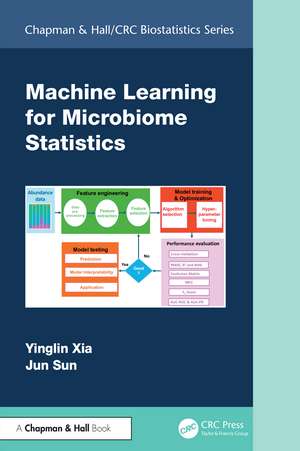
Machine Learning for Microbiome Statistics: Chapman & Hall/CRC Biostatistics Series
Autor Yinglin Xia, Jun Sunen Limba Engleză Hardback – 25 feb 2026
This unique book aims to address the challenges of machine learning statistics, emphasize the importance of performance valuation by appropriate metrics and independent data, and describe several important concepts of machine learning statistics, such as feature engineering and overfitting. It comprehensively reviews commonly used and newly developed machine learning models for microbiome research. Specifically, this book provides the step-by-step procedures to perform machine learning of microbiome data, including feature engineering, algorithm selection and optimization, performance evaluation and model testing. It comments the benefits and limitations of using machine learning for microbiome statistics and remarks on the advantages and disadvantages of each machine learning algorithm.
It will be an excellent reference book for students and academics in the field.
- Presents a thorough overview of machine learning algorithms for microbiome statistics.
- Performs step-by-step procedures to perform machine learning of microbiome data, using important supervised learning algorithms, including classical, ensemble learning and tree-based models.
- Describes important concepts of machine learning, including bias and variance tradeoff, accuracy and precision, overfitting and underfitting, model complexity and interpretability, and feature engineering.
- Investigates and applies various cross-validation techniques step-by-step.
- Introduces confusion matrix and its derived measures. Comprehensively describes the properties of F1, Matthews’ correlation coefficient (MCC), area under the receiver operating characteristic curve (AUC-ROC), and area under the precision-recall curve (AUC-PR), as well as discusses their advantages and disadvantages when using them for microbiome data.
- Offers all related R codes and the datasets from the authors’ first-hand microbiome research and publicly available data.
Din seria Chapman & Hall/CRC Biostatistics Series
- 9%
 Preț: 1388.37 lei
 - 9%
 Preț: 1135.32 lei
 - 9%
 Preț: 821.61 lei
 - 9%
 Preț: 969.20 lei
 -
 Preț: 439.99 lei
 -
 Preț: 455.93 lei
 - 5%
 Preț: 1079.79 lei
 -
 Preț: 492.93 lei
 - 15%
 Preț: 436.67 lei
 - 18%
 Preț: 1134.64 lei
 - 18%
 Preț: 892.90 lei
 -
 Preț: 481.14 lei
 - 18%
 Preț: 790.65 lei
 - 5%
 Preț: 1167.92 lei
 - 18%
 Preț: 924.53 lei
 - 15%
 Preț: 530.47 lei
 - 18%
 Preț: 1264.82 lei
 - 15%
 Preț: 552.07 lei
 - 5%
 Preț: 853.71 lei
 - 5%
 Preț: 877.12 lei
 - 18%
 Preț: 925.30 lei
 - 15%
 Preț: 561.84 lei
 - 18%
 Preț: 925.80 lei
 - 15%
 Preț: 540.75 lei
 - 18%
 Preț: 1125.63 lei
 - 18%
 Preț: 930.08 lei
 - 18%
 Preț: 1010.49 lei
 - 15%
 Preț: 562.20 lei
 -
 Preț: 491.22 lei
 - 5%
 Preț: 1315.61 lei
 - 15%
 Preț: 530.47 lei
 - 18%
 Preț: 722.07 lei
 -
 Preț: 490.14 lei
 - 18%
 Preț: 854.48 lei
 - 5%
 Preț: 467.20 lei
 - 18%
 Preț: 1264.91 lei
 - 5%
 Preț: 1085.31 lei
 - 18%
 Preț: 928.48 lei
 -
 Preț: 477.59 lei
 - 18%
 Preț: 1150.78 lei
 - 5%
 Preț: 2299.17 lei
 -
 Preț: 481.14 lei
 - 8%
 Preț: 435.55 lei
Preț: 1115.07 lei
Preț vechi: 1468.00 lei
-24%
Puncte Express: 1673
Carte indisponibilă temporar
Doresc să fiu notificat când acest titlu va fi disponibil:
Se trimite...
Specificații
ISBN-13: 9781041005247
ISBN-10: 1041005245
Pagini: 680
Ilustrații: 186
Dimensiuni: 156 x 234 mm
Greutate: 1.25 kg
Ediția:1
Editura: CRC Press
Colecția Chapman and Hall/CRC
Seria Chapman & Hall/CRC Biostatistics Series
ISBN-10: 1041005245
Pagini: 680
Ilustrații: 186
Dimensiuni: 156 x 234 mm
Greutate: 1.25 kg
Ediția:1
Editura: CRC Press
Colecția Chapman and Hall/CRC
Seria Chapman & Hall/CRC Biostatistics Series
Public țintă
AcademicCuprins
Preface Acknowledgements Chapter 1 Introduction to Machine Learning Chapter 2 Overview of Machine Learning in Microbiome Research Chapter 3 Accessing Model Accuracy and Goodness-of-Fit Tests for Normality Chapter 4 Overfitting and Underfitting Chapter 5 Assessing Model Accuracy Using Cross-Validation Chapter 6 Feature Engineering and Model Selection Chapter 7 Logistic Regression Chapter 8 Support Vector Machines Chapter 9 Classification Trees Chapter 10 Random Forest Chapter 11 The Evolution of Tree-Based Algorithms Chapter 12 Extreme Gradient Boosting (XGBoost) Chapter 13 Artificial Neural Networks and Deep Learning Chapter 14 Machine Learning Microbiome with SIAMCAT Chapter 15 Basic Performance Metrics for Machine Learning Models Chapter 16 Matthews Correlation Coefficient Chapter 17 Area under the Receiver Operating Characteristic Curve (AUC-ROC) Chapter 18 Area under the Precision-Recall Curve (AUC-PR) Chapter 19 Comparisons of Machine Learning Classification Models with Tidymodels
Notă biografică
Dr. Yinglin Xia is a Clinical Professor in the Department of Medicine at the University of Illinois Chicago. He has published six books on statistical analysis of microbiome and metabolomics data and more than 180 statistical methodology and research papers in peer-reviewed journals. He serves on the editorial boards of several scientific journals including as an Associate Editor of Gut Microbes and has served as a reviewer for over 100 scientific journals.
Dr. Jun Sun is a tenured Professor of Medicine at the University of Illinois Chicago and an internationally recognized expert on microbiome and human diseases, e.g., vitamin D receptor in inflammation, dysbiosis and intestinal dysfunction in amyotrophic lateral sclerosis (ALS). Her lab is the first to discover that chronic effects and molecular mechanisms of Salmonella infection and risk of colon cancer. Dr. Sun has published over 260 scientific articles in peer-reviewed journals and 10 books on microbiome.
Dr. Jun Sun is a tenured Professor of Medicine at the University of Illinois Chicago and an internationally recognized expert on microbiome and human diseases, e.g., vitamin D receptor in inflammation, dysbiosis and intestinal dysfunction in amyotrophic lateral sclerosis (ALS). Her lab is the first to discover that chronic effects and molecular mechanisms of Salmonella infection and risk of colon cancer. Dr. Sun has published over 260 scientific articles in peer-reviewed journals and 10 books on microbiome.
Descriere
This unique book aims to address the challenges of machine learning statistics, emphasize the importance of performance valuation by appropriate metrics and independent data, and describe several important concepts of machine learning statistics, such as feature engineering and overfitting.