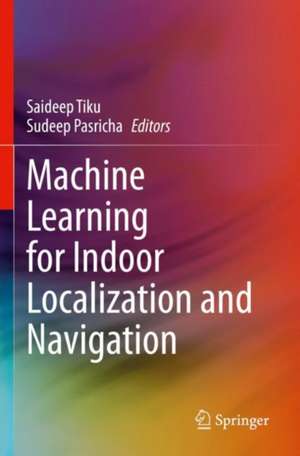
Machine Learning for Indoor Localization and Navigation
Editat de Saideep Tiku, Sudeep Pasrichaen Limba Engleză Paperback – iul 2024
Metodologia propusă în Machine Learning for Indoor Localization and Navigation se concentrează pe arhitecturi de calcul și algoritmi capabili să suplinească absența semnalului GPS în medii controlate sau subterane. Suntem de părere că această lucrare reprezintă un ghid tehnic riguros pentru dezvoltatorii care se confruntă cu atenuarea semnalelor în structuri acoperite sau centre urbane dense. Abordarea autorilor este profund ancorată în optimizarea resurselor, tratând critic limitările dispozitivelor mobile și eterogenitatea acestora, elemente care adesea compromit precizia sistemelor de navigație clasice. Structura volumului reflectă o progresie logică, pornind de la identificarea provocărilor fundamentale și avansând spre tehnici complexe de pattern-matching. Reținem capitolele dedicate rezilienței la variațiile de semnal și utilizarea tehnicilor de deep learning pentru a asigura o navigație robustă în timp real. Un aspect distinctiv este integrarea securității în designul sistemelor de localizare, un subiect critic pentru aplicațiile industriale și IoT. Această perspectivă tehnică diferă de abordarea din Positioning and Navigation Using Machine Learning Methods de Kegen Yu prin faptul că este mai puțin abstractă și mult mai aplicabilă segmentului de sisteme embedded și IoT, oferind soluții specifice pentru constrângerile de energie și putere de procesare. În paginile sale, editorii Saideep Tiku și Sudeep Pasricha compilează strategii pentru implementarea unor framework-uri de localizare pe dispozitive cu resurse limitate, punând accent pe eficiența energetică fără a sacrifica acuratețea. Este o resursă esențială pentru înțelegerea modului în care învățarea automată poate transforma datele brute de la senzori în rute de navigație precise pentru roboți, vehicule și pietoni în spații GPS-deprived.
Preț: 534.39 lei
Preț vechi: 667.99 lei
-20%
Carte disponibilă
Livrare economică 26 octombrie-09 noiembrie
Livrare express 10-16 octombrie pentru 49.71 lei
Specificații
ISBN-10: 3031267141
Pagini: 584
Ilustrații: XV, 567 p. 247 illus., 233 illus. in color.
Dimensiuni: 155 x 235 x 32 mm
Greutate: 0.87 kg
Ediția:2023
Editura: Springer
Locul publicării:Cham, Switzerland
V-ar putea interesa
-
 Ultimate Navigation ManualLyle BrothertonPreț: 145.58 lei
 -
 Preț: 440.31 lei
 -
 -39%Preț: 385.64 lei636.10 lei
 -
 -31%Preț: 607.05 lei885.58 lei
 -
 -15%Preț: 436.67 lei513.73 lei
 -
 Advances in Electronics, Computer, Physical and Chemical SciencesSaiyed Salim Sayeed-15%Preț: 443.43 lei521.69 lei
 -
 Preț: 433.49 lei
 -
 Kalman Filtering: Theory and Practice with MATLABMohinder S. Grewal-5%Preț: 616.46 lei648.91 lei
 -
 Handbook of Position LocationReza Zekavat-23%Preț: 911.43 lei1183.68 lei
 -
 -23%Preț: 1075.78 lei1397.11 lei
 -
 Deep Learning Crash CourseGiovanni Volpe-35%Preț: 284.12 lei439.78 lei
 -
 -36%Preț: 282.10 lei440.30 lei
 -
 Advances in AI for Cloud, Edge, and Mobile Computing ApplicationsShrikaant Kulkarni-20%Preț: 1296.62 lei1620.78 lei
 -
 Wireless Networks and Industrial IoTNurul Huda Mahmood-20%Preț: 1048.53 lei1310.67 lei
 -
 -24%Preț: 815.88 lei1073.53 lei
 -
 -24%Preț: 981.00 lei1290.79 lei
 -
 IoT Sensors, ML, AI and XAI: Empowering A Smarter WorldBiswajeet Pradhan-20%Preț: 1246.80 lei1558.50 lei
 -
 -20%Preț: 531.38 lei664.22 lei
 -
 -18%Preț: 1004.18 lei1224.62 lei
 -
 AI and MicroservicesDileep Kumar Pandiya-20%Preț: 263.90 lei329.88 lei
De ce să citești această carte
Recomandăm această carte inginerilor de sistem și cercetătorilor în IoT care au nevoie de soluții practice pentru navigația în spații închise. Cititorul câștigă acces la tehnici de optimizare a modelelor de machine learning pentru hardware limitat, învățând cum să gestioneze variațiile de semnal și securitatea datelor. Este un instrument indispensabil pentru proiectarea sistemelor de navigație autonome în medii industriale sau urbane complexe.
Despre autor
Volumul este coordonat de Saideep Tiku și Sudeep Pasricha, experți recunoscuți în domeniul sistemelor embedded și al arhitecturilor de calcul. Sudeep Pasricha deține o experiență vastă în optimizarea sistemelor integrate și a rețelelor on-chip, fiind profesor și cercetător cu numeroase contribuții în designul sistemelor eficiente energetic. Expertiza lor combinată asigură o perspectivă unitară asupra modului în care algoritmii de machine learning pot fi adaptați pentru a rula eficient pe dispozitive IoT, facilitând tranziția de la cercetarea teoretică la implementarea în condiții reale de teren.
Descriere scurtă
- Provides comprehensive coverage of the application of machine learning to the domain of indoor localization;
- Presents techniques to adapt and optimize machine learning models for fast, energy-efficient indoor localization;
- Covers design and deployment of indoor localization frameworks on mobile, IoT, and embedded devices in real conditions.
Cuprins
Notă biografică
Sudeep Pasricha is a Walter Scott Jr. College of Engineering Professor in the Department of Electrical and Computer Engineering, the Department of Computer Science, and the Department of Systems Engineering at Colorado State University. He is Director of the Embedded, High Performance, and Intelligent Computing(EPIC) Laboratory and the Chair of Computer Engineering. Prof. Pasricha received the B.E. degree in Electronics and Communication Engineering from Delhi Institute of Technology, India, in 2000, and his Ph.D. in Computer Science from the University of California, Irvine in 2008. He joined Colorado State University (CSU) in 2008. Prior to joining CSU, he spent several years working in STMicroelectronics and Conexant Inc. Prof. Pasricha’s research broadly focuses on software algorithms, hardware architectures, and hardware-software co-design for energy-efficient, fault-tolerant, real-time, and secure computing. These efforts target multi-scale computing platforms, including embedded and Internet of Things (IoT) systems, cyber-physical systems, mobile devices, and datacenters. He has received funding for his research from various sponsors such as the NSF, SRC, AFOSR, ORNL, DoD, Fiat-Chrysler, and NASA. He has co-authored five books, contributed to several book chapters, and published morethan 250 research articles in peer-reviewed conferences, journals, and books. Prof. Pasricha has received 16 Best Paper Awards and Nominations at various IEEE and ACM conferences, including at DAC, ASPDAC, NOCS, GLSVLSI, SLIP, AICCSA, and ISQED. Other notable awards include: the 2022 ACM Distinguished Speaker selection, 2019 George T. Abell Outstanding Research Faculty Award, the 2016-2018 University Distinguished Monfort Professorship, 2016-2019 Walter Scott Jr. College of Engineering Rockwell-Anderson Professorship, 2018 IEEE-CS/TCVLSI mid-career research
Achievement Award, the 2015 IEEE/TCSC Award for Excellence for a mid-career researcher, the 2014 George T. Abell Outstanding Mid-career Faculty Award, and the 2013 AFOSR Young Investigator Award.
Prof. Pasricha is currently the Vice Chair and Conference Chair of ACM SIGDA and a Senior Associate Editor for the ACM Journal of Emerging Technologies in Computing (JETC). He is currently or has been an Associate Editorfor the ACM Transactions on Embedded Computing Systems (TECS), IEEE Transactions on Computer-Aided Design of Integrated Circuits and Systems (TCAD), IEEE Consumer Electronics (CM), and IEEE Design & Test of Computers (D&T). He also serves as the Chair of the steering committee of IEEE Transactions on Sustainable Computing (TSUSC). He is currently or has been an Organizing Committee Member of several IEEE/ACM conferences such as DAC, ESWEEK, ICCAD, GLSVLSI, NOCS, RTCSA, etc. He has served as the General Chair for various IEEE/ACM conferences such as NOCS, HCW, IGSC, iSES, ICESS, etc.; and as Program Chair for CODES+ISSS, NOCS, IGSC, iNIS, VLSID, HCW, DAC PhD Forum, ICCAD Cadathlon, etc. He is also in the Technical Program Committee of several IEEE/ACM conferences such as DAC, DATE, ICCAD, ICCD, NOCS, etc. He holds an affiliate faculty member position at the Center for Embedded and Cyber-Physical Systems at UC Irvine. He has also received multiple awards for professional service,including the 2019 ACM SIGDA Distinguished Service Award, the 2015 ACM SIGDA Service Award, and the 2012 ACM SIGDA Technical Leadership Award.