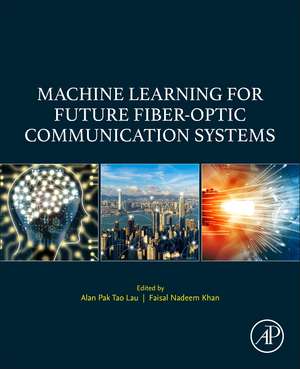
Machine Learning for Future Fiber-Optic Communication Systems
Editat de Alan Pak Tao Lau, Faisal Nadeem Khanen Limba Engleză Paperback – 15 feb 2022
Recomandăm Machine Learning for Future Fiber-Optic Communication Systems inginerilor de cercetare și dezvoltare, cercetătorilor universitari din domeniul fotonicii și studenților la masterat sau doctorat specializați în procesarea semnalelor. Această lucrare, publicată de ELSEVIER SCIENCE, reprezintă o sinteză tehnică riguroasă a modului în care algoritmii de învățare automată pot transforma infrastructura rețelelor optice în sisteme capabile de auto-gestionare și diagnoză.
Observăm o organizare progresivă a conținutului, structurată în 15 capitole tematice. Volumul debutează cu o introducere în conceptele de bază ale învățării automate, trecând rapid la aplicații practice în sisteme de transport pe distanțe lungi (long-haul) și rețele optice pasive. Pe linia practică a volumului Machine Learning and Wireless Communications, dar cu focus pe infrastructura de fibră optică, textul explorează tehnici de Deep Learning, inclusiv rețele neuronale convoluționale (CNN) și generative (GAN), aplicate pentru optimizarea dispozitivelor fotonice și codarea canalelor.
Remarcăm profunzimea cu care sunt tratate subiecte critice precum estimarea calității transmisiei (QoT), protecția împotriva defecțiunilor prin tehnici cognitive și securitatea rețelelor prin detecția intruziunilor. Spre deosebire de Optical and Wireless Communications, care oferă o perspectivă hibridă, lucrarea de față se concentrează strict pe provocările specifice mediului optic, oferind soluții pentru rețelele cu margini reduse de eroare și sisteme de comunicații cuantice. Tonul este unul tehnic, axat pe rezultate din cercetarea de ultimă oră și practici industriale, fiind un instrument de lucru esențial pentru designul viitoarelor rețele inteligente.
Preț: 676.81 lei
Preț vechi: 906.04 lei
-25%
Carte tipărită la comandă
Livrare economică 30 noiembrie-14 decembrie
Specificații
ISBN-10: 0323852270
Pagini: 402
Dimensiuni: 191 x 235 mm
Greutate: 0.69 kg
Editura: ELSEVIER SCIENCE
V-ar putea interesa
-
 Introduction to Fiber-Optic CommunicationsRongqing Hui-27%Preț: 766.77 lei1050.37 lei
 -
 Understanding Deep LearningSimon J. D. Prince-20%Preț: 636.22 lei795.27 lei
 -
 -38%Preț: 398.93 lei646.62 lei
 -
 -31%Preț: 607.05 lei885.58 lei
 -
 Computation, Optimization, and Machine Learning in SeismologySubhashis Mallick-23%Preț: 727.15 lei944.34 lei
 -
 -20%Preț: 1290.56 lei1613.21 lei
 -
 Optimization AlgorithmsAlaa Khamis-20%Preț: 405.89 lei507.37 lei
 -
 -20%Preț: 249.08 lei311.36 lei
 -
 Deep Learning Crash CourseGiovanni Volpe-35%Preț: 290.92 lei445.81 lei
 -
 Practical Deep Learning, 2nd Edition: A Python-Based IntroductionRonald T. Kneusel-35%Preț: 333.73 lei515.68 lei
 -
 Web, Artificial Intelligence and Network ApplicationsLeonard Barolli-20%Preț: 1255.62 lei1569.53 lei
 -
 Springer Handbook of Optical NetworksBiswanath Mukherjee-18%Preț: 2092.64 lei2552.00 lei
 -
 Computational Intelligence in Recent Communication NetworksMariya Ouaissa-20%Preț: 1319.88 lei1649.85 lei
 -
 Machine Learning for NetworkingÉric Renault-20%Preț: 431.67 lei539.58 lei
 -
 -15%Preț: 482.13 lei567.21 lei
 -
 Futuristic Communication and Network TechnologiesA. Sivasubramanian-24%Preț: 2192.98 lei2885.50 lei
 -
 Communication and Intelligent SystemsHarish Sharma-20%Preț: 1385.71 lei1732.14 lei
Public țintă
R&D engineers in optical communications; University researchers in photonicsDe ce să citești această carte
Recomandăm această carte specialiștilor care doresc să integreze inteligența artificială în designul rețelelor de telecomunicații. Cititorul câștigă o înțelegere aplicată a algoritmilor ML și DL pentru monitorizarea performanței și optimizarea resurselor. Este un ghid practic indispensabil pentru a trece de la rețelele optice statice la cele cognitive, capabile de auto-configurare și securitate avansată.
Descriere scurtă
With up-to-date coverage and extensive treatment of various important topics related to machine learning for fiber-optic communication systems, this book is an invaluable reference for photonics researchers and engineers. It is also a very suitable text for graduate students interested in ML-based signal processing and networking.
- Discusses the reasons behind the recent popularity of machine learning (ML) concepts in modern optical communication networks and the why/where/how ML can play a unique role
- Presents fundamental ML techniques like artificial neural networks (ANNs), support vector machines (SVMs), K-means clustering, expectation-maximization (EM) algorithm, principal component analysis (PCA), independent component analysis (ICA), reinforcement learning, and more
- Covers advanced deep learning (DL) methods such as deep neural networks (DNNs), convolutional neural networks (CNNs), recurrent neural networks (RNNs), and generative adversarial networks (GANs)
- Individual chapters focus on ML applications in key areas of optical communications and networking
Cuprins
2. ML techniques for long-haul systems
3. ML techniques for IM/DD systems
4. ML techniques for passive optical networks
5. ML for end-to-end learning of complete fiber-optic communication system
6. ML methods for QoT estimation and optical performance monitoring
7. ML-based adaptive network resources allocation, control and management
8. ML-assisted cognitive network fault protection and management
9. ML for cross-layer optimizations and automated network operation in SDNs
10. ML for network security management, and attacks and intrusions detection
11. ML for low-margin optical networking
12. ML for quantum optical communication systems
13. ML for intelligent testing and measurement equipment
14. ML for design and optimization of photonic devices and sub-systems
15. ML for channel coding