
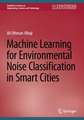
Machine Learning for Environmental Noise Classification in Smart Cities: Synthesis Lectures on Engineering, Science, and Technology
Autor Ali Othman Albajien Limba Engleză Paperback – 8 apr 2025
| Toate formatele și edițiile | Preț | Express |
|---|---|---|
| Paperback (1) | 427.32 lei 38-44 zile | |
| Springer – 8 apr 2025 | 427.32 lei 38-44 zile | |
| Hardback (1) | 406.82 lei 3-5 săpt. | |
| Springer Nature Switzerland – 23 mar 2024 | 406.82 lei 3-5 săpt. |
Din seria Synthesis Lectures on Engineering, Science, and Technology
- 18%
 Preț: 704.61 lei
 -
 Preț: 416.43 lei
 -
 Preț: 429.93 lei
 -
 Preț: 409.58 lei
 - 15%
 Preț: 481.36 lei
 -
 Preț: 403.00 lei
 -
 Preț: 234.44 lei
 -
 Preț: 211.70 lei
 -
 Preț: 308.34 lei
 - 20%
 Preț: 571.88 lei
 - 15%
 Preț: 493.49 lei
 - 20%
 Preț: 565.51 lei
 -
 Preț: 377.12 lei
 -
 Preț: 370.26 lei
 -
 Preț: 410.48 lei
 -
 Preț: 369.36 lei
 -
 Preț: 259.02 lei
 -
 Preț: 206.14 lei
 - 15%
 Preț: 507.69 lei
 - 15%
 Preț: 388.57 lei
 - 15%
 Preț: 561.12 lei
 -
 Preț: 337.37 lei
 - 15%
 Preț: 507.69 lei
 - 15%
 Preț: 615.35 lei
 - 15%
 Preț: 506.13 lei
 -
 Preț: 320.04 lei
 -
 Preț: 420.98 lei
 -
 Preț: 411.41 lei
 -
 Preț: 400.79 lei
 - 18%
 Preț: 697.98 lei
 - 15%
 Preț: 503.76 lei
 - 15%
 Preț: 620.07 lei
 -
 Preț: 404.05 lei
 -
 Preț: 494.63 lei
 -
 Preț: 406.82 lei
 - 15%
 Preț: 510.83 lei
 - 15%
 Preț: 508.48 lei
 - 15%
 Preț: 509.25 lei
 -
 Preț: 248.87 lei
 -
 Preț: 399.39 lei
 -
 Preț: 277.41 lei
 -
 Preț: 158.92 lei
 -
 Preț: 439.24 lei
 -
 Preț: 184.49 lei
 -
 Preț: 230.76 lei
 -
 Preț: 156.42 lei
Preț: 427.32 lei
Puncte Express: 641
Preț estimativ în valută:
75.50€ • 86.76$ • 65.40£
75.50€ • 86.76$ • 65.40£
Carte tipărită la comandă
Livrare economică 02-08 mai
Specificații
ISBN-13: 9783031546693
ISBN-10: 3031546695
Pagini: 188
Dimensiuni: 168 x 240 x 11 mm
Greutate: 0.33 kg
Editura: Springer
Seria Synthesis Lectures on Engineering, Science, and Technology
ISBN-10: 3031546695
Pagini: 188
Dimensiuni: 168 x 240 x 11 mm
Greutate: 0.33 kg
Editura: Springer
Seria Synthesis Lectures on Engineering, Science, and Technology
V-ar putea interesa
-
 Just Enough Data Science and Machine LearningMark LevenePreț: 327.74 lei
 -
 Why Sound MattersDamon KrukowskiPreț: 127.52 lei
 -
 -40%Preț: 369.43 lei616.13 lei
 -
 The Echo MachineDavid PakmanPreț: 146.43 lei
 -
 The Soundscape: Our Sonic Environment and the Tuning of the WorldR Murray SchaferPreț: 96.73 lei
 -
 Computation, Optimization, and Machine Learning in SeismologySubhashis Mallick-20%Preț: 746.25 lei932.82 lei
 -
 -19%Preț: 480.10 lei592.72 lei
 -
 -23%Preț: 1237.51 lei1607.15 lei
 -
 The Data Hero PlaybookMalcolm Hawker-20%Preț: 165.58 lei206.97 lei
 -
 Machine Learning For DummiesJohn Paul Mueller-20%Preț: 170.84 lei213.55 lei
 -
 Grokking Machine LearningLuis Serrano-20%Preț: 329.68 lei412.10 lei
 -
 PythonMartin Czygan-20%Preț: 693.27 lei866.59 lei
 -
 Listening to the Music the Machines MakeRichard Evans-18%Preț: 86.34 lei105.36 lei
 -
 Preț: 429.93 lei
 -
 -15%Preț: 572.64 lei673.69 lei
 -
 Advances in Machine Learning and Big Data Analytics IIAshokkumar Patel-18%Preț: 1174.02 lei1431.73 lei
 -
 -24%Preț: 973.78 lei1281.28 lei
 -
 Artificial Intelligence and Machine Learning with RBernd Heesen-20%Preț: 299.92 lei374.90 lei
 -
 -18%Preț: 965.31 lei1177.21 lei
Cuprins
Introduction. - Literature Review. - Research Methodology. - Results and Discussion. - Conclusion and Recommendations.
Notă biografică
Ali Othman Albaji received a bachelor’s degree in electrical engineering specializing in “General communications” from the Civil Aviation Higher College, Tripoli, Libya, in 2007, and a Master’s degree in electronics and telecommunication engineering from University Technology Malaysia *UTM*, Johor Bahru, Malaysia in 2022. His research interests are Machine Learning (ML), IoT, Wireless Sensor Networks (WSN), VSAT, SCADA Systems, Optical Networking, Wireless Communications, Deep Learning (DL), Artificial intelligence (AI), Web design, Robotics, and Programming Languages expert / Traineron ( Python, MATLAB, JAVA, JAVA Script, SQL, Data Base MSQL, C++, HTML, and....ETC).
Textul de pe ultima copertă
We present a Machine Learning (ML) approach to monitoring and classifying noise pollution. Both methods of monitoring and classification have been proven successful. MATLAB and Python code was generated to monitor all types of noise pollution from the collected data, while ML was trained to classify these data. ML algorithms showed promising performance in monitoring the different sound classes such as highways, railways, trains and birds, airports and many more. It is observed that all the data obtained by both methods can be used to control noise pollution levels and for data analytics. They can help decision making and policy making by stakeholders such as municipalities, housing authorities and urban planners in smart cities. The findings indicate that ML can be used effectively in monitoring and measurement. Improvements can be obtained by enhancing the data collection methods. The intention is to develop more ML platforms from which to construct a less noisy. The second objective of this study was to visualize and analyze the data of 18 types of noise pollution that have been collected from 16 different locations in Malaysia. All the collected data were stored in Tableau software. Through the use of both qualitative and quantitative measurements, the data collected for this project was then combined to create a noise map database that can help smart cities make informed decisions.
In addition, this book:
- Machine learning-based sound classifier for environmental noise
- Qualitative analysis of community perceptions based on a noise pollution survey
- Create an interactive web dashboard and data warehousing for intelligent analytics reporting
Caracteristici
Machine learning-based sound classifier for environmental noise Qualitative analysis of community perceptions based on a noise pollution survey Create an interactive web dashboard and data warehousing for intelligent analytics reporting