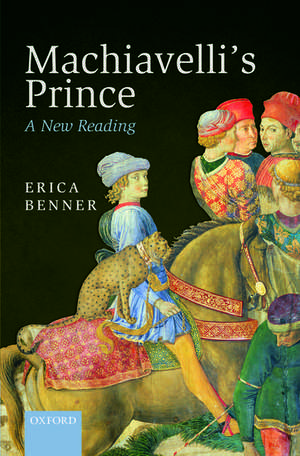
Machiavelli's Prince: A New Reading
Autor Erica Benneren Limba Engleză Hardback – 28 noi 2013
Preț: 871.81 lei
Preț vechi: 1264.36 lei
-31%
Puncte Express: 1308
Carte tipărită la comandă
Livrare economică 20 noiembrie-01 decembrie
Livrare prin curier în România Termenul estimat este afișat lângă disponibilitate.
Transport gratuit pentru acest produs Plată online sau ramburs, în funcție de opțiunile comenzii.
Retur gratuit în 14 zile Comandă securizată și suport în română.
Specificații
ISBN-13: 9780199653638
ISBN-10: 0199653631
Pagini: 400
Dimensiuni: 162 x 237 x 30 mm
Greutate: 0.75 kg
Editura: Oxford University Press
Colecția OUP Oxford
Locul publicării:Oxford, United Kingdom
ISBN-10: 0199653631
Pagini: 400
Dimensiuni: 162 x 237 x 30 mm
Greutate: 0.75 kg
Editura: Oxford University Press
Colecția OUP Oxford
Locul publicării:Oxford, United Kingdom
V-ar putea interesa
-
 NonviolenceMark KurlanskyPreț: 118.28 lei
 -
 Tall Tales about the Mind and Brain: Separating fact from fictionSergio Della Sala-28%Preț: 501.43 lei692.91 lei
 -
 -11%Preț: 347.11 lei390.64 lei
 -
 -21%Preț: 410.74 lei518.63 lei
 -
 -12%Preț: 305.43 lei348.35 lei
 -
 Essays on the History of Moral PhilosophyJ. B. Schneewind-21%Preț: 374.95 lei477.54 lei
 -
 Machiavelli, Hobbes, and RousseauJohn Plamenatz-31%Preț: 712.38 lei1032.00 lei
 -
 Of Men and Manners: Essays Historical and PhilosophicalAnthony Quinton-28%Preț: 539.14 lei753.65 lei
 -
 -24%Preț: 142.90 lei188.54 lei
 -
 Cosmos and PsycheRichard TarnasPreț: 136.06 lei
 -
 MorrisWilliam MorrisPreț: 317.34 lei
 -
 -19%Preț: 511.38 lei631.33 lei
 -
 StirnerMax StirnerPreț: 444.78 lei
 -
 Preț: 306.52 lei
 -
 -19%Preț: 467.69 lei577.39 lei
 -
 A History of Western Educational IdeasProfessor Peter Gordon-8%Preț: 436.52 lei474.48 lei
 -
 -15%Preț: 453.11 lei533.08 lei
 -
 Possible WorldsJ.B.S. HaldanePreț: 440.94 lei
 -
 The Normal and the PathologicalGeorges CanguilhemPreț: 215.63 lei
Recenzii
Every student of Machiavelli will benefit from reading this book.
Benner's book provides a great service to Machiavelli scholars . . . Because of her close reading and erudition, Benner points out much that is questionable in The Prince that could otherwise be missed (and which many scholars have missed). This is no small achievement. Benner's greatest interpretive innovation, however, does not stem from this close reading alone, but from having identified certain normatively laden code words that color Machiavelli's . . . seemingly neutral depiction of events and counsel.
The depth in which [Benner] pursues her interpretation . . . sets this book apart from previous studies . . . Benner's familiarity with the work of Tacitus, Livy and Plutarch enables her to identify dissonances that may have been more evident to Machiavelli and his classically educated contemporaries than they are to modern readers. Benner's book convincingly demonstrates the multi-layered complexity of Machiavelli's text, which she argues should be approached as a profoundly ambiguous piece of writing.
A welcome arrival, [this book] is a carefully considered examination that sheds much light on Machiavellis text and rhetoric . . . Benners excavation of Machiavellis subtle critique of empire and account of Cesare Borgias failures are particularly strong.
In this powerful and provocative re-reading, Erica Benner, the author of Machiavellis Ethics (2009), boldly challenges conventional wisdom concerning Machiavelli's purposes in the Prince by revealing his artful and subtle use of irony and dissimulation, informed by ancient philosophical techniques. Benner's stimulating reinterpretation is a "must read" that will compel you to rethink everything you thought you knew about the Prince.
This is a carefully constructed analysis of Machiavelli's Prince will be the interpretation to beat for the next generation of scholars. Where criticism customarily distinguishes what Machiavelli is doing in the Prince from his Discourses, Benner's appreciation of Machiavelli's mastery of irony allows her to present them as woven wholly from the same cloth. The result is a deeply informed, innovative, and thoroughly republican reading of Machiavelli's notorious handbook for tyrants.
Erica Benner's Machiavelli's Prince: A New Reading thoroughly lives up to its title. No other work before has so comprehensively interrogated the structure, rhetoric and sources of Machiavelli's infamous "little book." Benner draws upon the individual figures invoked by the Florentine to shine new light on the ultimate purposes of Machiavelli's lessons. Moreover, Benner rigorously interrogates Machiavelli's use of irony to highlight his argumentative strategy in a novel way. This book serves as a must-read during this 500th anniversary of the composition of Il Principe, and will continue to be required reading for many years to come.
The depth in which she pursues her interpretation, through detailed analysis of chapter after chapter from The Prince, also sets this book apart from previous studies ... a useful and thought-provoking contribution to the ongoing scholarly debate about this famous and controversial work.
Benner's book provides a great service to Machiavelli scholars . . . Because of her close reading and erudition, Benner points out much that is questionable in The Prince that could otherwise be missed (and which many scholars have missed). This is no small achievement. Benner's greatest interpretive innovation, however, does not stem from this close reading alone, but from having identified certain normatively laden code words that color Machiavelli's . . . seemingly neutral depiction of events and counsel.
The depth in which [Benner] pursues her interpretation . . . sets this book apart from previous studies . . . Benner's familiarity with the work of Tacitus, Livy and Plutarch enables her to identify dissonances that may have been more evident to Machiavelli and his classically educated contemporaries than they are to modern readers. Benner's book convincingly demonstrates the multi-layered complexity of Machiavelli's text, which she argues should be approached as a profoundly ambiguous piece of writing.
A welcome arrival, [this book] is a carefully considered examination that sheds much light on Machiavellis text and rhetoric . . . Benners excavation of Machiavellis subtle critique of empire and account of Cesare Borgias failures are particularly strong.
In this powerful and provocative re-reading, Erica Benner, the author of Machiavellis Ethics (2009), boldly challenges conventional wisdom concerning Machiavelli's purposes in the Prince by revealing his artful and subtle use of irony and dissimulation, informed by ancient philosophical techniques. Benner's stimulating reinterpretation is a "must read" that will compel you to rethink everything you thought you knew about the Prince.
This is a carefully constructed analysis of Machiavelli's Prince will be the interpretation to beat for the next generation of scholars. Where criticism customarily distinguishes what Machiavelli is doing in the Prince from his Discourses, Benner's appreciation of Machiavelli's mastery of irony allows her to present them as woven wholly from the same cloth. The result is a deeply informed, innovative, and thoroughly republican reading of Machiavelli's notorious handbook for tyrants.
Erica Benner's Machiavelli's Prince: A New Reading thoroughly lives up to its title. No other work before has so comprehensively interrogated the structure, rhetoric and sources of Machiavelli's infamous "little book." Benner draws upon the individual figures invoked by the Florentine to shine new light on the ultimate purposes of Machiavelli's lessons. Moreover, Benner rigorously interrogates Machiavelli's use of irony to highlight his argumentative strategy in a novel way. This book serves as a must-read during this 500th anniversary of the composition of Il Principe, and will continue to be required reading for many years to come.
The depth in which she pursues her interpretation, through detailed analysis of chapter after chapter from The Prince, also sets this book apart from previous studies ... a useful and thought-provoking contribution to the ongoing scholarly debate about this famous and controversial work.
Notă biografică
Erica Benner is Fellow in Ethics and Political philosophy at Yale University. She previously taught at Oxford University and the London School of Economics. She is the author of Really Existing Nationalisms (OUP 1995), Machiavelli's Ethics (PUP 2009), and many publications in the ethics of nationalism and self-determination.