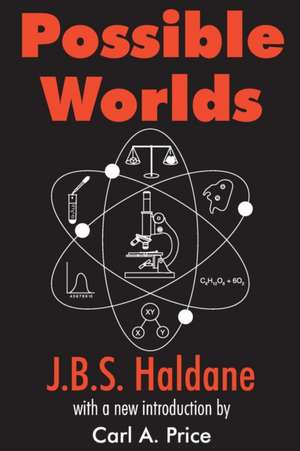
Possible Worlds
Autor J.B.S. Haldaneen Limba Engleză Paperback – 30 sep 2001
Preț: 440.94 lei
Puncte Express: 661
Carte indisponibilă temporar
Livrare prin curier în România Termenul estimat este afișat lângă disponibilitate.
Transport gratuit pentru acest produs Plată online sau ramburs, în funcție de opțiunile comenzii.
Retur gratuit în 14 zile Comandă securizată și suport în română.
Specificații
ISBN-13: 9780765807151
ISBN-10: 0765807157
Pagini: 352
Dimensiuni: 156 x 234 x 23 mm
Greutate: 0.52 kg
Ediția:1
Editura: Taylor & Francis
Colecția Routledge
Locul publicării:Oxford, United Kingdom
ISBN-10: 0765807157
Pagini: 352
Dimensiuni: 156 x 234 x 23 mm
Greutate: 0.52 kg
Ediția:1
Editura: Taylor & Francis
Colecția Routledge
Locul publicării:Oxford, United Kingdom
V-ar putea interesa
-
 Political Science and IdeologyWilliam ConnollyPreț: 460.39 lei
 -
 Preț: 448.56 lei
 -
 The Process of Politics: A Comparative ApproachJorgen RasmussenPreț: 461.37 lei
 -
 Iranian Intellectuals: 1997–2007Lloyd Ridgeon-18%Preț: 1112.85 lei1357.14 lei
 -
 Iranian Intellectuals: 1997–2007Lloyd RidgeonPreț: 457.33 lei
 -
 Commonwealth PrinciplesJonathan ScottPreț: 348.61 lei
 -
 The Sea! the Sea!Tim Rood-21%Preț: 159.65 lei202.05 lei
 -
 -18%Preț: 1121.97 lei1368.25 lei
 -
 Preț: 485.82 lei
 -
 Origins of the OtherSamuel MoynPreț: 132.52 lei
 -
 Everything Has a HistoryJbs HaldanePreț: 199.00 lei
 -
 Heredity and PoliticsJbs HaldanePreț: 439.48 lei
 -
 A.R.P - Air Raid PrecautionsJ. B. S. HaldanePreț: 225.30 lei
 -
 Preț: 188.28 lei
 -
 The Uncertain SciencesBruce MazlishPreț: 485.23 lei
 -
 Thorstein VeblenDavid RiesmanPreț: 462.35 lei
 -
 Offbeat: Collaborating with KerouacDavid AmramPreț: 395.45 lei
 -
 Preț: 397.72 lei
Cuprins
On Scales; Some Dates; On Being the Right Size; Darwinism To-Day; Enzymes; Vitamins; Man as a Sea Beast; Food Control in Insect Societies; Oxygen Want; Water Poisoning and Salt Poisoning; Immunity; Blood Transfusion; Cancer Research; The Fight With Tuberculosis; Food Poisoning; The Time Factor in Medicine; On Being One’s Own Rabbit; What Use is Astronomy?; Kant and Scientific Thought; Thomas Henry Huxley; William Bateson; The Future of Biology; Nationality and Research; Scientific Research for Amateurs; Should Scientific Research be Rewarded?; Science and Politics; Eugenics and Social Reform; Occupational Mortality; When I am Dead 1; The Duty of Doubt; Science and Theology as Art Forms; Meroz; Some Enemies of Science; Possible Worlds; The Last Judgment; Epilogue
Descriere
Haldane advanced genetics, population biology and evolutionary theory. This volume emphasizes important developments in natural sciences in the early-20th century. It describes Haldane's views on society, art, religion and economy as seen through the eyes of a politically alert major scientist.