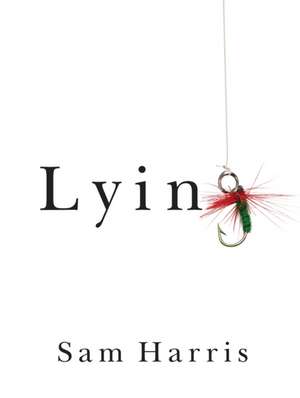
Lying
Autor Sam Harris Editat de Annaka Harrisen Limba Engleză Hardback – 5 noi 2013
Bazându-ne pe datele furnizate de autor și pe structura acestui eseu de tip long-form, Lying reprezintă o analiză chirurgicală a unui comportament uman universal, dar rareori chestionat riguros. Ne-a atras atenția modul în care Sam Harris alege să nu se concentreze doar pe marile înșelătorii publice, ci mai ales pe minciunile „albe” — acele neadevăruri spuse din dorința de a proteja sentimentele celorlalți. Apreciem faptul că autorul, fidel stilului său analitic dezvoltat în The Moral Landscape, tratează onestitatea nu ca pe o virtute abstractă, ci ca pe o problemă de optimizare socială și personală. Textul este organizat progresiv, de la definirea conceptului de minciună și analiza „oglinzii onestității”, până la situații extreme și conceptul de „mental accounting” — efortul cognitiv epuizat pentru a menține o rețea de minciuni. Comparabil cu A Pack of Lies de J. A. Barnes în rigurozitatea cu care analizează contextul social al înșelătoriei, Lying se diferențiază prin perspectiva neuroștiințifică a lui Harris, fiind actualizat pentru un cititor interesat de etica aplicată și eficiența comunicării. Spre deosebire de The Four Horsemen, unde dialogul este unul polemic și larg, aici Harris adoptă un ton introspectiv și pragmatic, oferind în anexă chiar și un set de răspunsuri la întrebările cititorilor pentru a clarifica dilemele morale cotidiene. Este o lucrare scurtă, dar densă, care completează temele despre conștiință și liber arbitru explorate ulterior în Waking Up și Free Will.
Preț: 93.21 lei
Carte disponibilă
Livrare economică 13-27 noiembrie
Specificații
ISBN-10: 1940051002
Pagini: 108
Dimensiuni: 113 x 172 x 20 mm
Greutate: 0.2 kg
Editura: INGRAM PUBLISHER SERVICES
V-ar putea interesa
-
 The End of FaithSam HarrisPreț: 102.83 lei
 -
 The Four HorsemenChristopher HitchensPreț: 134.73 lei
 -
 The Moral LandscapeSam Harris-18%Preț: 65.65 lei79.89 lei
 -
 Letter to a Christian NationSam Harris-20%Preț: 85.49 lei106.57 lei
 -
 Cultural Fault Lines in Healthcare: Reflections on Cultural CompetencyMichael C. Brannigan-23%Preț: 310.19 lei405.11 lei
 -
 -17%Preț: 60.06 lei72.52 lei
 -
 -25%Preț: 307.47 lei407.50 lei
 -
 A General Economy of Travel: Identity, Memory, and DeathAfshin Hafizi-27%Preț: 275.28 lei377.48 lei
 -
 Subjective MoralsSteve F. Sapontzis-14%Preț: 313.67 lei362.73 lei
 -
 Socrates' Criteria: A Libertarian InterpretationTommi Juhani Hanhijärvi-27%Preț: 253.22 lei348.71 lei
 -
 -21%Preț: 306.46 lei390.00 lei
 -
 Character and CopsEdwin J. DelattrePreț: 419.96 lei
 -
 Powerhouse RoadRonald Maloney MaloneyPreț: 125.29 lei
 -
 Preț: 387.19 lei
 -
 -15%Preț: 459.26 lei540.30 lei
 -
 Free WillSam Harris-20%Preț: 51.46 lei64.02 lei
 -
 HamSam HarrisPreț: 121.07 lei
 -
 Preț: 103.50 lei
 -
 Waking UpSam Harris-19%Preț: 63.98 lei78.67 lei
 -
 Living Our Values: Faith in ActionEdward L. FeltonPreț: 149.58 lei
Recenzii de la cititorii Books Express
Andrei Joldoş a dat nota:
Review-ul e legat de calitatea cărții fizice, nu a conținutului: e mică, îngustă, cu font-uri mici și foarte incomod de citit. Sunt foarte dezamăgit de acest aspect, considerând că costă 80 RON și are 105 pagini. Nu o recomand.
De ce să citești această carte
Recomandăm această carte oricărui cititor interesat de filozofie practică și psihologie. Lying nu este un manual de moralitate religioasă, ci un argument rațional pentru simplificarea existenței. Veți câștiga o perspectivă nouă asupra modului în care onestitatea radicală poate consolida relațiile și elimina stresul mental cauzat de gestionarea propriilor invenții, totul într-un format compact, ușor de parcurs într-o singură după-amiază.
Despre autor
Sam Harris (n. 1967) este un filosof, neurocercetător și autor american de succes, cunoscut ca una dintre figurile centrale ale „Noului Ateism” alături de Richard Dawkins și Christopher Hitchens. Cu un doctorat în neuroștiințe la UCLA, Harris explorează în lucrările sale intersecția dintre știință, etică și spiritualitate seculară. Prima sa carte, The End of Faith, a fost un fenomen editorial, fiind urmată de titluri de referință precum The Moral Landscape și Waking Up. Prin podcastul său, Making Sense, el continuă să influențeze dezbaterea publică asupra raționalității și inteligenței artificiale.
Cuprins
What is A Lie?
The Mirror of Honesty
Two Types of Lies
White Lies
Trust
Faint Praise
Secrets
Lies in Extremis
Mental Accounting
Integrity
Big Lies
Conclusion
Appendix 1: An Interview with Ron A. Howard
Appendix 2: Ten Questions from Readers
Acknowledgements
Notes
Recenzii
"This essay is quite brilliant. (I was hoping it would be, so I wouldn't have to lie.) I honestly loved it from beginning to end. Lying is the most thought-provoking read of the year."
— Ricky Gervais
"Humans have evolved to lie well, and no doubt you've seen the social lubrication at work. In many cases, we might not think of it as a true "lie": perhaps a "white lie" once in a blue moon, the omission of a sensitive detail here and there, false encouragement of others when we see no benefit in dashing someone's hopes, and the list goes on. In Lying, Sam Harris demonstrates how to benefit from being brutally—but pragmatically—honest. It's a compelling little book with a big impact."
— Tim Ferriss, author of the New York Times bestsellers, The 4-Hour Body, The 4-Hour Workweek, and The 4-Hour Chef
"In this brief but illuminating work, Sam Harris applies his characteristically calm and sensible logic to a subject that affects us all—the human capacity to lie. And by the book's end, Harris compels you to lead a better life because the benefits of telling the truth far outweigh the cost of lies—to yourself, to others, and to society."
— Neil deGrasse Tyson, Astrophysicist, American Museum of Natural History
Notă biografică
Mr. Harris's writing has been published in more than 15 languages. He and his work have been discussed in The New York Times, Time, Scientific American, Nature, Newsweek, Rolling Stone, The Atlantic, and many other journals. His writing has appeared in The New York Times, the Los Angeles Times, The Economist, Newsweek, The Times (London), The Boston Globe, The Atlantic, The Annals of Neurology, and elsewhere.
Mr. Harris is a cofounder and the CEO of Project Reason, a nonprofit foundation devoted to spreading scientific knowledge and secular values in society. He received a degree in philosophy from Stanford University and a Ph.D. in neuroscience from UCLA.
Descriere
In Lying, best-selling author and neuroscientist Sam Harris argues that we can radically simplify our lives and improve society by merely telling the truth in situations where others often lie. He focuses on "white" lies—those lies we tell for the purpose of sparing people discomfort—for these are the lies that most often tempt us. And they tend to be the only lies that good people tell while imagining that they are being good in the process.