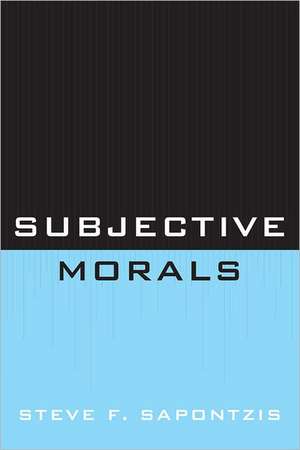
Subjective Morals
Autor Steve F. Sapontzisen Limba Engleză Paperback – 17 noi 2011
Preț: 313.67 lei
Preț vechi: 362.73 lei
-14%
Puncte Express: 471
Carte tipărită la comandă
Livrare economică 26 noiembrie-10 decembrie
Livrare prin curier în România Termenul estimat este afișat lângă disponibilitate.
Transport gratuit de la 400.00 lei Plată online sau ramburs, în funcție de opțiunile comenzii.
Retur gratuit în 14 zile Comandă securizată și suport în română.
Specificații
ISBN-13: 9780761856856
ISBN-10: 0761856854
Pagini: 218
Dimensiuni: 155 x 232 x 12 mm
Greutate: 0.31 kg
Editura: Bloomsbury Publishing
Colecția University Press of America
Locul publicării:New York, United States
ISBN-10: 0761856854
Pagini: 218
Dimensiuni: 155 x 232 x 12 mm
Greutate: 0.31 kg
Editura: Bloomsbury Publishing
Colecția University Press of America
Locul publicării:New York, United States
V-ar putea interesa
-
 Probability in the Philosophy of ReligionJake Chandler-31%Preț: 663.16 lei961.46 lei
 -
 Freedom, God, and WorldsMichael J. Almeida-31%Preț: 600.88 lei872.05 lei
 -
 -31%Preț: 659.66 lei959.33 lei
 -
 Divine Teaching and the Way of the World: A Defense of Revealed ReligionSamuel Fleischacker-20%Preț: 354.31 lei444.30 lei
 -
 Kant's Elliptical PathKarl Ameriks-21%Preț: 356.79 lei450.34 lei
 -
 Spirituality: What It Is and Why It MattersRoger S. Gottlieb-12%Preț: 335.75 lei379.62 lei
 -
 The New Testament and the People of GodNt WrightPreț: 382.42 lei
 -
 Imagining the KingdomJames K. A. SmithPreț: 149.47 lei
 -
 The Highest Poverty: Monastic Rules and Form-of-LifeGiorgio AgambenPreț: 133.54 lei
 -
 Theology in the Age of Global AIDS & HIVC. TrentazPreț: 383.15 lei
 -
 The Evolving God: Charles Darwin on the Naturalness of ReligionProfessor J. David PleinsPreț: 205.33 lei
 -
 God's Final Victory: A Comparative Philosophical Case for UniversalismProfessor John Kronen-25%Preț: 278.18 lei369.61 lei
 -
 CS Lewis vs the New AtheistsPeter S. WilliamsPreț: 140.63 lei
 -
 God: A Guide for the PerplexedKeith WardPreț: 68.78 lei
 -
 Models of God and Alternative Ultimate RealitiesJeanine Diller-18%Preț: 1415.25 lei1725.92 lei
Cuprins
Introduction
Chapter One: Starting with the Eye of the Beholder
1. No value without feeling
2. The primary argument
3. Three supporting arguments
4. Answering six common objections
5. Plato's rejection of subjective morals
Chapter Two: Axiology, More Complicated Than It Looks
1. Categorizing values
2. Derivative value
3. Direct value
4. Immediate value
5. Summary of categories
6. Imperatives and priorities
7. Answering Plato's cart-before-the-horse objection
Chapter Three: Varieties of Truth and Justification
1. Objectivity or bust
2. Circumstantial and contextual truth
3. Historical truth
4. Varieties of justification
5. Context-based justification
6. Summary
Chapter Four: A Phenomenology of Moral Values
1. Methodology
2. Origin
3. Subject matter
4. Functions
5. Concern
6. Priority
7. Extension: Impersonality, impartiality, inescapability, common sensicality, diversity
8. Summary and coordination
Chapter Five: Moral Relativism
1. Cultural relativism
2. The compulsion for moral values to be objective
3. Why should I be moral?
Chapter Six: The Right and the not so Good
1. Evaluating morality
2. The brighter side of morality: social coexistence
3. The brighter side: "true happiness"
4. The brighter side: nonhuman welfare
5. The darker side of morality: happiness
6. The darker side: liberty
7. The darker side: punishment, exploitation, intolerance, and zealotry
8. Circularity
9. An eye for an eye
10. Heat versus light
Chapter Seven: Inferences, Observations, and Speculations
1. Empathy, respect, and negative functioning
2. Moral persuasion
3. Religious morality
4. Recommendations
Chapter One: Starting with the Eye of the Beholder
1. No value without feeling
2. The primary argument
3. Three supporting arguments
4. Answering six common objections
5. Plato's rejection of subjective morals
Chapter Two: Axiology, More Complicated Than It Looks
1. Categorizing values
2. Derivative value
3. Direct value
4. Immediate value
5. Summary of categories
6. Imperatives and priorities
7. Answering Plato's cart-before-the-horse objection
Chapter Three: Varieties of Truth and Justification
1. Objectivity or bust
2. Circumstantial and contextual truth
3. Historical truth
4. Varieties of justification
5. Context-based justification
6. Summary
Chapter Four: A Phenomenology of Moral Values
1. Methodology
2. Origin
3. Subject matter
4. Functions
5. Concern
6. Priority
7. Extension: Impersonality, impartiality, inescapability, common sensicality, diversity
8. Summary and coordination
Chapter Five: Moral Relativism
1. Cultural relativism
2. The compulsion for moral values to be objective
3. Why should I be moral?
Chapter Six: The Right and the not so Good
1. Evaluating morality
2. The brighter side of morality: social coexistence
3. The brighter side: "true happiness"
4. The brighter side: nonhuman welfare
5. The darker side of morality: happiness
6. The darker side: liberty
7. The darker side: punishment, exploitation, intolerance, and zealotry
8. Circularity
9. An eye for an eye
10. Heat versus light
Chapter Seven: Inferences, Observations, and Speculations
1. Empathy, respect, and negative functioning
2. Moral persuasion
3. Religious morality
4. Recommendations