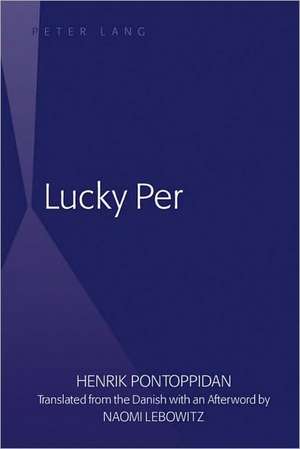
Lucky Per
Autor Henrik Pontoppidanen Limba Engleză Paperback – 5 oct 2010
Ce înseamnă să îți construiești propriul destin atunci când moștenirea ta este ancorată într-un conservatorism religios rigid? În Lucky Per, urmărim parcursul lui Per Sidenius, fiul unui preot din Iutlanda, care își părăsește familia pentru a cuceri capitala daneză. Nu este doar o fugă de trecut, ci o vânătoare asiduă a succesului, pe care Per îl percepe ca pe o fiară ce trebuie capturată și îmblânzită. Proiectul său vizionar de a transforma peisajul Danemarcei printr-un sistem inovator de canale devine simbolul ambiției sale tehnocratice, o încercare de a repoziționa o națiune mică pe harta lumii. Observăm cum autorul Henrik Pontoppidan construiește o narațiune densă, în care realismul social cel mai pur se întâlnește cu structura arhetipală a basmului. Relația lui Per cu Jakobe Salomon, o figură feminină de o profunzime rară în literatura europeană, oferă romanului o dimensiune intelectuală și emoțională care transcende simpla ascensiune socială. Cititorul care a apreciat respingerea valorilor vechi și a dogmelor religioase din Niels Lyhne de J. P. Jacobsen va găsi aici o temă similară a conflictului dintre individ și tradiție — însă, spre deosebire de melancolia lui Jacobsen, Pontoppidan oferă o analiză mai vastă a societății în plină transformare. Stilul este sobru, dar bogat în detalii, invitând la o reflecție asupra distincției fine dintre norocul exterior și fericirea interioară, o dilemă pe care Per o va dezlega abia spre amurgul existenței sale.
Preț: 573.35 lei
Preț vechi: 623.21 lei
-8%
Carte tipărită la comandă
Livrare economică 16-21 noiembrie
Specificații
ISBN-10: 143311092X
Pagini: 558
Dimensiuni: 146 x 223 x 32 mm
Greutate: 0 kg
Ediția:Nouă
Editura: Peter Lang Gmbh, Internationaler Verlag Der W
V-ar putea interesa
-
 -32%Preț: 800.48 lei1179.13 lei
 -
 -13%Preț: 304.17 lei350.40 lei
 -
 Selected Letters of Charlotte BrontëMargaret Smith-28%Preț: 540.50 lei753.81 lei
 -
 German Literature: A Very Short IntroductionNicholas Boyle-19%Preț: 57.66 lei71.43 lei
 -
 Jane AustenMarilyn Butler-21%Preț: 55.21 lei69.54 lei
 -
 Rehearsal from Shakespeare to SheridanTiffany Stern-28%Preț: 353.63 lei492.26 lei
 -
 -33%Preț: 2100.19 lei3123.65 lei
 -
 -19%Preț: 359.45 lei445.30 lei
 -
 -28%Preț: 450.18 lei624.86 lei
 -
 Love Poems of John KeatsJohn KeatsPreț: 61.35 lei
 -
 -18%Preț: 1119.36 lei1365.07 lei
 -
 Preț: 60.95 lei
 -
 Brief Lives: Gustave FlaubertAndrew BrownPreț: 94.69 lei
 -
 Cahiers / Notebooks 1Paul Valéry-27%Preț: 890.18 lei1219.42 lei
 -
 -22%Preț: 189.50 lei243.57 lei
De ce să citești această carte
Recomandăm această lectură celor pasionați de marile romane europene de secol XIX care explorează criza de identitate a omului modern. Este o oportunitate rară de a descoperi o operă fundamentală a literaturii daneze, tradusă în limba engleză, care analizează prețul ambiției și conflictul dintre progresul tehnic și valorile spirituale. Cititorul va câștiga o perspectivă profundă asupra modului în care mediul social modelează sau frânge caracterul uman.
Despre autor
Henrik Pontoppidan (1857–1943) a fost un romancier danez de prim rang, laureat al Premiului Nobel pentru Literatură în 1917. Fiu de pastor, la fel ca protagonistul său cel mai faimos, Pontoppidan a abandonat studiile de inginerie pentru a se dedica scrisului, devenind o figură centrală a „Marii Rupturi Moderne” în literatura scandinavă. Opera sa este marcată de un realism critic și o dorință de a expune contradicțiile societății daneze, de la satele sărace până la saloanele burgheze din Copenhaga, fiind considerat un cronicar neobosit al tranziției țării sale către modernitate.
Notă biografică
Descriere scurtă
Descriere
Social realism and fairy tale combine in Lucky Per, a bildungsroman about the ambitious son of a clergyman who rejects his faith and flees a restricted life in rural Jutland for Denmark's capital city. Per is a gifted young man who firmly believes that 'you had to hunt down luck as if it were a wild creature, a crooked-fanged beast ... and capture and bind it'. He falls in with Copenhagen's Jewish community, and falls for Jakobe Salomon, a wealthy heiress, who is not only the strongest character in the book but among the great Jewish heroines of European literature. Per becomes obsessed with a grand engineering scheme that he believes will both reshape Denmark's landscape and correct its minor position in the world. Eventually personal and his career ambitions alike come to grief. At the heart of Lucky Per lies the question of the relationship of 'luck' to 'happiness' (the Danish word in the title can have both meanings), a relationship which Per comes to view differently by the end of his life.