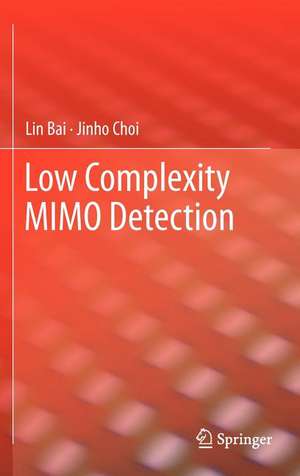
Low Complexity MIMO Detection
Autor Lin Bai, Jinho Choien Limba Engleză Hardback – 7 ian 2012
Preț: 667.41 lei
Preț vechi: 785.19 lei
-15%
Puncte Express: 1001
Carte tipărită la comandă
Livrare economică 30 noiembrie-14 decembrie
Livrare prin curier în România Termenul estimat este afișat lângă disponibilitate.
Transport gratuit pentru acest produs Plată online sau ramburs, în funcție de opțiunile comenzii.
Retur gratuit în 14 zile Comandă securizată și suport în română.
Specificații
ISBN-13: 9781441985828
ISBN-10: 1441985824
Pagini: 256
Ilustrații: XXVI, 230 p.
Dimensiuni: 160 x 241 x 17 mm
Greutate: 0.5 kg
Ediția:2012
Editura: Springer
Locul publicării:New York, NY, United States
ISBN-10: 1441985824
Pagini: 256
Ilustrații: XXVI, 230 p.
Dimensiuni: 160 x 241 x 17 mm
Greutate: 0.5 kg
Ediția:2012
Editura: Springer
Locul publicării:New York, NY, United States
V-ar putea interesa
-
 -14%Preț: 754.84 lei877.72 lei
 -
 Passive Imaging with Ambient NoiseJosselin Garnier-20%Preț: 869.55 lei1086.95 lei
 -
 Preț: 424.15 lei
 -
 Modern MeasurementsFerrero-9%Preț: 883.20 lei970.55 lei
 -
 Combining Pattern ClassifiersKuncheva-9%Preț: 747.40 lei821.31 lei
 -
 Real-Time Progressive Hyperspectral Image ProcessingChein-I Chang-18%Preț: 947.20 lei1155.12 lei
 -
 Advanced Color Image Processing and AnalysisChristine Fernandez-Maloigne-18%Preț: 1000.35 lei1219.95 lei
 -
 Noise-Driven Phenomena in Hysteretic SystemsMihai Dimian-15%Preț: 666.97 lei784.67 lei
 -
 3D Future Internet MediaTasos Dagiuklas-18%Preț: 985.70 lei1202.07 lei
 -
 Preț: 377.32 lei
 -
 -18%Preț: 908.45 lei1107.86 lei
 -
 Connected Media in the Future Internet EraAhmet Kondoz-15%Preț: 663.37 lei780.43 lei
 -
 An Introduction to 3D PrintingVictoria ZukasPreț: 225.45 lei
 -
 Preț: 70.35 lei
 -
 Low Complexity MIMO ReceiversLin Bai-18%Preț: 986.31 lei1202.82 lei
 -
 -15%Preț: 681.22 lei801.43 lei
 -
 Dense Image Correspondences for Computer VisionTal Hassner-15%Preț: 670.25 lei788.53 lei
 -
 Image Processing and Communications Challenges 7Ryszard S. Chora¿-20%Preț: 958.66 lei1198.32 lei
 -
 Advances in Face Detection and Facial Image AnalysisMichal KawulokPreț: 418.50 lei
 -
 Emotion, Affect and Personality in SpeechSwati JoharPreț: 362.18 lei
 -
 Hyperspectral Image ProcessingLiguo Wang-15%Preț: 674.07 lei793.03 lei
 -
 -20%Preț: 1259.79 lei1574.75 lei
Public țintă
ResearchCuprins
Introduction.- Part I: Point to Point MIMO.- Background of MIMO Detection.- List and Lattice Reduction-based Methods.- Partial MAP-based Detection.- Lattice Reduction-based List Detection.- Detection for Underdetermined MIMO Systems.- Part II: Multiuser MIMO.- Selection Criteria of Single User.- Selection Criteria of Multiple Users.- Conclusion.
Notă biografică
Jianwei Liu, received the Ph.D. in communication engineering from Xidian University, China in 1998, and his B.S. and M.S. degrees in electronic engineering from Shandong University, China in 1985 and 1988. He is currently a professor and dean of School of Cyber Science and Technology, Beihang University. His current research interests include cryptographic protocol design, security on wireless and mobile network, network security, and cryptography and its applications. He has published 7 books, 2 monographs and more than 200 papers in his research fields. He is a senior member of the Chinese Institute of Electronics, and managing director of the Chinese Association for Cryptologic Research, and managing director of Chinese Institute of Command and Control, and member of Teaching Steering Committee of Cyberspace Security of MOE, China, and member of the Academic Degrees Committee of the State Council. He has been awarded the first prize of technological invention of China. He is a expert obtaining the special allowance of State Council. He is a Member of the IEEE.
Lin Bai, received the B.Sc. degree in electronic and information engineering from the Huazhong University of Science and Technology, Wuhan, China, in 2004, the M.Sc. degree (Hons.) in communication systems from the University of Wales, Swansea, U.K., in 2007, and the Ph.D. degree in advanced telecommunications from the School of Engineering, Swansea University, U.K., in 2010. Since 2011, he has been with Beihang University, Beijing, China, where he is currently a Professor at the School of Cyber Science and Technology. His research interests include multiple-input multiple-output (MIMO), Internet-of Things (IoT), and unmanned aerial vehicle (UAV) communications. He has authored two books published by Springer in 2012 and 2014. He has served as a Symposium Co-Chair of IEEE GLOBECOM 2019 and a Tutorial Co-Chair of IEEE/CIC ICCC 2019. He is the founding Chair of IEEE ComSoc Wireless Communications Technical Committee Special Interest Group (SIG) on Space Air Ground Integrated (SAGI) Communications. He has served as an Editor for IEEE TRANSACTIONS ON SIGNAL PROCESSING and IEEE WIRELESS COMMUNICATIONS LETTERS, a Lead Guest Editor for IEEE Wireless Communications, and a Guest Editor for IEEE INTERNET OF THINGS JOURNAL. He is currently serving as an Editor for IEEE TRANSACTIONS ON WIRELESS COMMUNICATIONS and the Managing Editor for Journal of Communications and Information Networks. He is a Distinguished Lecturer of the IEEE Communications Society and the IEEE Vehicular Technology Society.
Chunxiao Jiang, received the B.S. degree in information engineering from Beihang University, Beijing in 2008 and the Ph.D. degree in electronic engineering from Tsinghua University, Beijing in 2013, both with the highest honors. From 2011 to 2012 (as a Joint Ph.D) and 2013 to 2016 (as a Postdoc), he was in the Department of Electrical and Computer Engineering at Universityof Maryland College Park under the supervision of Prof. K. J. Ray Liu. He is currently an associate professor in School of Information Science and Technology, Tsinghua University. His research interests include application of game theory, optimization, and statistical theories to communication, networking, and resource allocation problems, in particular space networks and heterogeneous networks. Dr. Jiang has served as an Editor of IEEE Transactions on Communications, IEEE Internet of Things Journal, IEEE Wireless Communications, IEEE Network, IEEE Communications Letters, and a Guest Editor of IEEE Communications Magazine, IEEE Transactions on Network Science and Engineering and IEEE Transactions on Cognitive Communications and Networking. He has also served as a member of the technical program committee as well as the Symposium Chair for a number of international conferences, including IEEE Globecom 2021 Symposium Chair, IEEE CNS 2020 Publication Chair, IEEE WCSP 2019 Symposium Chair, IEEE ICC 2018 Symp
Textul de pe ultima copertă
Methods of signal detection are becoming an ever more vital component of wireless services, as providers lean towards using multiple antennae to compensate for limitations in the available wireless spectrum. The co-authors of this book are two of the world’s leading authorities on so-called MIMO (multiple-input, multiple-output) systems, and here they share the key findings of their years of research. They detail a range of important techniques for signal detection when multiple transmitted and received signals are available. They then review and explain some conventional MIMO detection schemes, including the ML, linear, and SIC detectors, and show why these methodologies are less than optimal compared to the more versatile list decoding and lattice reduction-aided detection systems. In the second part of the book, the authors move on to discuss various user selection schemes in multiuser systems.
Its finely tuned balance of theoretical analysis and practical applications makes this book required reading for graduate students and wireless communications engineers, while its stepwise mode of presentation, from the elementary to the profound level, makes it remarkably accessible, given the complexities of the field.
Its finely tuned balance of theoretical analysis and practical applications makes this book required reading for graduate students and wireless communications engineers, while its stepwise mode of presentation, from the elementary to the profound level, makes it remarkably accessible, given the complexities of the field.
Caracteristici
Introduces Low Complexity MIMO detection Provides Matlab based simulation platform which helps readers to build up their own codes Focuses on lattice reduction based list detection within MIMO detection systems