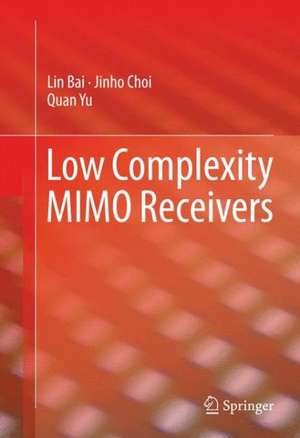
Low Complexity MIMO Receivers
Autor Lin Bai, Jinho Choi, Quan Yuen Limba Engleză Hardback – 31 mar 2014
Preț: 986.31 lei
Preț vechi: 1202.82 lei
-18%
Puncte Express: 1479
Carte tipărită la comandă
Livrare economică 30 noiembrie-14 decembrie
Livrare prin curier în România Termenul estimat este afișat lângă disponibilitate.
Transport gratuit pentru acest produs Plată online sau ramburs, în funcție de opțiunile comenzii.
Retur gratuit în 14 zile Comandă securizată și suport în română.
Specificații
ISBN-13: 9783319049830
ISBN-10: 3319049836
Pagini: 324
Ilustrații: XXVI, 296 p. 59 illus.
Dimensiuni: 160 x 241 x 22 mm
Greutate: 0.6 kg
Ediția:2014
Editura: Springer
Locul publicării:Cham, Switzerland
ISBN-10: 3319049836
Pagini: 324
Ilustrații: XXVI, 296 p. 59 illus.
Dimensiuni: 160 x 241 x 22 mm
Greutate: 0.6 kg
Ediția:2014
Editura: Springer
Locul publicării:Cham, Switzerland
V-ar putea interesa
-
 -14%Preț: 754.84 lei877.72 lei
 -
 Preț: 424.15 lei
 -
 Low Complexity MIMO DetectionLin Bai-15%Preț: 617.26 lei726.18 lei
 -
 Radio Freq. Sys. Arch. & DesignJohn W M Rogers-18%Preț: 957.54 lei1167.73 lei
 -
 Preț: 70.35 lei
 -
 -27%Preț: 1218.84 lei1660.40 lei
 -
 Preț: 378.09 lei
 -
 -18%Preț: 924.36 lei1127.27 lei
 -
 Optical Switching in Next Generation Data CentersFrancesco Testa-18%Preț: 1044.31 lei1273.55 lei
 -
 Sustainable Cloud and Energy ServicesWilson Rivera-18%Preț: 984.00 lei1200.01 lei
 -
 -15%Preț: 663.68 lei780.80 lei
 -
 Topic Detection and Classification in Social Networks: The Twitter CaseDimitrios Milioris-15%Preț: 613.49 lei721.74 lei
 -
 -17%Preț: 428.43 lei516.18 lei
 -
 Switching RelationsSverre August Christensen-8%Preț: 467.30 lei507.94 lei
 -
 Synchronisation TechniquesLi Zhang-8%Preț: 398.33 lei432.97 lei
 -
 Media Handling for Conferencing in Mobile Ad Hoc NetworksDhafer Ben Khedher-8%Preț: 398.33 lei432.97 lei
 -
 Voice Driven Emotion ReconstructionAISHAH ABDUL RAZAKPreț: 311.78 lei
 -
 Mobile, Ubiquitous, and Intelligent ComputingJames J. (Jong Hyuk) Park-18%Preț: 1287.38 lei1569.97 lei
 -
 IASON Semantic Content Management SystemJohannes GrunenbergPreț: 312.32 lei
 -
 Information and Communication TechnologyDurgesh Kumar Mishra-18%Preț: 951.85 lei1160.79 lei
 -
 Concurrency Control in Distributed System Using Mutual ExclusionSukhendu Kanrar-15%Preț: 639.27 lei752.08 lei
 -
 Space Science and Communication for SustainabilityWayan Suparta-18%Preț: 984.16 lei1200.19 lei
 -
 SPATIAL MULTIDIMENSION COOPER TRANSMISS THEORIES & KEY TECHXianling Liang Zhenyu Xiao Ro Lin Bai-20%Preț: 878.17 lei1097.71 lei
 -
 Space Information NetworksQuan Yu-20%Preț: 325.40 lei406.75 lei
Public țintă
ResearchCuprins
Introduction.- Signal Processing at Receivers: Detection Theory.- MIMO Detection: Vector Space Signal Detection.- Successive Interference Cancellation Based MIMO Detection.- Lattice Reduction Based MIMO Detection.- MIMO Iterative Receivers.- Bit-Wise MIMO-BICM-ID using Lattice Reduction.- Randomized Sampling-based MIMO Iterative Receivers.- Iterative Channel Estimation and Detection.- Multiuser and Multicell MIMO Systems: The Use of Lattice Reduction.
Notă biografică
Jianwei Liu, received the Ph.D. in communication engineering from Xidian University, China in 1998, and his B.S. and M.S. degrees in electronic engineering from Shandong University, China in 1985 and 1988. He is currently a professor and dean of School of Cyber Science and Technology, Beihang University. His current research interests include cryptographic protocol design, security on wireless and mobile network, network security, and cryptography and its applications. He has published 7 books, 2 monographs and more than 200 papers in his research fields. He is a senior member of the Chinese Institute of Electronics, and managing director of the Chinese Association for Cryptologic Research, and managing director of Chinese Institute of Command and Control, and member of Teaching Steering Committee of Cyberspace Security of MOE, China, and member of the Academic Degrees Committee of the State Council. He has been awarded the first prize of technological invention of China. He is a expert obtaining the special allowance of State Council. He is a Member of the IEEE.
Lin Bai, received the B.Sc. degree in electronic and information engineering from the Huazhong University of Science and Technology, Wuhan, China, in 2004, the M.Sc. degree (Hons.) in communication systems from the University of Wales, Swansea, U.K., in 2007, and the Ph.D. degree in advanced telecommunications from the School of Engineering, Swansea University, U.K., in 2010. Since 2011, he has been with Beihang University, Beijing, China, where he is currently a Professor at the School of Cyber Science and Technology. His research interests include multiple-input multiple-output (MIMO), Internet-of Things (IoT), and unmanned aerial vehicle (UAV) communications. He has authored two books published by Springer in 2012 and 2014. He has served as a Symposium Co-Chair of IEEE GLOBECOM 2019 and a Tutorial Co-Chair of IEEE/CIC ICCC 2019. He is the founding Chair of IEEE ComSoc Wireless Communications Technical Committee Special Interest Group (SIG) on Space Air Ground Integrated (SAGI) Communications. He has served as an Editor for IEEE TRANSACTIONS ON SIGNAL PROCESSING and IEEE WIRELESS COMMUNICATIONS LETTERS, a Lead Guest Editor for IEEE Wireless Communications, and a Guest Editor for IEEE INTERNET OF THINGS JOURNAL. He is currently serving as an Editor for IEEE TRANSACTIONS ON WIRELESS COMMUNICATIONS and the Managing Editor for Journal of Communications and Information Networks. He is a Distinguished Lecturer of the IEEE Communications Society and the IEEE Vehicular Technology Society.
Chunxiao Jiang, received the B.S. degree in information engineering from Beihang University, Beijing in 2008 and the Ph.D. degree in electronic engineering from Tsinghua University, Beijing in 2013, both with the highest honors. From 2011 to 2012 (as a Joint Ph.D) and 2013 to 2016 (as a Postdoc), he was in the Department of Electrical and Computer Engineering at Universityof Maryland College Park under the supervision of Prof. K. J. Ray Liu. He is currently an associate professor in School of Information Science and Technology, Tsinghua University. His research interests include application of game theory, optimization, and statistical theories to communication, networking, and resource allocation problems, in particular space networks and heterogeneous networks. Dr. Jiang has served as an Editor of IEEE Transactions on Communications, IEEE Internet of Things Journal, IEEE Wireless Communications, IEEE Network, IEEE Communications Letters, and a Guest Editor of IEEE Communications Magazine, IEEE Transactions on Network Science and Engineering and IEEE Transactions on Cognitive Communications and Networking. He has also served as a member of the technical program committee as well as the Symposium Chair for a number of international conferences, including IEEE Globecom 2021 Symposium Chair, IEEE CNS 2020 Publication Chair, IEEE WCSP 2019 Symposium Chair, IEEE ICC 2018 Symp
Textul de pe ultima copertă
Multiple-input multiple-output (MIMO) systems can increase the spectral efficiency in wireless communications. However, the interference becomes the major drawback that leads to high computational complexity at both transmitter and receiver. In particular, the complexity of MIMO receivers can be prohibitively high. As an efficient mathematical tool to devise low complexity approaches that mitigate the interference in MIMO systems, lattice reduction (LR) has been widely studied and employed over the last decade. The co-authors of this book are world's leading experts on MIMO receivers, and here they share the key findings of their research over years. They detail a range of key techniques for receiver design as multiple transmitted and received signals are available. The authors first introduce the principle of signal detection and the LR in mathematical aspects. They then move on to discuss the use of LR in low complexity MIMO receiver design with respect to different aspects, including uncoded MIMO detection, MIMO iterative receivers, receivers in multiuser scenarios, and multicell MIMO systems.
Caracteristici
Introduces the use of lattice reduction in MIMO receiver design
Examines implementation of MIMO hardware and lattice reduction techniques
Investigates LR-based MIMO iterative receiver from a stochastic aspect
Includes supplementary material: sn.pub/extras
Examines implementation of MIMO hardware and lattice reduction techniques
Investigates LR-based MIMO iterative receiver from a stochastic aspect
Includes supplementary material: sn.pub/extras