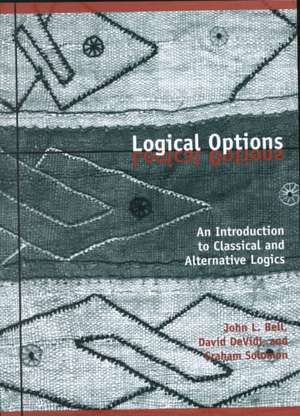
Logical Options: An Introduction to Classical and Alternative Logics
Autor John L. Bell, David DeVidi, Graham Solomonen Limba Engleză Paperback – 30 mar 2001
Preț: 438.38 lei
Preț vechi: 585.04 lei
-25%
Puncte Express: 658
Carte disponibilă
Livrare economică 07-21 noiembrie
Livrare express 24-30 octombrie pentru 95.37 lei
Livrare prin curier în România Termenul estimat este afișat lângă disponibilitate.
Transport gratuit pentru acest produs Plată online sau ramburs, în funcție de opțiunile comenzii.
Retur gratuit în 14 zile Comandă securizată și suport în română.
Specificații
ISBN-13: 9781551112978
ISBN-10: 1551112973
Pagini: 300
Dimensiuni: 165 x 229 x 16 mm
Greutate: 0.52 kg
Editura: BROADVIEW PR
Colecția Broadview Press
Locul publicării:Peterborough, Canada
ISBN-10: 1551112973
Pagini: 300
Dimensiuni: 165 x 229 x 16 mm
Greutate: 0.52 kg
Editura: BROADVIEW PR
Colecția Broadview Press
Locul publicării:Peterborough, Canada
V-ar putea interesa
-
 -21%Preț: 547.41 lei690.49 lei
 -
 Philosophy without IntuitionsHerman Cappelen-13%Preț: 278.80 lei320.69 lei
 -
 Frege's TheoremRichard G. HeckPreț: 274.43 lei
 -
 The Oxford Handbook of WittgensteinOskari Kuusela-18%Preț: 325.13 lei398.49 lei
 -
 Visual Thinking in MathematicsMarcus Giaquinto-12%Preț: 375.34 lei424.60 lei
 -
 Empty Representations: Reference and Non-ExistenceManuel García-Carpintero-31%Preț: 637.13 lei921.21 lei
 -
 -13%Preț: 256.58 lei295.35 lei
 -
 MetalogicGeoffrey HunterPreț: 275.22 lei
 -
 A Primer of Infinistesimal AnalysisJohn. L Bell-11%Preț: 521.23 lei585.66 lei
 -
 CausalityJudea Pearl-8%Preț: 489.25 lei531.80 lei
 -
 A Logical Approach to PhilosophyDavid Devidi-15%Preț: 667.38 lei785.15 lei
 -
 The Bloomsbury Companion to Philosophical LogicProfessor Leon Horsten-22%Preț: 272.05 lei350.25 lei
 -
 How to Win Every Argument: The Use and Abuse of LogicDr Madsen Pirie-35%Preț: 113.21 lei174.98 lei
 -
 -25%Preț: 464.47 lei618.50 lei
 -
 Deductive Logic in Natural LanguageDouglas Cannon-25%Preț: 417.79 lei554.30 lei
 -
 -10%Preț: 336.43 lei374.03 lei
 -
 Introducing Symbolic LogicRobert M. Martin-25%Preț: 356.91 lei474.94 lei
 -
 Essentials of Symbolic Logic - Third EditionR.L. Simpson-24%Preț: 419.01 lei553.90 lei
 -
 The Big Think BookPeter Cave-68%Preț: 97.39 lei303.10 lei
Recenzii
Logical Options introduces the extensions and alternatives to classical logic which are most discussed in the philosophical literature: many-sorted logic, second-order logic, modal logics, intuitionistic logic, three-valued logic, fuzzy logic, and free logic. Each logic is introduced with a brief description of some aspect of its philosophical significance, and wherever possible semantic and proof methods are employed to facilitate comparison of the various systems. The book is designed to be useful for philosophy students and professional philosophers who have learned some classical first-order logic and would like to learn about other logics important to their philosophical work.
“I love this book; I would have written it if I’d known how!” — Richard Jeffrey, Princeton University
“Logic teachers will love this book. Trees are probably the most accessible way to present logical systems to students and Bell, DeVidi and Solomon give tree formulations of a wide range of central logical systems—including truth-functional and quantificational logic, modal logic, provability logic, intuitionistic logic, three-valued logic, and free logic.… An excellent job.” — B. Jack Copeland, University of Canterbury
“I love this book; I would have written it if I’d known how!” — Richard Jeffrey, Princeton University
“Logic teachers will love this book. Trees are probably the most accessible way to present logical systems to students and Bell, DeVidi and Solomon give tree formulations of a wide range of central logical systems—including truth-functional and quantificational logic, modal logic, provability logic, intuitionistic logic, three-valued logic, and free logic.… An excellent job.” — B. Jack Copeland, University of Canterbury
Cuprins
Preface
1 Classical Propositional Logic
Predicate Logic: Postulates, Sorts and Second-Order Logic
1 Classical Propositional Logic
- Introductory Remarks
- Some Basic Concepts
- Formal Logics
- Propositional Logic
- Preliminaries
- Truth Values, Valuations, and validity
- Implication, Tautology, and Other Important Concepts
- Equivalence and Expressive Completeness
- Arithmetical Representation of Statements and Logical Operations
- Trees for Classical Propositional Logic
- Tree Rules for Classical Propositional Logic
- Trees as a Test for Validity
- Further Applications of the Tree Method
- Metatheorems
- Other Proof Methods
- Classical Propositional Calculus
- Natural Deduction
- Sequent Calculus
- Introductory Remarks
- Tree Rules for Classical Predicate Logic
- Rules for Quantifiers
- Identity
- Functions
- Predicate Languages and Their Interpretations
- The Languages
- Interpretations: Preliminary Remarks
- Set Theory
- Sets
- Relations
- Equivalence Relations
- Orderings
- Functions
- Interpretations of Languages for Predicate Logic
- Validity, Satisfiability, and Models
- Correctness and Adequacy
- Some Difficulties
- Dealing with Difficulties
- The Proofs
Predicate Logic: Postulates, Sorts and Second-Order Logic
- Postulate Systems
- Postulate Systems for Arithmetic
- Noncategoricity of First-Order Peano Arithmetic
- Many Sorted Logic
- Introductory Remarks
- Many Sorted Languages and Interpretations
- Reducing Many Sorted to Unsorted Logic
- Second-Order Logic
- Languages and Interpretations
- Second-Order Trees
- The Strength of Second-Order Logic
- Metatheory of Second-Order Logic
- The Propositional Modal Language and Models
- The Language
- Interpretations
- Classes of Frames and Different Logics
- Trees for Contextual Logics
- Proving Correctness for ▪
- Counterexamples
- Proving Adequacy for ▪
- Other Systems of Contextual (Modal) Logic
- Correctness and Adequacy for Trees
- Provability Logic
- Arithmetic Provability and Contextual Logic
- Frames and Provability Logic
- Trees for Provability Logic
- Multi-Modal Logic
- Quantificational Contextual Logic
- The Languages
- Introduction
- Semantics for Contextual Predicate Logic
- Concluding Remarks
- Three-Valued Logics
- Trees for Three-Valued Logic
- Intuitionistic Logic
- Introduction – Constructivism
- A More General Account
- Semantics and Countermodels
- Metatheorems for Intuitionistic Propositional Logic
- Comparing Intutionistic Logic to Other Logics
- Intuitionistic Predicate Logic
- Interpretations
- Trees for Intuitionistic Predicate Logic
- Intuitionistic Identity
- Fuzzy Logic
- Algebraic Logic
- Term Forming Operators and Free Logics
- Term Forming Operators
- Free Logics
- Solutions for Chapter 1
- Solutions for Chapter 2
- Solutions for Chapter 3
- Solutions for Chapter 4
- Solutions for Chapter 5
- Solutions for Chapter 6