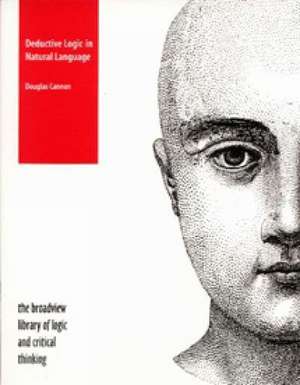
Deductive Logic in Natural Language
Autor Douglas Cannonen Limba Engleză Paperback – 13 noi 2002
Preț: 417.79 lei
Preț vechi: 554.30 lei
-25%
Puncte Express: 627
Carte disponibilă
Livrare economică 27 octombrie-10 noiembrie
Livrare express 13-17 octombrie pentru 91.80 lei
Livrare prin curier în România Termenul estimat este afișat lângă disponibilitate.
Transport gratuit pentru acest produs Plată online sau ramburs, în funcție de opțiunile comenzii.
Retur gratuit în 14 zile Comandă securizată și suport în română.
Specificații
ISBN-13: 9781551114453
ISBN-10: 1551114453
Pagini: 302
Dimensiuni: 178 x 229 x 16 mm
Greutate: 0.56 kg
Editura: BROADVIEW PR
Colecția Broadview Press
Locul publicării:Peterborough, Canada
ISBN-10: 1551114453
Pagini: 302
Dimensiuni: 178 x 229 x 16 mm
Greutate: 0.56 kg
Editura: BROADVIEW PR
Colecția Broadview Press
Locul publicării:Peterborough, Canada
V-ar putea interesa
-
 Introduction to Formal LogicRussell Marcus-23%Preț: 602.84 lei782.91 lei
 -
 Preț: 91.19 lei
 -
 Essential English GrammarPhilip GuckerPreț: 61.62 lei
 -
 Introduction to LogicAlfred TarskiPreț: 83.88 lei
 -
 Preț: 359.32 lei
 -
 Introduction to LogicIrving M. Copi-9%Preț: 1510.83 lei1660.25 lei
 -
 Cengage Advantage Books: Understanding Arguments, Concise EditionWalter Sinnott-ArmstrongPreț: 481.53 lei
 -
 Basic English Grammar For Dummies, 2nd Edition (USA Edition)Geraldine WoodsPreț: 140.66 lei
 -
 Logic For DummiesMark ZegarelliPreț: 116.11 lei
 -
 The Truth About English GrammarGeoffrey K. PullumPreț: 137.14 lei
 -
 Logic With Added ReasoningMichael Gabbay-25%Preț: 421.23 lei564.01 lei
 -
 Introducing Symbolic LogicRobert M. Martin-25%Preț: 356.91 lei474.94 lei
 -
 Essentials of Symbolic Logic - Third EditionR.L. Simpson-25%Preț: 409.30 lei546.33 lei
 -
 The Logic of Our Language: An Introduction to Symbolic LogicRodger L. Jackson-25%Preț: 342.56 lei457.69 lei
 -
 -25%Preț: 359.78 lei478.97 lei
 -
 Logical LabyrinthsRaymond Smullyan-9%Preț: 970.62 lei1066.61 lei
 -
 Preț: 321.41 lei
 -
 LogicEarl FontainellePreț: 51.96 lei
 -
 A System of Logic, Ratiocinative and Inductive Book 3 8th EditionStuart Mill JohnPreț: 131.36 lei
Recenzii
This text offers an innovative approach to the teaching of logic, which is rigorous but entirely non-symbolic. By introducing students to deductive inferences in natural language, the book breaks new ground pedagogically. Cannon focuses on such topics as using a tableaux technique to assess inconsistency; using generative grammar; employing logical analyses of sentences; and dealing with quantifier expressions and syllogisms. An appendix covers truth-functional logic.
Cuprins
Preface
Acknowledgments
Abbreviations
I. Fundamentals
Index
Acknowledgments
Abbreviations
I. Fundamentals
- Propositions and sentences—the basic units of logic and language
- Truth and (declarative) sentences
- Consistency and sets of sentences
- Validity and arguments
Exercises
- Reference and truth
- Meaning and truth
- Might have beens
- Truth with respect to a situation
Exercises
- Obvious inconsistency
- Semantic tableaux: dividing and conquering
- Efficiencies in tableaux
- A tableau that closes
Exercises
- Counter sets and validity
- Resolving reference
- Additional constructions
- When can a sentence be checked?
Exercises
- What we mean by a grammar
- Phrase-structure grammars; Phrase-markers
- Transformations
- Syntactic ambiguity
Exercises
- “If s,” “And’s,” or “But’s”: Conjunctions and sentence connectives
- Rule-governed sentence connectives in tableaux
- Transformations in logical analysis; Grouping
- The reach of rules; Negated conditionals
- Tableaux constructed by rules
Exercises
- Designators and predicates
- Properties and relations; Types of relations
- The peculiar relation of identity
- Tableau rules for identity
Exercises
- Quantifiers in general
- The simplest quantifiers: “everyone,” “someone,” and “no one”
- Tableau rules for the simplest quantifiers
- The simplest quantifiers in tableaux
- “Anyone,” quantifier scope, and anaphoric pronouns
Exercises
- The universal quantifier
- Relative pronouns, and the existential and nihilistic quantifiers
- Tableaux for syllogisms and other arguments
- “Anyone” and logical equivalence
- Things, times, and places
Exercises
- Review: Tableau rules for sentence connectives
- Three levels of symbolization
- Symbolic languages for algebra
- Truth-functions and their computational tables
- Truth tables and calculating truth-values
- Constructing an arbitrary function; Normal form
Exercises
Index