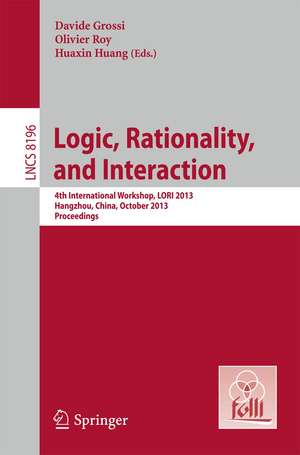
Logic, Rationality, and Interaction
Editat de Davide Grossi, Olivier Roy, Huaxin Huangen Limba Engleză Paperback – 13 sep 2013
Preț: 339.07 lei
Preț vechi: 423.84 lei
-20%
Puncte Express: 509
Carte tipărită la comandă
Livrare economică 24 noiembrie-08 decembrie
Livrare prin curier în România Termenul estimat este afișat lângă disponibilitate.
Transport gratuit de la 400.00 lei Plată online sau ramburs, în funcție de opțiunile comenzii.
Retur gratuit în 14 zile Comandă securizată și suport în română.
Specificații
ISBN-13: 9783642409479
ISBN-10: 3642409474
Pagini: 376
Ilustrații: XII, 363 p. 41 illus.
Dimensiuni: 155 x 235 x 21 mm
Greutate: 0.53 kg
Ediția:2013
Editura: Springer
Locul publicării:Berlin, Heidelberg, Germany
ISBN-10: 3642409474
Pagini: 376
Ilustrații: XII, 363 p. 41 illus.
Dimensiuni: 155 x 235 x 21 mm
Greutate: 0.53 kg
Ediția:2013
Editura: Springer
Locul publicării:Berlin, Heidelberg, Germany
V-ar putea interesa
-
 Cybersecurity and Applied MathematicsLeigh Metcalf-29%Preț: 340.35 lei479.85 lei
 -
 Automata and LanguagesJohn M. Howie-35%Preț: 339.47 lei520.04 lei
 -
 -36%Preț: 593.72 lei934.03 lei
 -
 Lambda Calculi: A Guide for Computer ScientistsChris Hankin-36%Preț: 359.37 lei564.70 lei
 -
 Advances in Logic Programming TheoryGiorgio Levi-38%Preț: 794.97 lei1280.71 lei
 -
 Concrete MathematicsRonald Graham-20%Preț: 560.73 lei700.91 lei
 -
 GraphsThulasiraman-9%Preț: 1628.00 lei1789.02 lei
 -
 -20%Preț: 356.23 lei445.29 lei
 -
 A Distributed Pi-CalculusMatthew Hennessy-20%Preț: 522.43 lei653.04 lei
 -
 Essential Linear Algebra with ApplicationsTitu Andreescu-15%Preț: 534.62 lei628.97 lei
 -
 -23%Preț: 487.76 lei633.45 lei
 -
 Seamless R and C++ Integration with RcppDirk Eddelbuettel-20%Preț: 561.37 lei701.71 lei
 -
 -25%Preț: 190.01 lei252.61 lei
 -
 Jihad and DeathOlivier Roy-18%Preț: 133.13 lei162.12 lei
Public țintă
ResearchCuprins
Full Papers.- Boolean Games with Epistemic Goals.- Minimal Preference Change.- The Topology of Belief, Belief Revision and Defeasible Knowledge.- Plan Recognition, Indefinites, and the Semantics-Pragmatics Boundary.- A Semantic Model for Interrogatives Based on Generalized Quantifiers and Bilattices.- A Two-Tiered Formalization of Social Influence.- A Unified Epistemic Analysis of Iterated Elimination Algorithms from Regret Viewpoint.- Listen to Me! Public Announcements to Agents That Pay Attention — or Not.- An Offer You Cannot Refuse: Obtaining Efficiency and Fairness in Preplay Negotiation Games with Conditional Offers.- Sequent Calculi for Multi-modal Logic with Interaction.- Dynamic Epistemic Logic Displayed.- Reasoning about Actions Meets Strategic Logics.- A Dynamic Deontic Logic Based on Histories.- Sequent Systems for Nondeterministic Propositional Logics without Reflexivity.- How to Update Neighborhood Models.- The Logic of a Priori and a Posteriori Rationality in Strategic Games.- Proof Theory, Semantics and Algebra for Normative Systems.- Explicit and Implicit Knowledge in Neighbourhood Models.- Expressivity Hierarchy of Languages for Epistemic Awareness Models.- Public Announcements, Private Actions and Common Knowledge in S5 Structures.- Logic Aggregation.- The Task Model of Court Investigation in a Multi-agent System of Argumentation in Court.- Short Papers.- A Deontic Action Logic for Complex Actions.- Planning Using Dynamic Epistemic Logic: Correspondence and Complexity.- Judgment Aggregation with Abstentions: A Hierarchical Approach.- A Note on Bayesian Games.- A Logic for Extensive Games with Short Sight.- Aggregated Beliefs and Informational Cascades.- Dynamic Attitudes, Fixed Points and Minimal Change.- Logic of Evidence-based Knowledge.- Backward Induction Is PTIME-complete.- On Fuzzy Propositional Logic with Different Negations.
Textul de pe ultima copertă
This book collects the papers presented at the 4th International Workshop on Logic, Rationality and Interaction/ (LORI-4), held in October 2013 at the /Center for the Study of Language and Cognition,
Zhejiang University, Hangzhou, China. LORI is a series that brings together researchers from a variety of logic-related fields: Game and Decision Theory, Philosophy, Linguistics, Computer Science and AI. This
year had a special emphasis on Norms and Argumentation. Out of 42 submissions, 23 full papers and 11 short contributions have been selected through peer-review for inclusion in the workshop program and
in this volume. The quality and diversity of these contributions witnesses a lively, fast-growing, and interdisciplinary community working at the intersection of logic and rational interaction.
Zhejiang University, Hangzhou, China. LORI is a series that brings together researchers from a variety of logic-related fields: Game and Decision Theory, Philosophy, Linguistics, Computer Science and AI. This
year had a special emphasis on Norms and Argumentation. Out of 42 submissions, 23 full papers and 11 short contributions have been selected through peer-review for inclusion in the workshop program and
in this volume. The quality and diversity of these contributions witnesses a lively, fast-growing, and interdisciplinary community working at the intersection of logic and rational interaction.