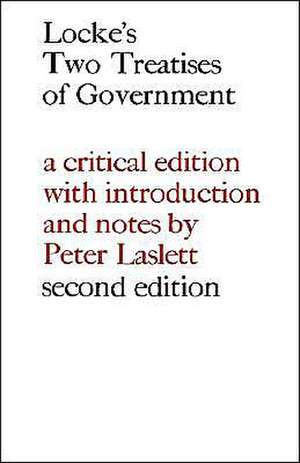
Locke
Autor John Locke Editat de Peter Lasletten Limba Engleză Hardback – 13 noi 2003
Interdisciplinaritatea acestui volum rezidă în fuziunea dintre filozofia politică, istoria ideilor religioase și fundamentele dreptului constituțional. Considerăm că această ediție îngrijită de David Wootton reușește să depășească prezentările unidimensionale ale lui John Locke ca simplu „părinte al liberalismului”. Prin includerea unor texte mai puțin explorate, precum documentele referitoare la Constituția Carolinei, volumul relevă tensiunile dintre idealurile de libertate și realitățile administrative ale epocii. Față de edițiile clasice care se limitează la cele două tratate, această culegere integrează scrieri care nuanțează perspectiva autorului asupra toleranței religioase și a rezistenței în fața absolutismului. Recomandăm această lucrare ca o alternativă robustă la volumul The Second Treatise of Government and a Letter Concerning Toleration pentru cursurile de științe politice, având avantajul unei documentări mai ample ce include fragmente din jurnalele și scrisorile lui John Locke. Această abordare oferă o imagine rotundă a evoluției sale intelectuale, de la empirismul explorat în An Essay Concerning Human Understanding până la principiile guvernării reprezentative. Stilul editorial al lui Wootton este precis, oferind contextul istoric esențial pentru a înțelege de ce A Letter Concerning Toleration a fost un act de curaj intelectual în contextul ascensiunii monarhiei catolice și al persecuțiilor împotriva protestanților. Volumul nu se rezumă la polemici, ci urmărește dezvoltarea argumentelor lui Locke despre proprietate, consimțământ și drepturi naturale, elemente care au fundamentat ulterior democrațiile moderne. Structura este clară, facilitând cercetarea academică prin note explicative și o introducere care situează opera în centrul Iluminismului britanic.
Preț: 687.51 lei
Preț vechi: 799.43 lei
-14%
Carte tipărită la comandă
Livrare economică 26 noiembrie-10 decembrie
Specificații
ISBN-10: 0521069033
Pagini: 548
Dimensiuni: 145 x 222 x 36 mm
Greutate: 0.9 kg
Ediția:2. Auflage
Editura: Cambridge University Press
Locul publicării:Cambridge, United Kingdom
V-ar putea interesa
-
 Locke: A Very Short IntroductionJohn Dunn-20%Preț: 57.07 lei71.06 lei
 -
 John Locke: Selected CorrespondenceMark Goldie-22%Preț: 365.81 lei468.39 lei
 -
 Preț: 410.59 lei
 -
 Preț: 70.50 lei
 -
 The Rights of ManThomas Paine-17%Preț: 24.19 lei29.08 lei
 -
 Preț: 38.44 lei
 -
 AristotleAristotlePreț: 193.55 lei
 -
 Hume: Political WritingsDavid Hume-17%Preț: 102.46 lei122.82 lei
 -
 -17%Preț: 109.50 lei131.70 lei
 -
 RousseauJean-Jacques Rousseau-19%Preț: 538.63 lei664.97 lei
 -
 Second Treatise of GovernmentJohn LockePreț: 37.07 lei
 -
 Two Treatises of GovernmentJohn LockePreț: 47.31 lei
 -
 A Letter Concerning TolerationJohn LockePreț: 33.29 lei
 -
 The Second Treatise of Civil GovernmentJohn Locke-17%Preț: 78.22 lei94.21 lei
 -
 The PrinceNiccolò MachiavelliPreț: 33.48 lei
 -
 UtopiaThomas MorePreț: 33.19 lei
 -
 The Social ContractJean-Jacques RousseauPreț: 61.99 lei
De ce să citești această carte
Această ediție este esențială pentru studenții la științe politice și filozofie care doresc să înțeleagă rădăcinile democrației liberale. Cititorul câștigă o perspectivă critică asupra lui Locke, dincolo de manualele simpliste, descoperind un gânditor complex ale cărui idei despre toleranță și proprietate rămân piloni ai statului de drept. Este o resursă academică completă, oferind acces la texte rare într-un format accesibil și riguros adnotat.
Despre autor
John Locke (1632–1704) a fost un filozof și medic englez, figură centrală a Iluminismului și teoretician al contractului social. Influențat de tradiția empiristă a lui Francis Bacon, Locke a respins ideile înnăscute, propunând conceptul de „tabula rasa” în lucrarea sa fundamentală An Essay Concerning Human Understanding. Contribuțiile sale la teoria drepturilor naturale și a guvernării limitate au influențat direct Declarația de Independență a Statelor Unite și gânditori precum Voltaire și Rousseau. Opera sa polivalentă cuprinde și scrieri despre educație, precum Some Thoughts Concerning Education and of the Conduct of the Understanding, demonstrând un interes constant pentru formarea minții umane în raport cu experiența.
Descriere scurtă
Cuprins
Descriere
John Locke's Second Treatise of Government (c. 1681) is perhaps the key founding liberal text. A Letter Concerning Toleration, written in 1685 (a year when a Catholic monarch came to the throne of England and Louis XIV unleashed a reign of terror against Protestants in France), is a classic defense of religious freedom. Yet many of Locke's other writings--not least the Constitutions of Carolina, which he helped draft--are almost defiantly anti-liberal in outlook.
This comprehensive collection brings together the main published works (excluding polemical attacks on other people's views) with the most important surviving evidence from among Locke’s papers relating to his political philosophy. David Wootton's wide-ranging and scholarly Introduction sets the writings in the context of their time, examines Locke's developing ideas and unorthodox Christianity, and analyzes his main arguments. The result is the first fully rounded picture of Locke’s political thought in his own words.
Recenzii
"...the very existence of a collection of this breadth with this sort of documentation is so remarkable that it seems wrong to criticize it. It is an excellent idea well executed." Ruth Sample, Philosophy in Review