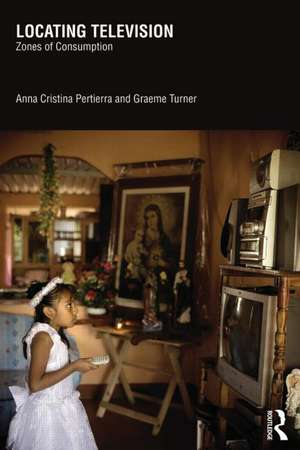
Locating Television: Zones of Consumption
Autor Anna Cristina Pertierra, Graeme Turneren Limba Engleză Paperback – 11 dec 2012
The book addresses this question in two interrelated ways:
- by situating the consumption of television within the full range of structures, patterns and practices of everyday life;
- and by retrieving the importance of location as fundamental to these structures, patterns and practices – and, consequently, to the experience of television.
Although the study draws its examples from a wide range of locations (the US, the UK, Australia, Malaysia, Cuba, and the Chinese language markets in Asia - -Hong Kong, Singapore, China and Taiwan), its argument is strongly informed by the evidence and the insights which emerged from ethnographic research in Mexico. This research site serves a strategic purpose: by working on a location with a highly developed and commercially successful transnational television industry, but which is not among the locations usually considered by television studies written in English, the limitations to some of the assumptions underlying the orthodoxies in Anglo-American television studies are highlighted.
Suitable for both upper level students and researchers, this book is a valuable and original contribution to television, media and cultural studies, and anthropology, presenting approaches and evidence that are new to the field.
Preț: 371.78 lei
Puncte Express: 558
Carte disponibilă
Livrare economică 05-19 noiembrie
Livrare express 22-28 octombrie pentru 28.87 lei
Livrare prin curier în România Termenul estimat este afișat lângă disponibilitate.
Transport gratuit de la 400.00 lei Plată online sau ramburs, în funcție de opțiunile comenzii.
Retur gratuit în 14 zile Comandă securizată și suport în română.
Specificații
ISBN-13: 9780415509794
ISBN-10: 0415509793
Pagini: 168
Ilustrații: 3 tables and 9 halftones
Dimensiuni: 156 x 234 x 15 mm
Greutate: 0.31 kg
Ediția:1
Editura: Taylor & Francis
Colecția Routledge
Locul publicării:Oxford, United Kingdom
ISBN-10: 0415509793
Pagini: 168
Ilustrații: 3 tables and 9 halftones
Dimensiuni: 156 x 234 x 15 mm
Greutate: 0.31 kg
Ediția:1
Editura: Taylor & Francis
Colecția Routledge
Locul publicării:Oxford, United Kingdom
V-ar putea interesa
-
 -15%Preț: 643.71 lei757.31 lei
 -
 Islam, Security and Television NewsC. FloodPreț: 394.88 lei
 -
 Public Service Media and Policy in EuropeK. DondersPreț: 393.20 lei
 -
 Media and SocietyGraeme Burton-26%Preț: 224.24 lei304.67 lei
 -
 Film as Social PracticeGraeme TurnerPreț: 363.05 lei
 -
 Preț: 395.84 lei
 -
 An Introduction to Television StudiesJonathan BignellPreț: 338.25 lei
 -
 Reality TVMisha Kavka-18%Preț: 171.01 lei207.58 lei
 -
 The MakeoverKatherine SenderPreț: 277.36 lei
 -
 The HBO EffectDr. Dean J. DeFino-41%Preț: 116.77 lei197.55 lei
 -
 Media Power and the Transformation of WarKenneth A LoparoPreț: 405.15 lei
 -
 The Information BombPaul VirilioPreț: 113.04 lei
 -
 Open SkyPaul VirilioPreț: 91.90 lei
 -
 What's Become of Cultural Studies?Graeme Turner-15%Preț: 591.92 lei696.37 lei
Public țintă
Postgraduate and UndergraduateCuprins
Chapter One: Understanding Television Today Chapter Two: Television and the Nation: The Return of the Repressed Chapter Three: Sharedness, Liveness and the Construction of Communities Chapter Four: Television and the Desire for Modernity Chapter Five: Television, Domestic Space and the Moral Economy of the Family Chapter 6: Conclusion
Recenzii
"This wonderfully theorized book provides a timely call for the field of global media studies. Re-energizing the efforts to explore the mediums increasing global reach it nonetheless emphasizes the crucial need to carefully contextualize the study of television in its ever proliferating locations. Challenging us to find a way to address the particularities of specific locations, or as the writers aptly call it, 'zones of consumption', this meticulously conceptualized and impressively researched volume draws on cultural anthropology and global television studies approaches, promising to enhance the field's investigation into the medium as a global whole without abandoning the particularities through which it is experienced in the daily lives of audience and producers around the world." - Sharon Shahaf, Georgia State University, USA
Descriere
Locating Television: Zones of Consumption takes an important next step for television studies and addresses the question of ‘what is television now?’