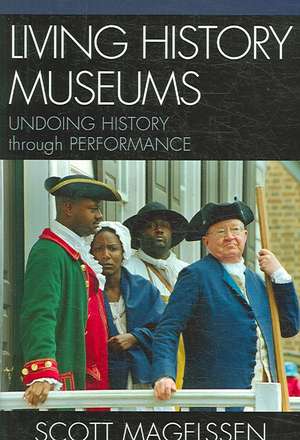
Living History Museums: Undoing History through Performance
Autor Scott Magelssenen Limba Engleză Paperback – feb 2007
Currently, existing scholarship on living history museums addresses the subject from a museum-studies or anthropology perspective. Author Scott Magelssen, however, approaches the material from a background in theatre history and theory, analyzing living history museums using postmodern methodology. Considering performance as a method for the study of history and exploring emergent non-traditional theatrical practices, the book offers suggestions for performance in an increasingly postmodern landscape. Concluding with an international listing of living history institutions and a complete list of sources, Living History Museums is a valuable resource for students and teachers of theatre and performance studies, cultural studies, folklore, popular culture, American studies, and museum studies.
Preț: 503.10 lei
Preț vechi: 732.48 lei
-31%
Puncte Express: 755
Carte tipărită la comandă
Livrare economică 17 noiembrie-01 decembrie
Livrare prin curier în România Termenul estimat este afișat lângă disponibilitate.
Transport gratuit pentru acest produs Plată online sau ramburs, în funcție de opțiunile comenzii.
Retur gratuit în 14 zile Comandă securizată și suport în română.
Specificații
ISBN-13: 9780810858657
ISBN-10: 0810858657
Pagini: 207
Dimensiuni: 155 x 232 x 15 mm
Greutate: 0.4 kg
Editura: Bloomsbury Publishing
Colecția Scarecrow Press
Locul publicării:New York, United States
ISBN-10: 0810858657
Pagini: 207
Dimensiuni: 155 x 232 x 15 mm
Greutate: 0.4 kg
Editura: Bloomsbury Publishing
Colecția Scarecrow Press
Locul publicării:New York, United States
V-ar putea interesa
-
 Ghosts Behind Glass: Encountering Extinction in MuseumsDolly JørgensenPreț: 121.33 lei
 -
 The Presentation of Self in Everyday LifeErving Goffman-31%Preț: 63.73 lei92.78 lei
 -
 Museums and Design for Creative LivesSuzanne MacLeodPreț: 362.58 lei
 -
 Museum ManagementKevin MoorePreț: 265.11 lei
 -
 Thinking About ExhibitionsBruce W. FergusonPreț: 375.49 lei
 -
 Preț: 341.99 lei
 -
 Nagler, A: Source Book in Theatrical HistoryAlois Maria NaglerPreț: 199.22 lei
 -
 Travels with GeorgeNathaniel PhilbrickPreț: 108.84 lei
 -
 Preț: 378.40 lei
 -
 Storytelling Exhibitions: Identity, Truth and WonderPhilip Hughes-25%Preț: 265.02 lei351.98 lei
 -
 Historical Authenticity: A Transdisciplinary CompendiumProf. Dr. Martin Sabrow-45%Preț: 585.71 lei1061.88 lei
 -
 How To Live An Artful LifeKaty HesselPreț: 124.38 lei
 -
 Preț: 296.25 lei
 -
 Southern Stages - Space and Memory in US PerformanceChandra Owenby Hopkins-8%Preț: 597.81 lei649.79 lei
 -
 The Culture Box: Museums as MediaHarley Parker-18%Preț: 160.38 lei194.79 lei
 -
 Performance in the MuseumPierre SaurissePreț: 256.24 lei
 -
 -11%Preț: 89.48 lei100.08 lei
 -
 British Contested HistoryCaroline DonnellanPreț: 317.89 lei
Cuprins
Part 1 Acknowledgments
Part 2 Introduction
Part 3 Chapter 1 The Dilemmas of Contemporary Living History Museum Historiography in Theory and Practice
Chapter 4 The Progressive Development Narrative of Living History Museum History
Chapter 5 Progressive Histories: Major Works
Chapter 6 The Progressive Development Narrative in Practice
Chapter 7 (In)authentic Revolutions: Time, Space, and Living History Museums
Chapter 8 Plimoth Plantation
Chapter 9 Colonial WIlliamsburg
Chapter 10 Old Sturbridge Village
Chapter 11 Storytelling vs. Scientific Discourse
Part 12 Chapter 2 Toward a New Genealogy of Living History Museum Performance
Chapter 13 A Historiography of Immanence
Chapter 14 Defining the Episteme
Chapter 15 An Emergence within a Shifting Field
Chapter 16 Capitalizing on the Past-Capitalizing on Loss
Chapter 17 Social History and the Trajectory of Living Museum Performance
Chapter 18 The Naturalistic Ideal
Chapter 19 Living History as Pleasure
Part 20 Chapter 3 Performace as Historiography at Living History Museums
Chapter 21 The Historiography of Performance
Chapter 22 The Field
Chapter 23 Missed Opportunities
Chapter 24 Alternatives to the Naturalistic Mode
Chapter 25 Post-Tourists and Living History Performace
Part 26 Conclusion
Part 27 Appendix: Selected Living History Programming Sites
Part 28 Bibliography
Part 29 Index
Part 30 About the Author
Part 2 Introduction
Part 3 Chapter 1 The Dilemmas of Contemporary Living History Museum Historiography in Theory and Practice
Chapter 4 The Progressive Development Narrative of Living History Museum History
Chapter 5 Progressive Histories: Major Works
Chapter 6 The Progressive Development Narrative in Practice
Chapter 7 (In)authentic Revolutions: Time, Space, and Living History Museums
Chapter 8 Plimoth Plantation
Chapter 9 Colonial WIlliamsburg
Chapter 10 Old Sturbridge Village
Chapter 11 Storytelling vs. Scientific Discourse
Part 12 Chapter 2 Toward a New Genealogy of Living History Museum Performance
Chapter 13 A Historiography of Immanence
Chapter 14 Defining the Episteme
Chapter 15 An Emergence within a Shifting Field
Chapter 16 Capitalizing on the Past-Capitalizing on Loss
Chapter 17 Social History and the Trajectory of Living Museum Performance
Chapter 18 The Naturalistic Ideal
Chapter 19 Living History as Pleasure
Part 20 Chapter 3 Performace as Historiography at Living History Museums
Chapter 21 The Historiography of Performance
Chapter 22 The Field
Chapter 23 Missed Opportunities
Chapter 24 Alternatives to the Naturalistic Mode
Chapter 25 Post-Tourists and Living History Performace
Part 26 Conclusion
Part 27 Appendix: Selected Living History Programming Sites
Part 28 Bibliography
Part 29 Index
Part 30 About the Author
Recenzii
After outlining a new history of these performances in the United States and Europe, Magelssen offers suggestions for their improvement, which he sates is achievable if museums abandon their 'just-the-facts' mentality and embrace alternative modes of performance.
...points out the dilemmas of living interpretation, from misleading visitors about time and history to perpetuating outmoded linear views of historical progress.
An external researcher rather than a participant in living museums or a particular fan of them, Magelssen (theater arts, Augustana College, Illinois), examines the performance practices, philosophies, and curatorial methods they have used to stage the past through the 20th and into the 21st centuries, and how they see themselves as the very products of these practices.
...points out the dilemmas of living interpretation, from misleading visitors about time and history to perpetuating outmoded linear views of historical progress.
An external researcher rather than a participant in living museums or a particular fan of them, Magelssen (theater arts, Augustana College, Illinois), examines the performance practices, philosophies, and curatorial methods they have used to stage the past through the 20th and into the 21st centuries, and how they see themselves as the very products of these practices.